. 2011 Feb 8;108(6):2611-6.
doi: 10.1073/pnas.1018921108. Epub 2011 Jan 24.

Activation of the plasma membrane Na/H antiporter Salt-Overly-Sensitive 1 (SOS1) by phosphorylation of an auto-inhibitory C-terminal domain

Affiliations

Activation of the plasma membrane Na/H antiporter Salt-Overly-Sensitive 1 (SOS1) by phosphorylation of an auto-inhibitory C-terminal domain

Francisco J Quintero et al. Proc Natl Acad Sci U S A. .

Abstract

The plasma membrane sodium/proton exchanger Salt-Overly-Sensitive 1 (SOS1) is a critical salt tolerance determinant in plants. The SOS2-SOS3 calcium-dependent protein kinase complex up-regulates SOS1 activity, but the mechanistic details of this crucial event remain unresolved. Here we show that SOS1 is maintained in a resting state by a C-terminal auto-inhibitory domain that is the target of SOS2-SOS3. The auto-inhibitory domain interacts intramolecularly with an adjacent domain of SOS1 that is essential for activity. SOS1 is relieved from auto-inhibition upon phosphorylation of the auto-inhibitory domain by SOS2-SOS3. Mutation of the SOS2 phosphorylation and recognition site impeded the activation of SOS1 in vivo and in vitro. Additional amino acid residues critically important for SOS1 activity and regulation were identified in a genetic screen for hypermorphic alleles.


Conflict of interest statement

The authors declare no conflict of interest.

Figures
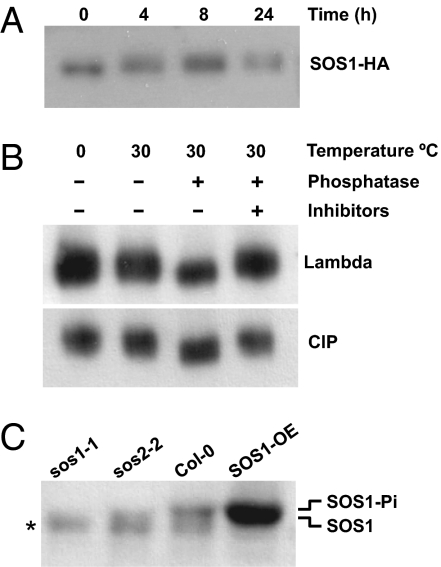
Fig. 1.
Fig. 1.
Phosphorylation of SOS1 in planta. (A) Gel mobility shift of SOS1 elicited by salt treatment. Arabidopsis plants were treated with 100 mM NaCl for the time indicated in hours; the protein extracts were resolved by SDS/PAGE, and the HA-tagged SOS1 protein was detected with anti-HA antibodies. (B) Reversal of gel mobility shift by phosphatase treatment. Protein extracts from plants treated with NaCl for 24 h were kept on ice or treated at 30 °C with λ-phosphatase or calf intestinal (CIP) phosphatase with and without the addition of the phosphatase inhibitors; HA-tagged SOS1 protein was detected with anti-HA antibodies. (C) SOS2-dependent mobility shift of SOS1. Protein extracts from mutants sos1-1, sos2-2, wild-type Col-0 gl1 plants, and the latter transformed to over-express the SOS1 protein were resolved by SDS/PAGE and the SOS1 protein was immunodetected with anti-SOS1 antibodies; plants were treated with 100 mM NaCl for 24 h. The identity of the lower band cross-reacting in all samples (asterisk), including the deletion mutant sos1-1, is unknown.
Fig. 2.
Fig. 2.
Phosphorylation of the SOS1 C terminus. (A) Schematic structure and deletion mapping of SOS1; fragments F1–F4 were subjected to the SOS2 phosphorylation assay (B). Purified proteins corresponding to fragments F1–F4 were incubated with SOS2T168D/Δ308 in the presence of [γ-32P]ATP, resolved in SDS/PAGE (Left), and exposed to X-ray film (Right). (C) Yeast two-hybrid assay demonstrating the interaction of SOS2 with the last 147 amino acids of SOS1.
Fig. 3.
Fig. 3.
Serines 1136 and 1138 in the SOS2 phosphorylation site are essential for SOS1 activation. (A) GST fusions encompassing the SOS1 cytosolic tail (amino acids 441–1146) from the wild-type protein (DSPS), mutant S1136A (DAPS), mutant S1138A (DSPA), and mutant S1136A/S1138A (DAPA) were subjected to phosphorylation by SOS2 in vitro, resolved by SDS/PAGE (Upper) and exposed to X-ray film (Lower). (B) Full-length wild-type or mutant SOS1 proteins were expressed in the yeast strain AXT3K with (Right) or without (Left) the coexpression of SOS2T168D/Δ308. Decimal dilutions of saturated cultures were plated in AP medium supplemented with 1 mM KCl and with the indicated concentration of NaCl. Growth of all transformants was indistinguishable in plates without NaCl.
Fig. 4.
Fig. 4.
Functional domains of SOS1. (A) Representative class 1 and class 2 mutants were transformed in strain AXT3K, with and without the coexpression of the SOS2–SOS3 kinase complex, and compared with wild-type SOS1 in AP medium (1 mM KCl) with the indicated concentrations of NaCl. All transformants had identical growth in plates without NaCl. (B) The yeast mutant cdc25-2, transformed with the reporter protein hSos:SOS1998-1146, was further transformed to express wild-type SOS1, or mutant proteins truncated at residues 745 and 998, or with an empty vector. Decimal dilutions of liquid cultures were plated and incubated at the permissive (23 °C) or restrictive (37 °C) temperature to identify protein interactions at the plasma membrane. (C) Salt-tolerance test of AXT3K cells expressing the indicated SOS1 mutant proteins with and without the coexpression of the SOS2–SOS3 kinase complex.

References

    1. Abrol IP, Yadav JSP, Massoud FI. FAO Soils Bull. Food and Agriculture Organization (Rome); 1988. Salt-affected soils and their management.
    1. Tester M, Davenport R. Na+ tolerance and Na+ transport in higher plants. Ann Bot. 2003;91:503–527. - PMC - PubMed
    1. Munns R, Tester M. Mechanisms of salinity tolerance. Annu Rev Plant Biol. 2008;59:651–681. - PubMed
    1. Shi HZ, Quintero FJ, Pardo JM, Zhu JK. The putative plasma membrane Na(+)/H(+) antiporter SOS1 controls long-distance Na(+) transport in plants. Plant Cell. 2002;14:465–477. - PMC - PubMed
    1. Oh D-H, et al. Loss of halophytism by interference with SOS1 expression. Plant Physiol. 2009;151:210–222. - PMC - PubMed

Publication types

MeSH terms

Substances
