. 2011 Feb 8;108(6):2593-8.
doi: 10.1073/pnas.1014641108. Epub 2011 Jan 24.

Lysosomal trapping of a radiolabeled substrate of P-glycoprotein as a mechanism for signal amplification in PET

Affiliations

Lysosomal trapping of a radiolabeled substrate of P-glycoprotein as a mechanism for signal amplification in PET

Pavitra Kannan et al. Proc Natl Acad Sci U S A. .

Abstract

The radiotracer [(11)C]N-desmethyl-loperamide (dLop) images the in vivo function of P-glycoprotein (P-gp), a transporter that blocks the entry of drugs that are substrates into brain. When P-gp is inhibited, [(11)C]dLop, a potent opiate agonist, enters and becomes trapped in the brain. This trapping is beneficial from an imaging perspective, because it amplifies the PET signal, essentially by accumulating radioactivity over time. As we previously demonstrated that this trapping was not caused by binding to opiate receptors, we examined whether [(11)C]dLop, a weak base, is ionically trapped in acidic lysosomes. To test this hypothesis, we measured [(3)H]dLop accumulation in human cells by using lysosomotropics. Because the in vivo trapping of dLop was seen after P-gp inhibition, we also measured [(3)H]dLop uptake in P-gp-expressing cells treated with the P-gp inhibitor tariquidar. All lysosomotropics decreased [(3)H]dLop accumulation by at least 50%. In P-gp-expressing cells, tariquidar (and another P-gp inhibitor) surprisingly decreased [(3)H]dLop uptake. Consequently, we measured [(11)C]dLop uptake before and after tariquidar preadministration in lysosome-rich organs of P-gp KO mice and humans. After tariquidar pretreatment in both species, radioactivity uptake in these organs decreased by 35% to 40%. Our results indicate that dLop is trapped in lysosomes and that tariquidar competes with dLop for lysosomal accumulation in vitro and in vivo. Although tariquidar and dLop compete for lysosomal trapping in the periphery, such competition does not occur in brain because tariquidar has negligible entry into brain. In summary, tariquidar and [(11)C]dLop can be used in combination to selectively measure the function of P-gp at the blood-brain barrier.


Conflict of interest statement

The authors declare no conflict of interest.

Figures
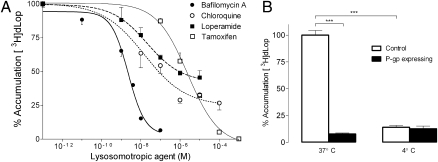
Fig. 1.
Fig. 1.
The P-gp substrate dLop is trapped in lysosomes. (A) Reduction of [3H]dLop (1 nM) accumulation in control KB-3–1 cells by compounds that increase lysosomal pH (i.e., lysosomotropic agents). Data represent mean ± SD (n = 3 observations); error bars are unidirectional for figure clarity. (B) The effect of temperature on the accumulation of [3H]dLop (1 nM) in control (KB-3-1) and P-gp–expressing (KB-8-5-11) cells. Accumulation in control (□) cells is much lower at 4 °C than at 37 °C, and accumulation in P-gp–expressing (■) cells is not affected by temperature (***P < 0.001). Data represent mean ± SD (n = 3 observations).
Fig. 2.
Fig. 2.
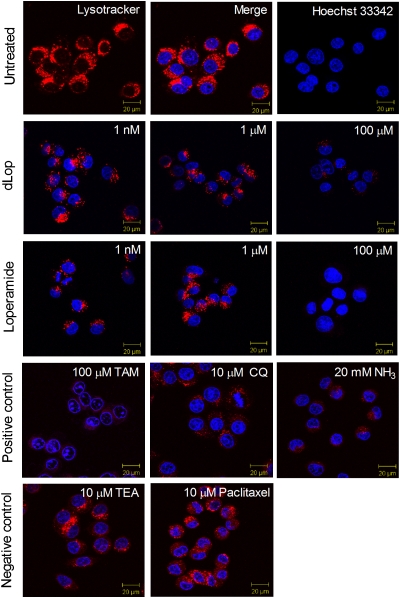
Reduction in accumulation of a fluorescent weak base from lysosomes by increasing concentrations of dLop and loperamide as assessed by confocal microscopy. Images are merged to show the simultaneous staining of the lysosomes with LysoTracker Red DND-99 (10 nM) and of the nucleus with Hoechst 33342 (8 μM; row 1). Weak bases dLop, loperamide, tamoxifen (TAM), chloroquine (CQ), and ammonia (NH3) block the accumulation of the fluorescent base (rows 2–4); the cationic compound TEA-HCl and the nonbase paclitaxel do not (row 5).
Fig. 3.
Fig. 3.
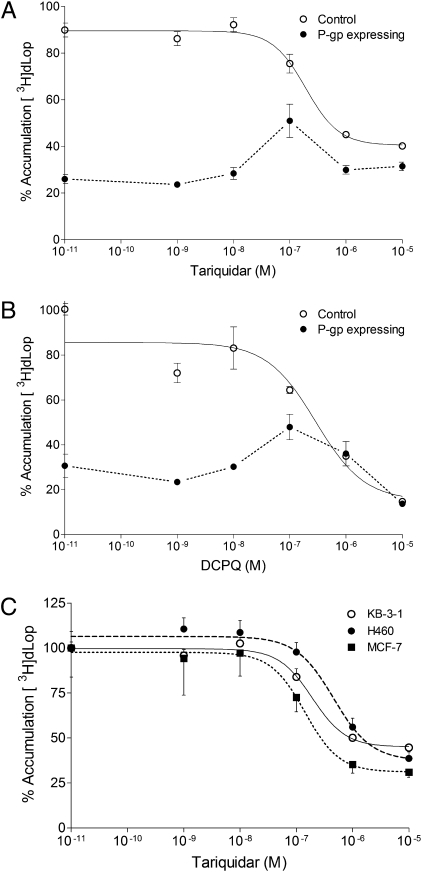
Increasing concentrations of two P-gp inhibitors decrease the accumulation of [3H]dLop in various cell lines. (A) Tariquidar and (B) DCPQ have two effects on [3H]dLop accumulation in control KB-3–1 (○) and P-gp–expressing KB-8–5–11 (●) cells. First, at concentrations lower than 100 nM, both inhibitors increase the accumulation of [3H]dLop but have no effect in control cells. Second, at concentrations greater than 100 nM, both inhibitors decrease the accumulation of [3H]dLop in both cell types. (C) Tariquidar reduces [3H]dLop accumulation in two control cell lines [H460 (●) and MCF-7 (■)] derived from different tumors than KB-3–1 cells. Data represent mean ± SD (n = 3 observations).
Fig. 4.
Fig. 4.
Weak base competition between two P-gp inhibitors and compounds that increase lysosomal pH in KB-3–1 cells. (A) Two weak bases, tamoxifen and chloroquine, decrease the cellular accumulation of [3H]tariquidar (1 nM) from cells. Data represent mean ± SD (n = 3 observations). (B) Reduction in accumulation of the fluorescent weak base LysoTracker Red in cellular lysosomes by increasing concentrations of tariquidar and DCPQ assessed by confocal microscopy. Fluorescent staining shows the lysosomes (red, LysoTracker Red 10 nM) and the nuclei (blue, Hoechst 33342 8 μM).

References

    1. Gottesman MM, Fojo T, Bates SE. Multidrug resistance in cancer: Role of ATP-dependent transporters. Nat Rev Cancer. 2002;2:48–58. - PubMed
    1. Löscher W, Potschka H. Role of drug efflux transporters in the brain for drug disposition and treatment of brain diseases. Prog Neurobiol. 2005;76:22–76. - PubMed
    1. Kannan P, et al. N-desmethyl-loperamide is selective for P-glycoprotein among three ATP-binding cassette transporters at the blood-brain barrier. Drug Metab Dispos. 2010;38:917–922. - PMC - PubMed
    1. Kreisl WC, et al. P-glycoprotein function at the blood-brain barrier in humans can be quantified with the substrate radiotracer 11C-N-desmethyl-loperamide. J Nucl Med. 2010;51:559–566. - PMC - PubMed
    1. Lazarova N, et al. Synthesis and evaluation of [N-methyl-11C]N-desmethyl-loperamide as a new and improved PET radiotracer for imaging P-gp function. J Med Chem. 2008;51:6034–6043. - PMC - PubMed

Publication types

MeSH terms

LinkOut - more resources