


Effects of recombinant human prolactin on breast milk composition
- PMID: 21262884
- PMCID: PMC3387861
- DOI: 10.1542/peds.2010-1627
Effects of recombinant human prolactin on breast milk composition
Abstract
Objective: The objective of this study was to determine the impact of recombinant human prolactin (r-hPRL) on the nutritional and immunologic composition of breast milk.
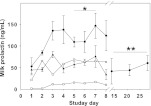
Methods: We conducted 2 trials of r-hPRL treatment. In the first study, mothers with documented prolactin deficiency were given r-hPRL every 12 hours in a 28-day, open-label trial. In the second study, mothers with lactation insufficiency that developed while they were pumping breast milk for their preterm infants were given r-hPRL daily in a 7-day, double-blind, placebo-controlled trial. Breast milk characteristics were compared before and during 7 days of treatment.
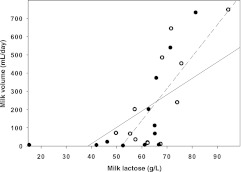
Results: Among subjects treated with r-hPRL (N = 11), milk volumes (73 ± 36 to 146 ± 54 mL/day; P < .001) and milk lactose levels (155 ± 15 to 184 ± 8 mmol/L; P = .01) increased, whereas milk sodium levels decreased (12.1 ± 2.0 to 8.3 ± 0.5 mmol/L; P = .02). Milk calcium levels increased in subjects treated with r-hPRL twice daily (2.8 ± 0.6 to 5.0 ± 0.9 mmol/L; P = .03). Total neutral (1.5 ± 0.3 to 2.5 ± 0.4 g/L; P = .04) and acidic (33 ± 4 to 60 ± 6 mg/L; P = .02) oligosaccharide levels increased in r-hPRL-treated subjects, whereas total daily milk immunoglobulin A secretion was unchanged.
Conclusions: r-hPRL treatment increased milk volume and induced changes in milk composition similar to those that occur during normal lactogenesis. r-hPRL also increased antimicrobially active oligosaccharide concentrations. These effects were achieved for women with both prolactin deficiency and lactation insufficiency.
Trial registration: ClinicalTrials.gov NCT00181610 NCT00181623.
Figures
References
-
- Neifert MR. Prevention of breastfeeding tragedies. Pediatr Clin North Am. 2001;48(2):273–294 - PubMed
-
- Brun del Re R, del Pozo E, de Grandi P, Friesen H, Hinselmann M, Wyss H. Prolactin inhibition and suppression of puerperal lactation by a Br-ergocryptine (CB 154). A comparison with estrogen. Obstet Gynecol. 1973;41(6):884–890 - PubMed
-
- Kauppila A, Chatelain P, Kirkinen P, Kivinen S, Ruokonen A. Isolated prolactin deficiency in a woman with puerperal alactogenesis. J Clin Endocrinol Metab. 1987;64(2):309–312 - PubMed
-
- Neville MC, Allen JC, Archer PC, et al. Studies in human lactation: milk volume and nutrient composition during weaning and lactogenesis. Am J Clin Nutr. 1991;54(1):81–92 - PubMed
-
- Kulski JK, Hartmann PE. Changes in human milk composition during the initiation of lactation. Aust J Exp Biol Med Sci. 1981;59(1):101–114 - PubMed
Publication types
MeSH terms
Substances
Associated data
Grants and funding
LinkOut - more resources
Full Text Sources
Other Literature Sources
Medical
