


A low-glycemic nutritional fitness program to reverse metabolic syndrome in professional firefighters: results of a pilot study
- PMID: 21263343
- PMCID: PMC3114284
- DOI: 10.1097/JCN.0b013e31820344d7
A low-glycemic nutritional fitness program to reverse metabolic syndrome in professional firefighters: results of a pilot study
Abstract
Background: The risk for cardiovascular events is higher for those with metabolic syndrome (MetS), and it is known that firefighters have a 4-fold risk for cardiovascular events. The purpose of this study was to quantify MetS prevalence and evaluate the effect of a low-glycemic nutritional fitness program on the reduction of MetS risk factors among firefighters.
Methods: Professional firefighters were screened for MetS then enrolled in a low-glycemic nutritional fitness program for a 12-week period. Anthropometric and physiological measurements were obtained at the start and end of the program. Subjects with 3 or more of the following were positive for MetS: waist-40-inches or greater (men) or 35 inches or greater (women), blood pressure 135 mm Hg or greater (systole) or 85 mm Hg or greater (diastole), fasting blood sugar 100 mg/dL or greater, triglycerides 150 mg/dL or greater, and high-density lipoproteins less than 40 mg/dL (men) or less than 50 mg/dL (women). Weekly sessions provided low-glycemic nutrition instruction, fitness training, and evaluation of individual progress.
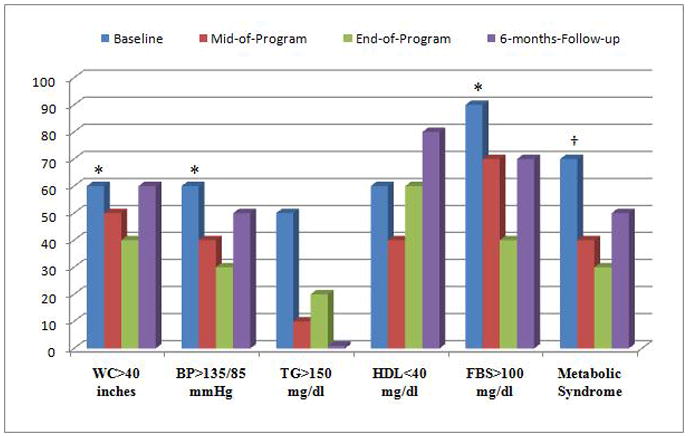
Results: Seventy-five firefighters (aged 42 [SD, 8] years, mostly white men) had a total MetS prevalence of 46.7% (P<.05 vs normal population). One platoon (10 men, aged 48 [SD, 5] years) was enrolled in the 12-week program. Most (7/10) had MetS at the baseline, but this prevalence decreased significantly after 12 weeks to 3 subjects (P=.02). On average, subjects had 3.2 (SD, 1.6) versus 1.9 (SD, 1.7) MetS risk factors (P<.01) at baseline and the 12-week interval, respectively.
Conclusions: The prevalence of MetS and MetS risk factors is higher among professional firefighters compared with the general population. A short-duration, low-glycemic fitness program can successfully improve anthropometric and physiological measures and reduce the prevalence of MetS.
Copyright © 2011 Lippincott Williams & Wilkins.
Figures
References
-
- Grundy SM, Cleeman JI, Bairey Merz CN, et al. Implications of Recent Clinical Trials for the National Cholesterol Education Program Adult Treatment Panel III Guidelines. Journal of the American College of Cardiology. 2004;44(3):720–732. - PubMed
-
- Potenza MV, Mechanick JI. The Metabolic Syndrome: Definition, Global Impact, and Pathophysiology. Nutrition in Clinical Practice. 2009;24(5):560–577. - PubMed
-
- Expert Panel on Detection E, Treatment of High Blood Cholesterol in Adults. Executive Summary of the Third Report of the National Cholesterol Education Program (NCEP) Expert Panel on Detection, Evaluation, and Treatment of High Blood Cholesterol in Adults (Adult Treatment Panel III) JAMA. 2001;285(19):2486–2497. - PubMed
-
- Ervin R. Prevalence of metabolic syndrome among adults 20 years of age and over, by sex, age, race and ethnicity, and body mass index: United States, 2003–2006. Hyattsville, MD: U.S. Department of Health and Human Services, Division of Health and Nutrition Examination Surveys, Centers for Disease Control and Prevention, National Center for Health Statistics; 2009. - PubMed
-
- Grundy, Cleeman JI, Merz CNB, et al. Implications of Recent Clinical Trials for the National Cholesterol Education Program Adult Treatment Panel III Guidelines. Circulation. 2004;110(2):227–239. - PubMed
