. 2011 Jan 19:17:199-209.

Structural basement membrane components and corresponding integrins in Schlemm's canal endothelia

Affiliations

Structural basement membrane components and corresponding integrins in Schlemm's canal endothelia

Saumya S VanderWyst et al. Mol Vis. .

Abstract

Purpose: The conventional outflow pathway provides the primary source of resistance to aqueous humor drainage, regulating intraocular pressure. Despite large pressure gradients across the inner wall of Schlemm's canal (SC), cells remain attached to their basement membrane. The goal of this study was to examine integrin-extracellular matrix binding partners of the inner wall basement membrane that facilitate attachment.

Methods: Human outflow tissues and cultured cells were analyzed by immunofluorescence and western blotting, respectively. Radial sections of human donor eyes or en face preparations of human SC inner wall were probed with antibodies that specifically recognize collagens (Type I, III, and IV), laminins (LM-332 and LM-511) and laminin-specific integrin subunits, α3, α6, β1, and β4, typical of vascular endothelia.

Results: Immunofluorescence studies showed collagens Type I and IV in the SC basement membrane but not collagen III. As expected with mature vascular endothelia, SC cells in situ expressed LM-511 but not LM-332. Significantly, the integrin α6 subunit was expressed uniquely by SC. En face labeling of the inner wall displayed integrin α6 colocalizing with LM α5 at the cell periphery. Western blots of cultured human SC endothelial cell monolayers confirmed expression of Type I collagen, collagen IV, LM-511, and the α6 integrin subunit. Interestingly, LM-332 was present in cultured SC cells up to 60 days post-confluence.

Conclusions: Even though cells of the inner wall endure pressure gradients in the basal to apical direction, opposite of other endothelia, human SC cells express basement membrane proteins and their cognate integrins typical of vascular endothelia.


Figures

Figure 1
Figure 1
Collagens in human conventional outflow pathway and cultured cells. A: Confocal immunofluorescence microscopy of outflow tissues from cadaveric human eyes examining the expression levels of collagen (CN) I, III, and IV. Vascular endothelial cadherin (VE-cad) labeling was used as positive control for integrity of tissue antigens and localization of Schlemm’s canal (SC). Shown are representative images taken from section of one donor eye of 3 examined. B: Western blot analysis of collagen levels in different strains of cultured human trabecular meshwork (TM) and SC cell monolayers isolated from different individual eye donors. Anti-collagen I IgGs recognized multiple bands between 140 and 40 kDa, corresponding to post-translational modifications.
Figure 2
Figure 2
Laminins-332 and −511 in human conventional outflow pathway and cultured cells. A: Confocal immunofluorescence microscopy of endothelial laminins (LM) in radial sections through human conventional outflow tissues. Shown are representative images taken from one human donor eye of three that were examined. B: western blot analysis of endothelial laminin levels by different strains of cultured SC and TM cell monolayers isolated from different individual eye donors. Samples for laminin α5 blots were obtained after cell lysates were first immunoprecipitated with anti-laminin γ1 IgGs.
Figure 3
Figure 3
Vascular endothelial integrins in human conventional outflow pathway and cultured cells. A: Confocal immunofluorescence microscopy of outflow tissues from human, post-mortem eyes examining integrin (INTG) subunit levels. Shown are results obtained from one eye from one individual donor of three total that were examined. Background fluorescence in the absence of primary antibodies is shown (2°). B: western blot analysis of integrin levels by different human Schlemm’s canal (SC) and trabecular meshwork (TM) cell strains in culture.
Figure 4
Figure 4
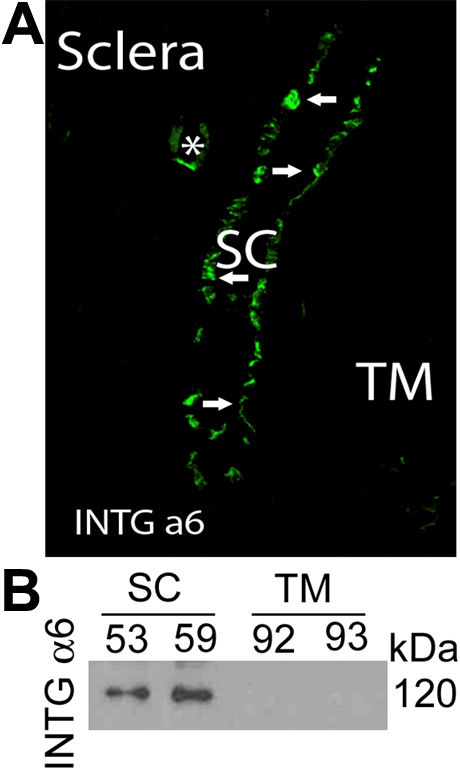
Integrin α6 subunit expression by Schlemm’s canal cells. A: Confocal immunofluorescence microscopy of outflow tissues including Schlemm’s canal (SC) from human donor eyes showing α6 integrin (INTG) levels. Shown is representative image from eye of individual human donor of 3 donor eyes that were examined. For comparison, a scleral vessel is indicated (*). B: western blot analysis of different human SC and trabecular meshwork (TM) cell strains checking for α6 integrin levels. Cell lysates were first subjected to immunoprecipition using integrin α6-specific IgGs, followed by SDS–PAGE and western blotting using IgGs that recognize both α3 and α6 INTG.
Figure 5
Figure 5
En face confocal immunofluorescence microscopy of Schlemm’s canal inner wall. Shown is labeling of the inner wall of SC (viewed from luminal side) for integrin α6 (A, green), laminin α5 (B, red), CD31 (C, blue). Panel D is a merged image of all three proteins plus nuclei (brown). Shown is representative image from a human donor eye of 6 total eyes that were examined.

References

    1. Epstein D, Allingham R, Schuman J, editors. Chandler and Grant's, Glaucoma, 4th ed., Baltimore: Williams and Wilkins; 1997.
    1. Grant WM. Clinical tonography. Trans Am Acad Ophthalmol Otolaryngol. 1951;55:774–81. - PubMed
    1. Grant WM. Experimental aqueous perfusion in enucleated human eyes. Arch Ophthalmol. 1963;69:783–801. - PubMed
    1. Bahler CK, Hann C, Fautsch M, Johnson D. Pharmacological disruption of Schlemm's canal cells and outflow facility in anterior segments of human eyes. Invest Ophthalmol Vis Sci. 2004;45:2246–54. - PubMed
    1. Ethier CR, Chan D. Cationic ferritin changes outflow facility whereas anionic ferritin does not. Invest Ophthalmol Vis Sci. 2001;42:1795–802. - PubMed

Publication types