


A positive correlation between atypical memory B cells and Plasmodium falciparum transmission intensity in cross-sectional studies in Peru and Mali
- PMID: 21264245
- PMCID: PMC3021525
- DOI: 10.1371/journal.pone.0015983
A positive correlation between atypical memory B cells and Plasmodium falciparum transmission intensity in cross-sectional studies in Peru and Mali
Abstract
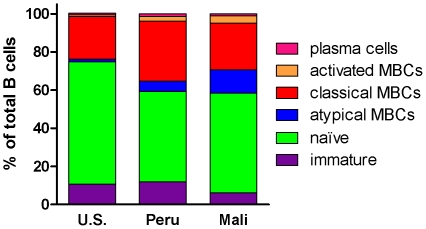
Background: Antibodies that protect against Plasmodium falciparum (Pf) malaria are only acquired after years of repeated infections. The B cell biology that underlies this observation is poorly understood. We previously reported that "atypical" memory B cells are increased in children and adults exposed to intense Pf transmission in Mali, similar to what has been observed in individuals infected with HIV. In this study we examined B cell subsets of Pf -infected adults in Peru and Mali to determine if Pf transmission intensity correlates with atypical memory B cell expansion.
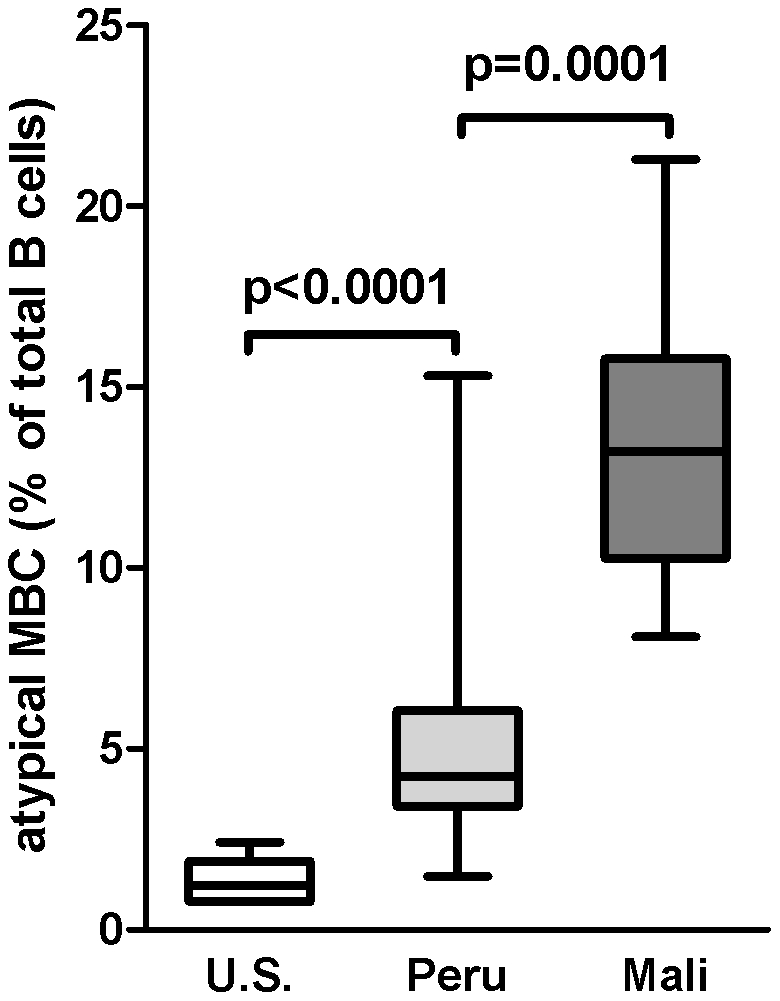
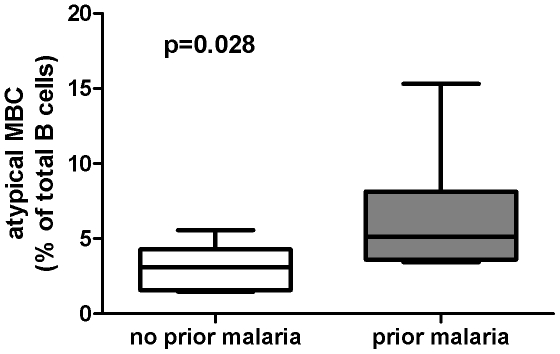
Methodology/principal findings: In this cross-sectional study venous blood was collected from adults in areas of zero (U.S., n = 10), low (Peru, n = 18) and high (Mali, n = 12) Pf transmission. Adults in Peru and Mali were infected with Pf at the time of blood collection. Thawed lymphocytes were analyzed by flow cytometry to quantify B cell subsets, including atypical memory B cells, defined by the cell surface markers CD19(+) CD20(+) CD21(-) CD27(-) CD10(-). In Peru, the mean level of atypical memory B cells, as a percent of total B cells, was higher than U.S. adults (Peru mean: 5.4% [95% CI: 3.61-7.28]; U.S. mean: 1.4% [95% CI: 0.92-1.81]; p<0.0001) but lower than Malian adults (Mali mean 13.1% [95% CI: 10.68-15.57]; p = 0.0001). In Peru, individuals self-reporting ≥1 prior malaria episodes had a higher percentage of atypical memory B cells compared to those reporting no prior episodes (≥1 prior episodes mean: 6.6% [95% CI: 4.09-9.11]; no prior episodes mean: 3.1% [95% CI: 1.52-4.73]; p = 0.028).
Conclusions/significance: Compared to Pf-naive controls, atypical memory B cells were increased in Peruvian adults exposed to low Pf transmission, and further increased in Malian adults exposed to intense Pf transmission. Understanding the origin, function and antigen specificity of atypical memory B cells in the context of Pf infection could contribute to our understanding of naturally-acquired malaria immunity.
Conflict of interest statement
Figures
References
-
- Cohen S, Mc GI, Carrington S. Gamma-globulin and acquired immunity to human malaria. Nature. 1961;192:733–737. - PubMed
-
- Sabchareon A, Burnouf T, Ouattara D, Attanath P, Bouharoun-Tayoun H, et al. Parasitologic and clinical human response to immunoglobulin administration in falciparum malaria. Am J Trop Med Hyg. 1991;45:297–308. - PubMed
-
- Marsh K, Kinyanjui S. Immune effector mechanisms in malaria. Parasite Immunol. 2006;28:51–60. - PubMed
-
- Amanna IJ, Carlson NE, Slifka MK. Duration of humoral immunity to common viral and vaccine antigens. N Engl J Med. 2007;357:1903–1915. - PubMed
Publication types
MeSH terms
Substances
Grants and funding
LinkOut - more resources
Full Text Sources
Research Materials
