


Degenerative cervical spondylolisthesis: a systematic review
- PMID: 21264670
- PMCID: PMC3103955
- DOI: 10.1007/s00264-010-1203-5
Degenerative cervical spondylolisthesis: a systematic review
Abstract
Purpose: Degenerative cervical spondylolisthesis has received insufficient attention, in contrast to degenerative lumbar spondylolisthesis. In fact, degenerative cervical spondylolisthesis may be more common than previously thought.
Methods: In order to provide appropriate guidelines for the treatment of degenerative cervical spondylolisthesis, a systematic review of degenerative cervical spondylolisthesis was performed. An English literature search from January 1947 to November 2010 was completed with reference to radiological examination and management of degenerative cervical spondylolisthesis.
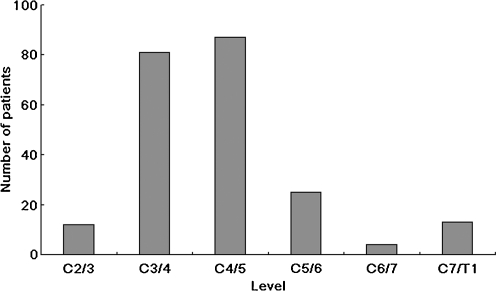
Results: Of 102 patients with degenerative cervical spondylolisthesis, 52 patients (51%) had neck or occipital pain, 23 patients (22.5%) were referred with radiculopathy and 65 patients (63.7%) presented with myelopathy or myeloradiculopathy. Degenerative cervical spondylolisthesis was most common in C3/4 and C4/5, occurring in 81 patients at C3/4 (46%) and 87 at C4/5 (49.4%). Disc degeneration and facet hypertrophy were the main causes of this clinical entity. Of 123 patients, 57 (46.3%) were found to have segmental instability as shown by flexion-extension lateral radiographs. There are two classification systems for degenerative cervical spondylolisthesis. Surgery was indicated in patients who had radiologically proven cervical spondylolisthesis with instability and/or spinal cord compression.
Conclusion: Prospective studies should be designed in the future to draw a more reliable conclusion about the management of degenerative cervical spondylolisthesis.
Figures
References
-
- Hardouin P, Flipo RM, Foissac-Gegoux P, Thevenon A, Pouyol F, Duquesnoy B, Delcambre B. Current aspects of osteoarticular pathology in patients undergoing hemodialysis: study of 80 patients. Part 1. Clinical and radiological analysis. J Rheumatol. 1987;14:780–783. - PubMed
-
- Perlman R, Hawes LE. Cervical spondylolisthesis. J Bone Joint Surg Am. 1951;33:1012–1013. - PubMed
-
- Deburge A, Mazda K, Guigui P. Unstable degenerative spondylolisthesis of the cervical spine. J Bone Joint Surg Br. 1995;77:122–125. - PubMed
Publication types
MeSH terms
LinkOut - more resources
Full Text Sources
Medical
Miscellaneous
