Review
. 2011 Feb 11;50(7):1478-91.
doi: 10.1002/anie.201005142. Epub 2011 Jan 24.

Bystanding F+ oxidants enable selective reductive elimination from high-valent metal centers in catalysis

Affiliations
Review

Bystanding F+ oxidants enable selective reductive elimination from high-valent metal centers in catalysis

Keary M Engle et al. Angew Chem Int Ed Engl. .

Abstract

Reductive elimination from partially or completely oxidized metal centers is a vital step in a myriad of carbon-carbon and carbon-heteroatom bond-forming reactions. One strategy for promoting otherwise challenging reductive elimination reactions is to oxidize the metal center using a two-electron oxidant (that is, from M((n)) to M((n+2))). However, many of the commonly used oxidants for this type of transformation contain oxygen, nitrogen, or halogen moieties that are subsequently capable of participating in reductive elimination, thus leading to a mixture of products. In this Minireview, we examine the use of bystanding F(+) oxidants for addressing this widespread problem in organometallic chemistry and describe recent applications in Pd(II) /Pd(IV) and Au(I) /Au(III) catalysis. We then briefly discuss a rare example in which one-electron oxidants have been shown to promote selective reductive elimination in palladium(II)-catalyzed C-H functionalization, which we view as a promising future direction in the field.


Figures

Scheme 1
Scheme 1
BQ-promoted reductive elimination from a Pd(II) intermediate in a Pd(II)-catalyzed C–H activation/C–C cross-coupling reaction (Yu et al., 2006).[6d]
Scheme 2
Scheme 2
CuCl2-promoted reductive amination in a Pd(II)-catalyzed olefin diamination reaction (Muñiz et al., 2008).[7] DMF = N,N-dimethylformamide.
Scheme 3
Scheme 3
Possible outcomes of reductive elimination from an octahedral Pd(IV) intermediate.
Scheme 4
Scheme 4
The first report of diastereoselective Pd(II)-catalyzed C(sp3)–H iodination via Pd(II)/Pd(IV) catalysis (Yu et al., 2005).[13b] DCM = dichloromethane. RT = room temperature.
Scheme 5
Scheme 5
The first report of Pd(II)-catalyzed C–H fluorination via Pd(II)/Pd(IV) catalysis (Sanford et al., 2006).[28a]
Scheme 6
Scheme 6
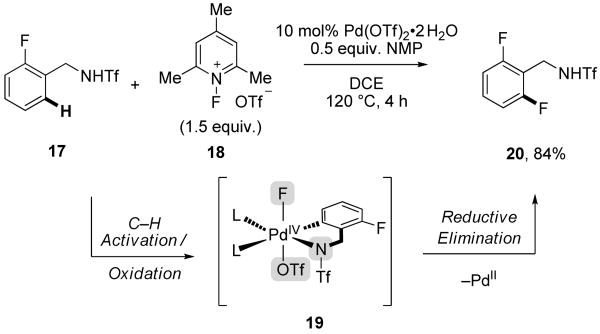
Selective C–F reductive elimination using catalytic Pd(OTf)2 with benzyltriflamide substrates (Yu et al., 2009).[28b] DCE = 1,2-dichloroethane. NMP = N-methyl-2-pyrrolidone.
Scheme 7
Scheme 7
Possible outcomes of reductive elimination from an octahedral Pd(IV) intermediate in our studies of Pd(II)-catalyzed C–H fluorination.[28b]
Scheme 8
Scheme 8
C–F reductive elimination from a Pd(IV) complex (Furuya and Ritter, 2008).[18b] o-Nos = 2-nitrobenzenesulfonyl. DMSO = dimethylsulfoxide.
Scheme 9
Scheme 9
C–F reductive elimination from a Pd(IV) complex (Ball and Sanford, 2009).[18c] tBu-bpy = 4,4′-di-tert-butyl-2,2′-bipyridine.
Scheme 10
Scheme 10
Heterocycle formation via C–H activation/C–Y cyclization.
Scheme 11
Scheme 11
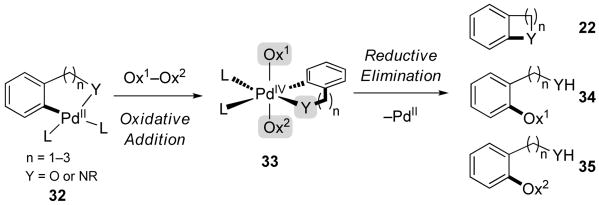
Challenges in selective C–Y reductive elimination from Pd(IV) intermediates. “Ox1–Ox2” represents a generic oxidant.
Scheme 12
Scheme 12
Pd(II)-catalyzed C–H amination (Buchwald et al., 2005).[30]
Scheme 13
Scheme 13
Pd(II)-catalyzed intramolecular C–H amination using a bystanding F+ oxidant (Yu et al., 2009).[16]
Scheme 14
Scheme 14
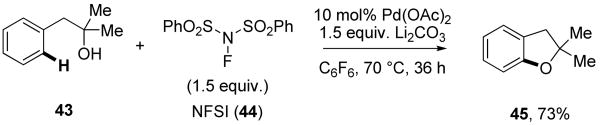
Pd(II)-catalyzed intramolecular C–H etherification using a bystanding F+ oxidant (Yu et al., 2010).[34]
Scheme 15
Scheme 15
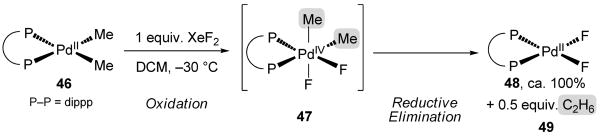
Selective C–C reductive elimination induced by XeF2 (Vigalok et al., 2003).[27]
Scheme 16
Scheme 16
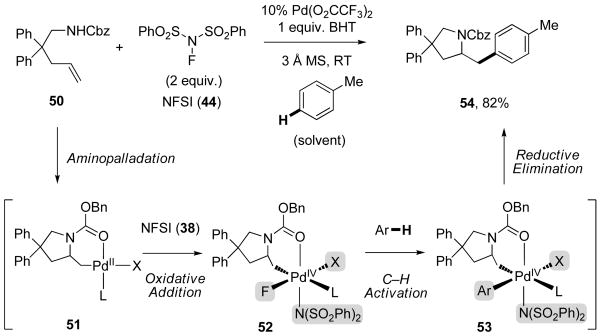
Pd(II)-catalyzed olefin carboamidation using a bystanding F+ oxidant for selective reductive elimination from a Pd(IV) intermediate (Michael et al., 2009).[41,42]
Scheme 17
Scheme 17
The first example of Pd(II)-catalyzed C–H trifluoromethylation (Yu et al., 2010).[45] TFA = trifluoroacetic acid.
Scheme 18
Scheme 18
Selective C–CF3 reductive elimination from a Pd(IV) complex induced by a bystanding electrophilic N–F reagent (Sanford et al., 2010).[44b]
Scheme 19
Scheme 19
Electrophilic iodination of a [Au(I)–vinyl] intermediate in an Au(I)-catalyzed cyclization reaction (Buzas and Gagosz, 2006).[51a]
Scheme 20
Scheme 20
Electrophilic fluorination of a [Au(I)–vinyl] intermediate in an Au(I)-catalyzed cyclization reaction (Gouverneur et al., 2008).[52a]
Scheme 21
Scheme 21
Selectfluor (62) as a bystanding oxidant in C–O bond–forming Au(I)/Au(III) catalysis (Zhang et al., 2009).[59]
Scheme 22
Scheme 22
Selectfluor (62) as a bystanding oxidant in C–C bond–forming Au(I)/Au(III) catalysis (Zhang et al., 2009).[60]
Scheme 23
Scheme 23
Selectfluor (66) as a bystanding oxidant in olefin oxyarylation and aminoarylation via Au(I)/Au(III) catalysis (Zhang et al., 2010).[61] Ts = p-toluenesolfonyl.
Scheme 24
Scheme 24
Selectfluor (66) as a bystanding oxidant in olefin aminoarylation via Au(I)/Au(III) catalysis (Toste et al., 2010).[62] dppm = 1,1,-bis(diphenylphosphino)methane.
Scheme 25
Scheme 25
A three component coupling reaction via Au(I)/Au(III) catalysis using Selectfluor (66) (Toste et al., 2010).[63] Phth = phthaloyl.
Scheme 26
Scheme 26
Intramolecular oxidative arylation of a [Au(I)–vinyl] intermediate via Au(I)/Au(III) catalysis using Selectfluor (66) as a bystanding oxidant (Gouverneur et al., 2010).[64]
Scheme 27
Scheme 27
Oxidation of Au(I) complex 97 with an F+ reagent (Mankad and Toste, 2010).[65]
Scheme 28
Scheme 28
Reactivity of 98 and 100 complexes with PhB(OH)2 (Mankad and Toste, 2010).[65]
Scheme 29
Scheme 29
Depiction of one-electron oxidation events that can take place with a [Pd(II)–R] intermediate.
Scheme 30
Scheme 30
Ce(IV) as a one-electron oxidant for selective C–N reductive elimination in an intramolecular Pd(II)-catalyzed C–H amination reaction (Yu et al., 2009).[16]
Scheme 31
Scheme 31
C–C reductive elimination promoted by Cp2Fe+, a one-electron oxidant (Mayer and Sanford et at., 2009).[6g]
Scheme 32
Scheme 32
Proposed mechanism for C–C reductive elimination (Mayer and Sanford et at., 2009) [6g]

References

    1. Gillie A, Stille JK. J Am Chem Soc. 1980;102:4933–4941.
    1. For reviews of C–Y reductive elimination from Pd(II) centers, see: Hartwig JF. Acc Chem Res. 1998;31:852–860.Hartwig JF. Nature. 2008;455:314–322.

    1. For reviews discussing ligand design in Pd(0) chemistry, see: Herrmann WA. Angew Chem. 2002;114:1342–1363.Angew Chem Int Ed. 2002;41:1290–1309.Littke AF, Fu GC. Angew Chem. 2002;114:4350–4386.Angew Chem Int Ed. 2002;41:4176–4211.Martin R, Buchwald SL. Acc Chem Res. 2008;41:1461–1473.Hartwig JF. Acc Chem Res. 2008;41:1534–1544.

    1. For reviews of Pd-catalyzed C–H functionalization reactions, see: Jia C, Kitamura T, Fujiwara Y. Acc Chem Res. 2001;34:633–639.Satoh T, Miura M. Chem Lett. 2007;36:200–205.Seregin IV, Gevorgyan V. Chem Soc Rev. 2007;36:1173–1193.Campeau LC, Stuart DR, Fagnou K. Aldrichim Acta. 2007;40:35–41.Alberico D, Scott ME, Lautens M. Chem Rev. 2007;107:174–238.Li BJ, Yang SD, Shi ZJ. Synlett. 2008:949–957.Kakiuchi F, Kochi T. Synthesis. 2008:3013–3039.Daugulis O, Do HQ, Shabashov D. Acc Chem Res. 2009;42:1074–1086.Chen X, Engle KM, Wang DH, Yu JQ. Angew Chem. 2009;121:5196–5217.Angew Chem Int Ed. 2009;48:5094–5115.Ackermann L, Vicente R, Kapdi AR. Angew Chem. 2009;121:9976–10011.Angew Chem Int Ed. 2009;48:9792–9826.Lyons TW, Sanford MS. Chem Rev. 2010;110:1147–1169.

    1. Hegedus LS. Transition Metals in the Synthesis of Complex Organic Molecules. 2nd. University Science Books; Sausalito (CA, USA): 1999. pp. 22–23. For examples of CO-promoted reductive elimination in transition metal chemistry, see: Kondo T, Kodoi K, Nishinaga E, Okada T, Morisaki Y, Watanabe Y, Mitsudo T. J Am Chem Soc. 1998;120:5587–5588.Carbayo A, Cuevas JV, García-Herbosa G. J Organomet Chem. 2002;658:15–20.West NM, Reinartz S, White PS, Templeton JL. J Am Chem Soc. 2006;128:2059–2066.

Publication types

LinkOut - more resources