


Effect of statin therapy on disease progression in pediatric ADPKD: design and baseline characteristics of participants
- PMID: 21266204
- PMCID: PMC3077046
- DOI: 10.1016/j.cct.2011.01.008
Effect of statin therapy on disease progression in pediatric ADPKD: design and baseline characteristics of participants
Abstract
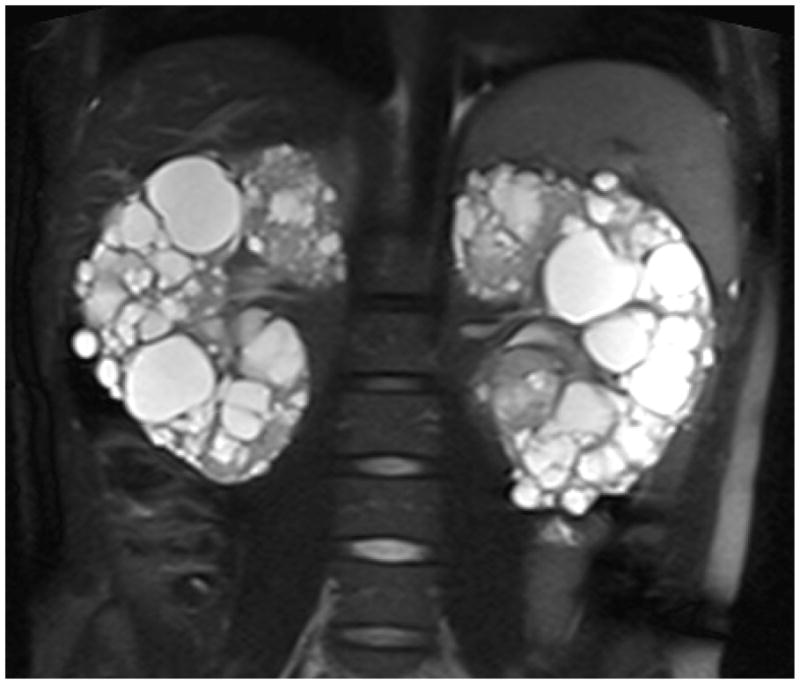
Autosomal dominant polycystic kidney disease (ADPKD) is the most common genetic kidney condition and is associated with important renal and cardiovascular manifestations in childhood. Renal cystic disease can be documented in some cases as early as in utero. Early intervention is critical if the long-term complications of this condition, including end-stage renal disease, are to be ameliorated. Here we describe our ongoing randomized double-blind placebo-controlled phase III clinical trial to assess the effect of pravastatin treatment on renal and cardiovascular disease progression in 107 children and young adults age 8-22 years with ADPKD who are receiving the angiotensin converting enzyme inhibitor lisinopril. Baseline demographic and laboratory data are provided. Results of this study could markedly impact the standard of care for evaluation and treatment of ADPKD in this population.
Copyright © 2011 Elsevier Inc. All rights reserved.
Figures

References
-
- Ecder T, Fick-Brosnahan G, Schrier RW. Polycystic Kidney Disease. In: Schrier RW, editor. Diseases of the Kidney and Urinary Tract. 8. Philadelphia: Lippincott Williams & Wilkins; 2007. pp. 502–39.
-
- Pazour GJ. Intraflagellar transport and cilia-dependent renal disease: the ciliary hypothesis of polycystic kidney disease. J Am Soc Nephrol. 2004 Oct;15(10):2528–36. - PubMed
-
- Yoder BK, Hou X, Guay-Woodford LM. The polycystic kidney disease proteins, polycystin-1, polycystin-2, polaris, and cystin, are co-localized in renal cilia. J Am Soc Nephrol. 2002 Oct;13(10):2508–16. - PubMed
-
- Nauli SM, Alenghat FJ, Luo Y, Williams E, Vassilev P, Li X, Elia AE, Lu W, Brown EM, Quinn SJ, et al. Polycystins 1 and 2 mediate mechanosensation in the primary cilium of kidney cells. Nat Genet. 2003 Feb;33(2):129–37. - PubMed
-
- Praetorius HA, Frokiaer J, Nielsen S, Spring KR. Bending the primary cilium opens Ca2+-sensitive intermediate-conductance K+ channels in MDCK cells. J Membr Biol. 2003 Feb 1;191(3):193–200. - PubMed
Publication types
MeSH terms
Substances
Grants and funding
LinkOut - more resources
Full Text Sources
Medical
