. 2011 May;39(10):4427-37.
doi: 10.1093/nar/gkq1244. Epub 2011 Jan 25.

NMR structure of the A730 loop of the Neurospora VS ribozyme: insights into the formation of the active site

Affiliations

NMR structure of the A730 loop of the Neurospora VS ribozyme: insights into the formation of the active site

Geneviève Desjardins et al. Nucleic Acids Res. 2011 May.

Abstract

The Neurospora VS ribozyme is a small nucleolytic ribozyme with unique primary, secondary and global tertiary structures, which displays mechanistic similarities to the hairpin ribozyme. Here, we determined the high-resolution NMR structure of a stem-loop VI fragment containing the A730 internal loop, which forms part of the active site. In the presence of magnesium ions, the A730 loop adopts a structure that is consistent with existing biochemical data and most likely reflects its conformation in the VS ribozyme prior to docking with the cleavage site internal loop. Interestingly, the A730 loop adopts an S-turn motif that is also present in loop B within the hairpin ribozyme active site. The S-turn appears necessary to expose the Watson-Crick edge of a catalytically important residue (A756) so that it can fulfill its role in catalysis. The A730 loop and the cleavage site loop of the VS ribozyme display structural similarities to internal loops found in the active site of the hairpin ribozyme. These similarities provided a rationale to build a model of the VS ribozyme active site based on the crystal structure of the hairpin ribozyme.


Figures

Figure 1.
Figure 1.
The Neurospora VS ribozyme and its A730 internal loop. (A) Primary and secondary structures of the VS ribozyme (wild-type sequence nucleotides 617–783). The site of self-cleavage is indicated by an arrow, and circled nucleotides in loops I and V form the I/V kissing-loop interaction. (B) Schematic of the VS ribozyme (left) and hairpin ribozyme (right) illustrating similarities at the active site (see text). The residues highlighted with white circles are key players of proposed general acid-based mechanisms (4). (C) Primary and predicted secondary structures of the 26-nt SLVI RNA fragment, which includes the A730 loop domain (gray box). Phosphate groups that display inhibitory effect when substituted by Rp phosphorothioate are indicated by an arrow (20,63), and the arrow is filled in those cases where the inhibition could be suppressed by addition of manganese ions (63).
Figure 2.
Figure 2.
Stabilization of the A730 loop by Mg2+ ions. Imino regions of 1D flip-back watergate (44,45) 1H spectra of SLVI collected at 15°C in NMR buffer containing different concentrations of free MgCl2. Imino proton assignments were derived from 2D NOESY spectra collected in NMR buffer at 0, 5 and 10 mM MgCl2.
Figure 3.
Figure 3.
NMR solution structure of the SLVI RNA fragment. (A) Stereoview of the 20 lowest-energy structures. The superposition was made on the minimized average structure (not shown) over heavy atoms of residues 2–25. The view is into the minor groove of the A730 active site internal loop. (B and C) Stick representations of the lowest-energy structure of SLVI. For simplicity only heavy atoms are shown and the ribbon replacing the phosphorus and non-bonded oxygen atoms is used to indicate the backbone topology. SLVI nucleotides are color-coded: the loop closing base pairs (G6–C21 and C10–G19) are dark gray, C7 (C755) is magenta, A8 (A756) is green, G9 (G757) is gold and A20 (A730) is blue.
Figure 4.
Figure 4.
Formation of a cis WC/WC G9-A20 base pair in the A730 loop. (A) Selected regions from a 2D 1H–15N CPMG-NOESY spectrum showing NOEs that define the geometry of the G9–A20 base pair. The spectrum was collected at 15°C with a mixing time of 160 ms. (B) The G9–A20 base pair in the 20 lowest-energy structures. The superposition is from Figure 3a. (C) Stacking of the G9–A20 base pair onto the C10–G19 base pair in the lowest-energy structure of SLVI. Dashed lines connect protons for which a NOE is observed in (A).
Figure 5.
Figure 5.
S-turn motif in the A730 loop of the SLVI RNA. (A) Schematic summarizing the inter-residue NOEs for the A730 internal loop of the SLVI RNA. Black lines indicate NOEs between nucleotides that are adjacent in the sequence, pink lines indicate NOEs between base-pairing residues, blue lines indicate NOEs between G6 and G9, and orange lines refer to NOEs between C7 and G9. For simplicity, all ribose protons (H1′, H2′, H3′, H4′, H5′ and H5″) were grouped under the ribose denomination. (B and C) Close up views of the S-turn motif in the lowest-energy structure showing (B) the ribose reversal at A8 and nearby phosphates and (C) stacking of C7 and A8 in the minor groove and stabilizing hydrogen bonds. In (B) the pro–Rp oxygens are shown in blue and the 2′-oxygens in red. In (C) three hydrogen bonds are shown (A8 N3: G9 2′–OH, C7 NH2: G9 N3 and A8 2′–OH: G9 O4′) that likely stabilize the S-turn motif. For simplicity only heavy atoms are shown and the ribbon replacing the phosphorus and non-bonded oxygen atoms is used to indicate the backbone topology.
Figure 6.
Figure 6.
Determination of adenine pKa’s in SLVI. (A) Superposition of the aromatic C2–H2 regions of 2D 1H–13C HMQC spectra collected at 25°C and at pH 4.7 (beige), pH 5.1 (black), pH 5.5 (pale blue) and pH 8.6 (grayish blue). Arrows point to significant pH-dependent changes in 13C chemical shift for A8 and A20. (B) Summary of the adenine pKa values in the A730 internal loop.
Figure 7.
Figure 7.
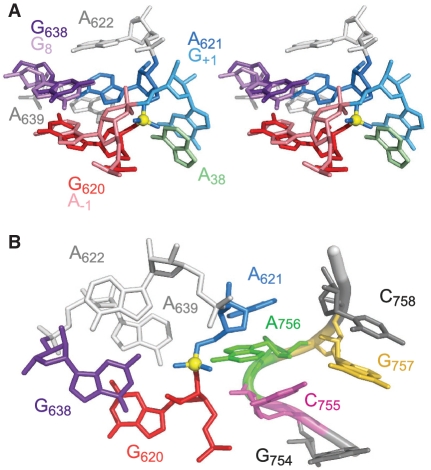
Homology modeling of the VS ribozyme active site. (A) Heavy atom superposition of the G638 and G620 nucleotides of the VS ribozyme with the G8 and A − 1 nucleotides of the hairpin ribozyme [pdb entry 1M5O; (60)]. (B) Modeling of the active site by association of the substrate internal loop and the A730 internal loop (see text). For simplicity only heavy atoms are shown and the ribbon replacing the phosphorus and non-bonded oxygen atoms is used to indicate the backbone topology. The yellow sphere represents the scissile phosphate.

References

    1. Collins RA. The Neurospora Varkud satellite ribozyme. Bioch. Soc. Trans. Rev. 2002;30:1122–1126. - PubMed
    1. Lilley DM. The Varkud satellite ribozyme. RNA. 2004;10:151–158. - PMC - PubMed
    1. Cochrane JC, Strobel SA. Catalytic strategies of self-cleaving ribozymes. Acc. Chem. Res. 2008;41:1027–1035. - PubMed
    1. Lilley DMJ. In: Ribozymes and RNA catalysis. Lilley DMJ, Eckstein F, editors. Cambridge: Royal Society of Chemistry; 2008. pp. 66–91.
    1. Pyle AM. Ribozymes: a distinct class of metalloenzymes. Science. 1993;261:709–714. - PubMed

Publication types