. 2011 Feb 1;17(3):483-93.
doi: 10.1158/1078-0432.CCR-10-1670. Epub 2011 Jan 25.

Combined blockade of Src kinase and epidermal growth factor receptor with gemcitabine overcomes STAT3-mediated resistance of inhibition of pancreatic tumor growth

Affiliations

Combined blockade of Src kinase and epidermal growth factor receptor with gemcitabine overcomes STAT3-mediated resistance of inhibition of pancreatic tumor growth

Nagathihalli S Nagaraj et al. Clin Cancer Res. .

Abstract

Purpose: We previously established a mechanistic rationale for Src inhibition as a novel therapeutic target in pancreatic cancer and have identified activated STAT3 as a potential biomarker of resistance to Src inhibition. The purpose of this study was to translate the current understanding of complementary activated tyrosine kinase signaling pathways by targeting Src kinase and epidermal growth factor receptor (EGFR).

Experimental design: IC(50) values for dasatinib, a Src kinase inhibitor, erlotinib, an EGFR tyrosine kinase inhibitor and gemcitabine were determined and sensitive and resistant pancreatic cancer cell lines were identified. The in vitro and in vivo effects of these agents on multiple signaling pathways and tumorigenicity in pancreatic cancer were investigated.

Results: The combination of dasatinib, erlotinib, and gemcitabine resulted in cooperative inhibition of cell migration and invasion of both sensitive and resistant pancreatic cancer cells as well as cooperative inhibition of multiple signaling pathways including FAK, AKT, ERK, JNK, MAPK, and STAT3 at concentrations that were ineffective as individual agents or as double combinations of agents. The triple combination of agents was also most effective at inhibiting the growth of xenografts of both sensitive and resistant pancreatic cancer cells in vivo without increasing toxicity. Furthermore, combined inhibition of Src and EGFR with gemcitabine inhibited constitutively activated STAT3 in vitro and in vivo.

Conclusions: These results provide evidence that combined targeted biological therapy in addition to cytotoxic chemotherapy can overcome treatment resistance. Such treatment strategies may be used to tailor therapy based on identified biomarkers of resistance to targeted monotherapy.


Conflict of interest statement

Conflict of interest: The authors declare no conflict of interest.

Figures

Fig. 1
Fig. 1
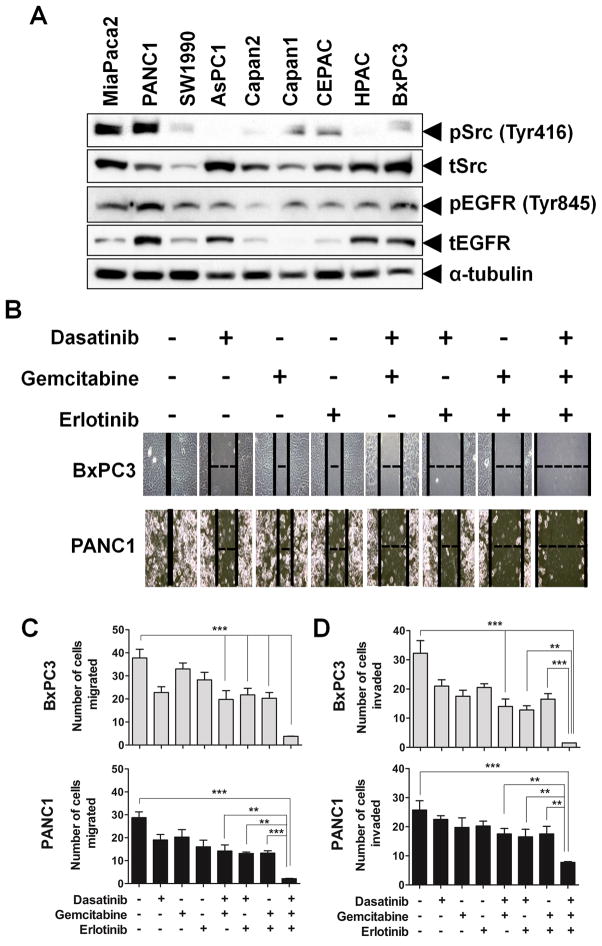
Inhibition of cell motility, migration and invasion with dasatinib, erlotinib and gemcitabine in pancreatic cancer cells. (A) Expression of pSrc, Src, pEGFR and EGFR in human pancreatic cancer cell lines. Cells were grown to 70% to 80% confluence then cell lysates were prepared from nine human pancreatic cancer cell lines as indicated and immunoblotted for pSrc, Src, pEGFR and EGFR as described in Materials and Methods. The blots were subsequently stripped and reprobed for α-tubulin. BxPC3 and PANC1 cells were treated with their respective IC50 doses of dasatinib (BxPC3-5 nmol/L; PANC1-50 nmol/L), erlotinib (BxPC3-100 nmol/L; PANC1-1000 nmol/L) and gemcitabine (BxPC3-30 nmol/L; PANC1-100 nmol/L). Treatment with the combination of the three drugs significantly decreased (B) cell motility, (C) migration and (D) invasion compared with treatment of individual or double combinations of drugs. BxPC3 cells were significantly more sensitive with any agent studied when compared with more resistant PANC1 cells. Individual data points represent the mean ± SD of three independent experiments. **p<0.01; ***p<0.001.
Fig. 2
Fig. 2
Cooperative effect of Src and EGFR inhibition with gemcitabine on cell signaling. BxPC3 vector control-shRNA, Src shRNA and EGFR shRNA cells were investigated with dasatinib (5 nmol/L) or erlotinib (100 nmol/L) for anti-proliferative activity by MTT assay and anti-invasion by matrigel invasion assay. Significantly reduction in (A) cell viability and (B) invasion was seen with combined targeting of Src and EGFR signalling. Individual data point represents the mean ± SD of three independent wells. *p<0.05; **p<0.01; ***p<0.001. (C) BxPC3 cells were treated with dasatinib (5 nmol/L) and/or gemcitabine (30 nmol/L) and/or erlotinib (100 nmol/L); PANC1 cells were treated with dasatinib (25 nmol/L) and/or gemcitabine (75 nmol/L) and/or erlotinib (500 nmol/L) for 12 h, lysed, and analyzed by Western blotting with indicated antibodies. At doses that had minimal effects on inhibition of any signaling pathway, only the triple combination of dasatinib, erlotinib and gemcitabine showed inhibition of pSrc, pEGFR, pFAK, pAKT, pSTAT3, pERK, pJNK or pMAPK. Furthermore, only this triple combination overcomes constitutive activation of STAT3-mediating signaling seen in PANC1 cells. Blots are representative of at least two separate experiments with similar results.
Fig. 3
Fig. 3
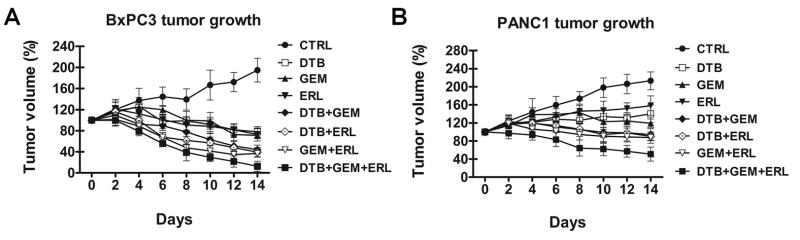
Combination of dasatinib, erlotinib and gemcitabine effectively inhibits tumor growth in vivo. Mice with subcutaneously established tumors from (A) BxPC3 (n=5) (B) or PANC1 (n=5) cells were treated with dasatinib (DTB) at 25 mg/kg daily and/or gemcitabine (GEM) at 20 mg/kg for every 3 days and/or erlotinib (ERL) at 50 mg/kg/daily or vehicle for 14 days. Growth curves for tumors are presented as the mean ± SD of five tumors in each data point.
Fig. 4
Fig. 4
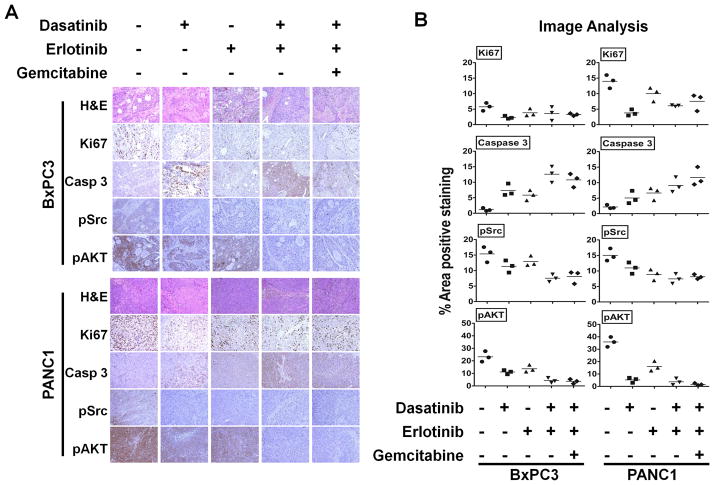
Effect of Src and EGFR inhibition on proliferation, apoptosis, angiogenesis and phosphorylation of Src and AKT in vivo. Representative examples of immunohistochemical analysis of (A) BxPC3 and PANC1 tumor tissues stained with H&E, Ki67, cleaved caspase 3, pSrc and pAKT antibodies are shown. There is no evidence of treatment-induced necrosis on H&E staining. Magnification ×20. (B) The percent area positive staining was determined using Image J image analysis. Compared with vehicle treated controls or any single or double agent treatment, mice treated with the triple combination of dasatinib, erlotinib and gemcitabine show reduced expression of pSrc and pAKT and increased cleaved caspase 3 staining in their tumors, showing successful target inhibition. Individual data point represents the mean ± SD of three independent tissue samples analyzed in each treatment.
Fig. 5
Fig. 5
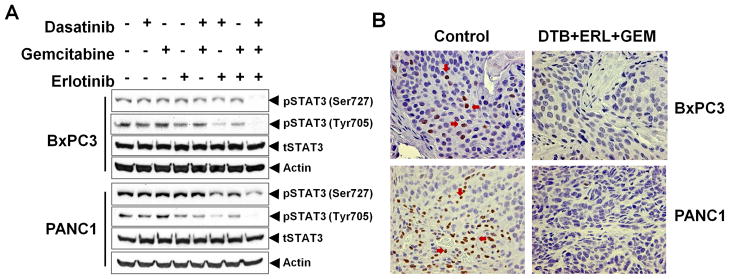
Effect of Src and EGFR inhibition with gemcitabine on constitutively activated STAT3. (A) BxPC3 and PANC1 tumor tissue lysates were analyzed for pSTAT3 (Ser727 and Tyr705) and total STAT3. Only the combined treatment of dasatinib and erlotinib with gemcitabine inhibits constitutively activated STAT3 in both BxPC3 and PANC1 tumor xenografts in vivo. (B) Representative examples of immunohistochemical analysis of BxPC3 and PANC1 tumor tissues of vehicle (control) and dasatinib (DTB)+erlotinib (ERL)+gemcitabine (GEM) treated, and were stained for pSTAT3 (positive staining in brown is indicated by arrows).

Comment in

References

    1. Jemal A, Siegel R, Ward E, et al. Cancer statistics, 2008. CA Cancer J Clin. 2008;58:71–96. - PubMed
    1. Jones S, Zhang X, Parsons DW, et al. Core signaling pathways in human pancreatic cancers revealed by global genomic analyses. Science. 2008;321:1801–6. - PMC - PubMed
    1. Korc M, Chandrasekar B, Yamanaka Y, Friess H, Buchier M, Beger HG. Overexpression of the epidermal growth factor receptor in human pancreatic cancer is associated with concomitant increases in the levels of epidermal growth factor and transforming growth factor alpha. J Clin Invest. 1992;90:1352–60. - PMC - PubMed
    1. Lutz MP, Esser IB, Flossmann-Kast BB, et al. Overexpression and activation of the tyrosine kinase Src in human pancreatic carcinoma. Biochem Biophys Res Commun. 1998;243:503–8. - PubMed
    1. Yamanaka Y, Friess H, Kobrin MS, Buchler M, Beger HG, Korc M. Coexpression of epidermal growth factor receptor and ligands in human pancreatic cancer is associated with enhanced tumor aggressiveness. Anticancer Res. 1993;13:565–9. - PubMed

Publication types

MeSH terms