


Hemoglobin A1c and mean glucose in patients with type 1 diabetes: analysis of data from the Juvenile Diabetes Research Foundation continuous glucose monitoring randomized trial
- PMID: 21266647
- PMCID: PMC3041177
- DOI: 10.2337/dc10-1054
Hemoglobin A1c and mean glucose in patients with type 1 diabetes: analysis of data from the Juvenile Diabetes Research Foundation continuous glucose monitoring randomized trial
Abstract
Objective: To determine the relationship between mean sensor glucose concentrations and hemoglobin A(1c) (HbA(1c)) values measured in the Diabetes Control and Complications Trial/Epidemiology of Diabetes Interventions and Complications laboratory at the University of Minnesota in a cohort of subjects with type 1 diabetes from the Juvenile Diabetes Research Foundation continuous glucose monitoring randomized trial.
Research design and methods: Near-continuous glucose sensor data (≥ 4 days/week) were collected for 3 months before a central laboratory-measured HbA(1c) was performed for 252 subjects aged 8-74 years, the majority of whom had stable HbA(1c) values (77% within ± 0.4% of the patient mean).
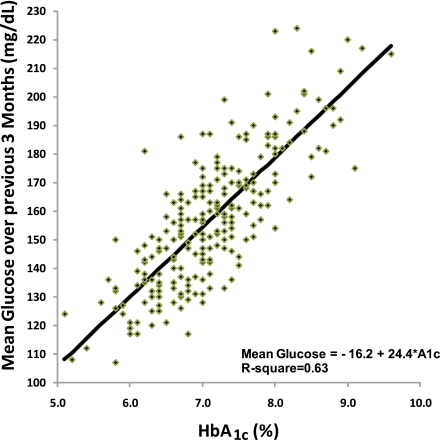
Results: The slope (95% CI) for mean sensor glucose concentration (area under the curve) versus a centrally measured HbA(1c) was 24.4 mg/dL (22.0-26.7) for each 1% change in HbA(1c), with an intercept of -16.2 mg/dL (-32.9 to 0.6). Although the slope did not vary with age or sex, there was substantial individual variability, with mean sensor glucose concentrations ranging from 128 to 187 mg/dL for an HbA(1c) of 6.9-7.1%. The root mean square of the errors between the actual mean sensor glucose concentration versus the value calculated using the regression equation was 14.3 mg/dL, whereas the median absolute difference was 10.1 mg/dL.
Conclusions: There is substantial individual variability between the measured versus calculated mean glucose concentrations. Consequently, estimated average glucose concentrations calculated from measured HbA(1c) values should be used with caution.
Trial registration: ClinicalTrials.gov NCT00406133.
Figures
References
-
- Cohen RM, Franco RS, Joiner CH. Is poor glycemic control associated with reduced red blood cell lifespan? Diabetes Care 2004;27:1013–1014 - PubMed
-
- Diabetes Control and Complications Trial Research Group The effect of intensive treatment of diabetes on the development and progression of long-term complications in insulin-dependent diabetes mellitus. N Engl J Med 1993;329:977–986 - PubMed
-
- Tamborlane WV, Kollman C, Steffes MW, et al. Comparison of fingerstick hemoglobin A1c levels assayed by DCA 2000 with the DCCT/EDIC central laboratory assay: results of a Diabetes Research in Children Network (DirecNet) Study. Pediatr Diabetes 2005;6:13–16 - PubMed
-
- Fiallo-Scharer R, Diabetes Research in Children Network Study Group Eight-point glucose testing versus the continuous glucose monitoring system in evaluation of glycemic control in type 1 diabetes. J Clin Endocrinol Metab 2005;90:3387–3391 - PubMed
Publication types
MeSH terms
Substances
Associated data
LinkOut - more resources
Full Text Sources
Medical
Miscellaneous
