. 2011 Jan 25:2:168.
doi: 10.1038/ncomms1170.

Molecular decoding using luminescence from an entangled porous framework

Affiliations
Free PMC article

Molecular decoding using luminescence from an entangled porous framework

Yohei Takashima et al. Nat Commun. .
Free PMC article

Abstract

Chemosensors detect a single target molecule from among several molecules, but cannot differentiate targets from one another. In this study, we report a molecular decoding strategy in which a single host domain accommodates a class of molecules and distinguishes between them with a corresponding readout. We synthesized the decoding host by embedding naphthalenediimide into the scaffold of an entangled porous framework that exhibited structural dynamics due to the dislocation of two chemically non-interconnected frameworks. An intense turn-on emission was observed on incorporation of a class of aromatic compounds, and the resulting luminescent colour was dependent on the chemical substituent of the aromatic guest. This unprecedented chemoresponsive, multicolour luminescence originates from an enhanced naphthalenediimide-aromatic guest interaction because of the induced-fit structural transformation of the entangled framework. We demonstrate that the cooperative structural transition in mesoscopic crystal domains results in a nonlinear sensor response to the guest concentration.


Figures
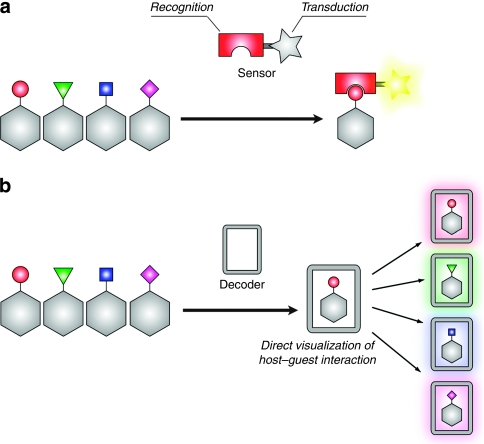
Figure 1
Figure 1. Conventional molecular sensing and molecular decoding protocols.
(a) The conventional molecular sensing protocol is demonstrated by molecules or organic polymers that possess the following two distinct chemical units: a recognition part and a transduction part. An improvement in the recognition selectivity leads to a high sensing capability. (b) Molecular decoding materials can not only accommodate chemically diverse analytes but also differentiate between them by displaying a signal that corresponds to each analyte. The direct transduction of the host–guest interaction into a corresponding signal is key to the implementation of successful molecular decoding.
Figure 2
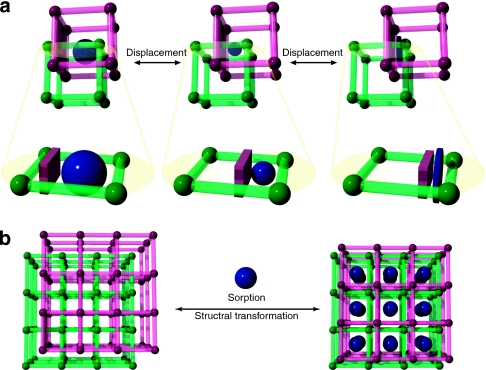
Figure 2. Advantages of entangled PCPs for molecular decoding.
(a) The framework entanglements provide flexibility through spaces when the pore size and shape are altered in response to the structure of a target guest molecule without changing the total void space. Chemically non-interconnected frameworks show dynamic movement by the dislocation of their mutual positions to effectively trap molecules while maximizing their host–guest interaction. (b) The crystallinity of an entangled framework ordered on the mesoscopic scale demonstrates a cooperative structural transition in response to guest accommodation in its crystal domain. This leads to simultaneous access to the decoding unit.
Figure 3
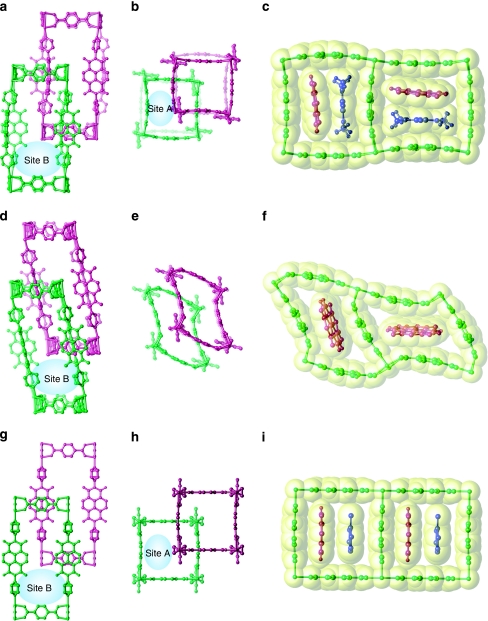
Figure 3. Structural dynamics of 1 on the removal and incorporation of guest molecules.
(ac) The crystal structure of 1a. The views along the main axes of bdc (a) and dpNDI (b) are shown. Site A is defined as the slit-type pore between dpNDI and bdc as shown in (b) and highlighted in (c). Site B illustrated in (a) presents the remaining pore. (df) The crystal structure of 1b, determined after the removal of two DMF molecules from site A of 1a. The grid composed of bdc and dpNDI is sheared while maintaining site B (d), and the shearing of the grid composed of two bdc units decreases the size of site A (e); this is also highlighted in (f). (gi) The crystal structure of 1c. The incorporation of toluene into 1 induces a structural transition to a non-distorted framework (g, h). Compared with 1a (b), the displacement of one framework in the other, along the main axis of bdc, leads to an enlargement in the pore size of site A (h). The toluene molecule interacts with the NDI in site A in a face-to-face manner (i). One of the entangled frameworks is highlighted in green and the other in purple; the guest DMF and toluene molecules are shown in blue. The van der Waals surface is highlighted in yellow.
Figure 4
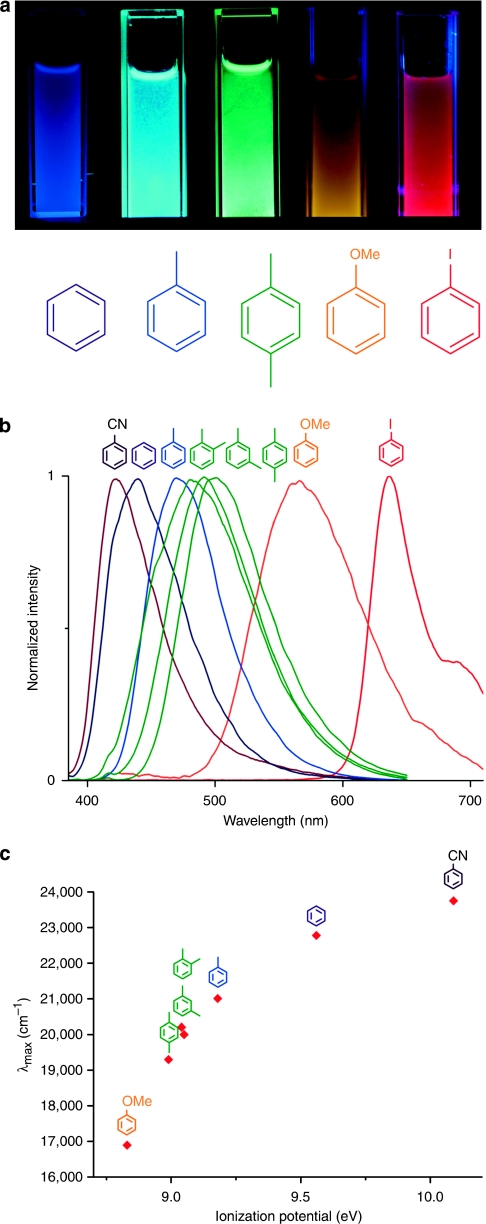
Figure 4. Multicolour luminescence of 1VOCs.
(a) The resulting luminescence of crystal powders of 1, suspended in each VOC liquid after excitation at 365 nm using a commercial ultraviolet lamp. (b) Height-normalized luminescent spectra of 1formula imageVOCs after excitation at 370 nm. (c) The relationship between the emission energy of 1formula imageVOCs and the ionization potential of each VOC. The linear correlation implies that the CT complexation dominates the fluorescence.
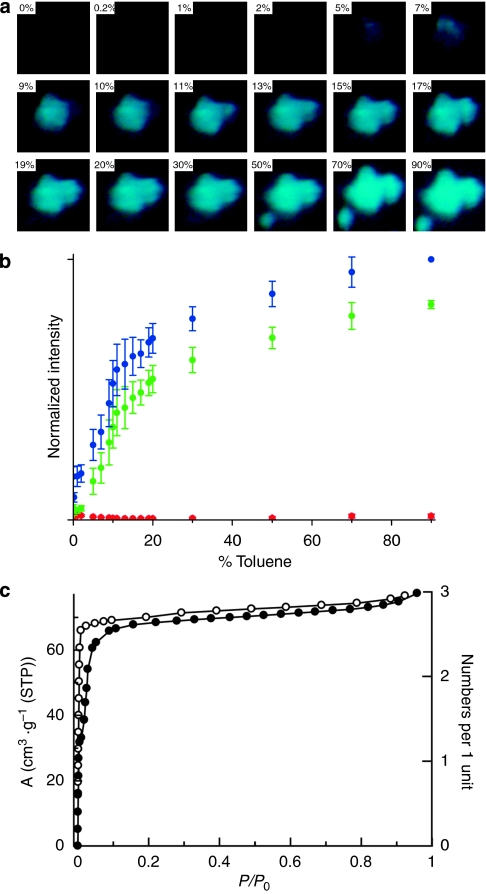
Figure 5
Figure 5. Nonlinear fluorescent sensor response measurements of 1 at a controlled relative toluene vapour pressure.
(a) A series of microscopic fluorescent images of 1 under the following relative toluene vapour pressures: 0, 0.2, 1, 2, 5, 7, 9, 10, 11, 13, 15, 17, 19, 20, 30, 50, 70 and 90%. (b) A plot of the RGB fluorescence intensity against the relative toluene vapour pressure in a helium gas stream showing the nonlinear sensor response of the blue and green signals. The data were obtained using the arithmetic mean of 14 samples. The error bars denote the standard deviation. (c) An adsorption isotherm of 1 for benzene with two adsorption steps with hysteresis clearly indicates the cooperative structural transformation in response to guest accommodation.

References

    1. Haupt K. & Mosbach K. Molecularly imprinted polymers and their use in biomimetic sensors. Chem. Rev. 100, 2495–2504 (2000). - PubMed
    1. McQuade D. T., Pullen A. E. & Swager T. M. Conjugated polymer-based chemical sensors. Chem. Rev. 100, 2537–2574 (2000). - PubMed
    1. de Sliva A. P. et al. Signaling recognition events with fluorescent sensors and switches. Chem. Rev. 97, 1515–1566 (1997). - PubMed
    1. Beer P. D. & Gale P. A. Anion recognition and sensing: the state of the art and future perspectives. Angew. Chem. Int. Ed. 40, 486–516 (2001). - PubMed
    1. Rakow N. A. & Suslick K. S. A colorimetric sensor array for odour visualization. Nature 406, 710–713 (2000). - PubMed