


Effect of erythropoietin on level of circulating endothelial progenitor cells and outcome in patients after acute ischemic stroke
- PMID: 21269484
- PMCID: PMC3221969
- DOI: 10.1186/cc10002
Effect of erythropoietin on level of circulating endothelial progenitor cells and outcome in patients after acute ischemic stroke
Abstract
Introduction: Erythropoietin (EPO) enhances the circulating level of endothelial progenitor cells (EPCs), which has been reported to be associated with prognostic outcome in ischemic stroke (IS) patients. The aim of this study was to evaluate the time course of circulating EPC level and the impact of EPO therapy on EPC level and clinical outcome in patients after acute IS.
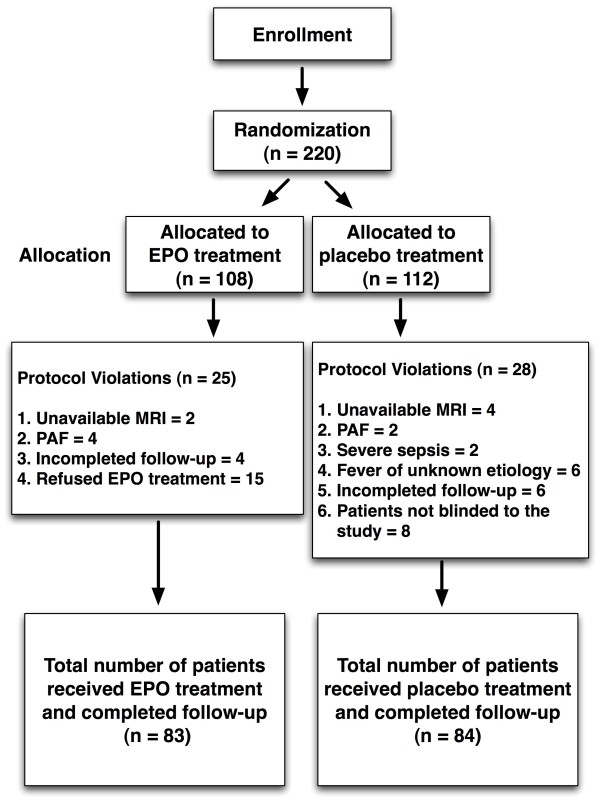
Methods: In total, 167 patients were prospectively randomized to receive either EPO therapy (group 1) (5,000 IU each time, subcutaneously) at 48 h and 72 h after acute IS, or serve as placebo (group 2). The circulating level of EPCs (double-stained markers: CD31/CD34 (E1), CD62E/CD34 (E2) and KDR/CD34 (E3)) was determined using flow cytometry at 48 h and on days 7 and 21 after IS. EPC level was also evaluated once in 60 healthy volunteers.
Results: Circulating EPC (E1 to E3) level at 48 h after IS was remarkably higher in patients than in control subjects (P < 0.02). At 48 h and on Day 7 after IS, EPC (E1 to E3) level did not differ between groups 1 and 2 (all P > 0.1). However, by Day 21, EPC (E1 to E3) level was significantly higher in group 1 than in group 2 (all P < 0.03). Additionally, 90-day recurrent stroke rate was notably lower in group 1 compared with group 2 (P = 0.022). Multivariate analysis demonstrated that EPO therapy (95% confidence interval (CI), 0.153 to 0.730; P = 0.006) and EPC (E3) (95% CI, 0.341 to 0.997; P = 0.049) levels were significantly and independently predictive of a reduced 90-day major adverse neurological event (MANE) (defined as recurrent stroke, National Institutes of Health Stroke scale ≥8, or death).
Conclusions: EPO therapy significantly improved circulating EPC level and 90-day MANE.
Trial registration number: ISRCTN: ISRCTN96340690.
Figures
Comment in
-
Erythropoietin for stroke treatment: dead or alive?Crit Care. 2011;15(2):129. doi: 10.1186/cc10057. Epub 2011 Mar 9. Crit Care. 2011. PMID: 21418552 Free PMC article.
-
Effect of erythropoietin therapy on clinical outcome in patients after acute ischemic stroke: a debatable issue.Crit Care. 2011;15(3):425. doi: 10.1186/cc10145. Epub 2011 May 17. Crit Care. 2011. PMID: 21586100 Free PMC article. No abstract available.
References
-
- World Health Organization. World Health Report 1999 - Making a Difference. Geneva, Switzerland: World Health Organization; 1999.
-
- Association AH. Stroke Statistics. Dallas, Dallas, TX: American Heart Association; 2002.
-
- Muir KW, Weir CJ, Murray GD, Povey C, Lees KR. Comparison of neurological scales and scoring systems for acute stroke prognosis. Stroke. 1996;27:1817–1820. - PubMed
-
- Adams HP Jr, Bendixen BH, Kappelle LJ, Biller J, Love BB, Gordon DL, Marsh EE. Classification of subtype of acute ischemic stroke. Definitions for use in a multicenter clinical trial. TOAST. Trial of Org 10172 in Acute Stroke Treatment. Stroke. 1993;24:35–41. - PubMed
Publication types
MeSH terms
Substances
Associated data
LinkOut - more resources
Full Text Sources
Medical
Research Materials
