


Generalized anxiety disorder: course and risk factors in pregnancy
- PMID: 21269708
- PMCID: PMC3095713
- DOI: 10.1016/j.jad.2011.01.003
Generalized anxiety disorder: course and risk factors in pregnancy
Abstract
Background: There are limited studies of generalized anxiety disorder (GAD) across pregnancy.
Methods: Women (n = 2793) were enrolled in the Yale Pink and Blue study, a cohort enriched with subjects who suffered from major depressive disorder (MDD) within the past five years or used antidepressants in the past year. Subjects were evaluated with the Composite International Diagnostic Interview at three time points: twice in pregnancy and once after delivery. We defined a generalized anxiety disorder (GAD) episode as per DSM IV but with required duration reduced to one month or longer. Course and correlates of GAD were examined in women who had: 1) no GAD during the 6 months prior or in pregnancy (Group A), 2) GAD in the 6 months prior to but not in pregnancy (Group B), 3) GAD in pregnancy only (Group C) and 4) GAD both in the 6 months prior to and during pregnancy (Group D).
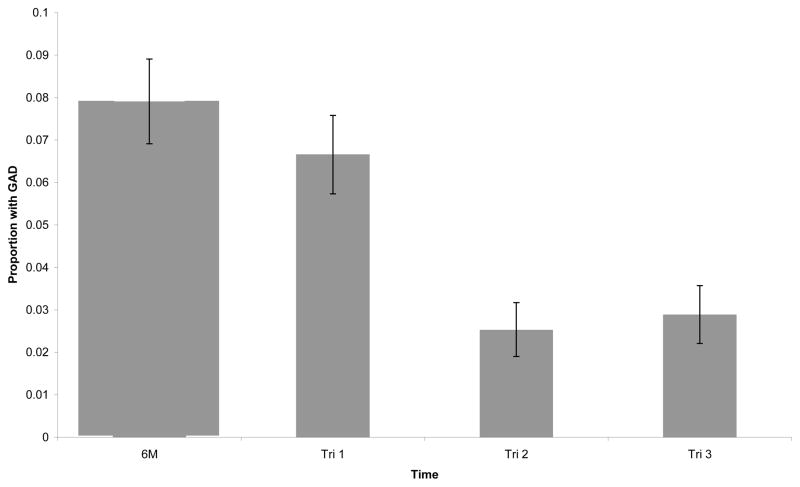
Results: 9.5% of the cohort suffered from GAD at some point in pregnancy. Anxiety symptoms were highest in the first trimester and decreased across pregnancy. Regression analysis revealed that previous GAD episodes, education, social support and a history of child abuse distinguished between membership in the four groups.
Limitations: The sample may not be representational, as it was enhanced with those at risk, and had relatively low representation of socio-economically disadvantaged women.
Conclusions: Identification of anxious patients during pregnancy may provide an opportunity to engage those in need of psychiatric treatment.
Copyright © 2011 Elsevier B.V. All rights reserved.
Conflict of interest statement
Anne Buist has received educational and travel grants from Astrazeneca in the previous three years
Kimberly Yonkers has received an investigator initiated grant from Lilly and study medication from Pfizer in the previous three years.
Nathan Gotman – no conflicts
Figures
References
-
- American Psychiatric Association, A. Diagnostic and Statistical Manual of Mental Disorders. 4. Washington, DC: American Psychiatric Association; 2000. Text Revision (DSM IV-TR)
-
- Andersson L, Sundstrom-Poromaa I, Wulff M, Astrom M, Bixo M, Andersson L, Sundstrom-Poromaa I, Wulff M, Astrom M, Bixo M. Depression and anxiety during pregnancy and six months postpartum: a follow-up study. Acta Obstetricia et Gynecologica Scandinavica. 2006;85(8):937–944. - PubMed
-
- Bifulco A, Figueiredo B, Guedeney N, Gorman LL, Hayes S, Muzik M, Glatigny-Dallay E, Valoriani V, Kammerer MH, Henshaw CA. Maternal attachment style and depression associated with childbirth: preliminary results from a European and US cross-cultural study. The British Journal of Psychiatry. 2004;184(46):s31–37. - PubMed
-
- Bowen A, Bowen R, Maslany G, Muhajarine N. Anxiety in a socially high-risk sample of pregnant women in Canada. Can J Psychiatry. 2008;53(7):435–440. - PubMed
-
- Buist A. Childhood abuse, postpartum depression and parenting difficulties: a literature review of associations. Aust N Z J Psychiatry. 1998;32(3):370–378. - PubMed
Publication types
MeSH terms
Grants and funding
LinkOut - more resources
Full Text Sources
Other Literature Sources
Medical
Miscellaneous
