


Sedentary activity associated with metabolic syndrome independent of physical activity
- PMID: 21270206
- PMCID: PMC3024375
- DOI: 10.2337/dc10-0987
Sedentary activity associated with metabolic syndrome independent of physical activity
Abstract
Objective: This study examined the association between objectively measured sedentary activity and metabolic syndrome among older adults.
Research design and methods: Data were from 1,367 men and women, aged ≥ 60 years who participated in the 2003-2006 National Health and Nutrition Examination Survey (NHANES). Sedentary time during waking hours was measured by an accelerometer (<100 counts per minute). A sedentary bout was defined as a period of time >5 min. A sedentary break was defined as an interruption in sedentary time (≥ 100 counts per minute). Metabolic syndrome was defined according to the Adult Treatment Panel (ATP) III criteria.
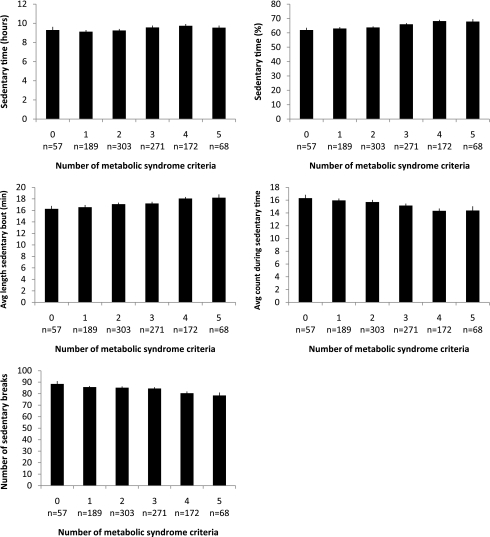
Results: On average, people spent 9.5 h (65% of wear time) as sedentary. Compared with people without metabolic syndrome, people with metabolic syndrome spent a greater percentage of time as sedentary (67.3 vs. 62.2%), had longer average sedentary bouts (17.7 vs. 16.7 min), had lower intensity during sedentary time (14.8 vs. 15.8 average counts per minute), and had fewer sedentary breaks (82.3 vs. 86.7), adjusted for age and sex (all P < 0.01). A higher percentage of time sedentary and fewer sedentary breaks were associated with a significantly greater likelihood of metabolic syndrome after adjustment for age, sex, ethnicity, education, alcohol consumption, smoking, BMI, diabetes, heart disease, and physical activity. The association between intensity during sedentary time and metabolic syndrome was borderline significant.
Conclusions: The proportion of sedentary time was strongly related to metabolic risk, independent of physical activity. Current results suggest older people may benefit from reducing total sedentary time and avoiding prolonged periods of sedentary time by increasing the number of breaks during sedentary time.
Figures
References
-
- Ervin RB. Prevalence of metabolic syndrome among adults 20 years of age and over, by sex, age, race and ethnicity, and body mass index: United States, 2003-2006 National Health Statistics Reports, No. 13, Hyattsville, MD, National Center for Health Statistics, May 5, 2009 (DHHS publ. no. 2009-1250) - PubMed
-
- Grundy SM, Cleeman JI, Daniels SR, et al. American Heart Association. National Heart, Lung, and Blood Institute Diagnosis and management of the metabolic syndrome. An American Heart Association/National Heart, Lung, and Blood Institute Scientific Statement. Executive summary. Cardiol Rev 2005;13:322–327 - PubMed
-
- Laaksonen DE, Lakka HM, Niskanen LK, Kaplan GA, Salonen JT, Lakka TA. Metabolic syndrome and development of diabetes mellitus: application and validation of recently suggested definitions of the metabolic syndrome in a prospective cohort study. Am J Epidemiol 2002;156:1070–1077 - PubMed
-
- McNeill AM, Katz R, Girman CJ, et al. Metabolic syndrome and cardiovascular disease in older people: the cardiovascular health study. J Am Geriatr Soc 2006;54:1317–1324 - PubMed
-
- Zhang WW, Liu CY, Wang YJ, Xu ZQ, Chen Y, Zhou HD. Metabolic syndrome increases the risk of stroke: a 5-year follow-up study in a Chinese population. J Neurol 2009;256:1493–1499 - PubMed
Publication types
MeSH terms
Grants and funding
LinkOut - more resources
Full Text Sources
Medical
