Review
. 2011 Feb;155A(2):270-9.
doi: 10.1002/ajmg.a.33702. Epub 2010 Dec 10.

Cranial neural crest cells on the move: their roles in craniofacial development

Affiliations
Review

Cranial neural crest cells on the move: their roles in craniofacial development

Dwight R Cordero et al. Am J Med Genet A. 2011 Feb.

Abstract

The craniofacial region is assembled through the active migration of cells and the rearrangement and sculpting of facial prominences and pharyngeal arches, which consequently make it particularly susceptible to a large number of birth defects. Genetic, molecular, and cellular processes must be temporally and spatially regulated to culminate in the three-dimension structures of the face. The starting constituent for the majority of skeletal and connective tissues in the face is a pluripotent population of cells, the cranial neural crest cells (NCCs). In this review we discuss the newest scientific findings in the development of the craniofacial complex as related to NCCs. Furthermore, we present recent findings on NCC diseases called neurocristopathies and, in doing so, provide clinicians with new tools for understanding a growing number of craniofacial genetic disorders.


Figures

FIGURE 1
FIGURE 1
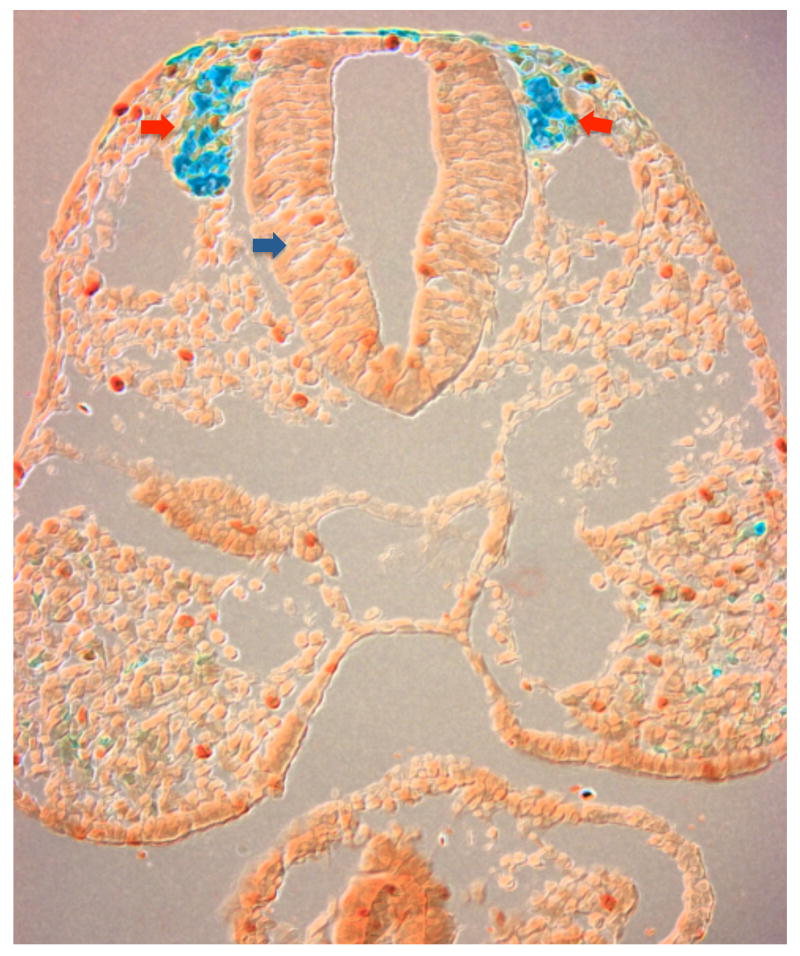
Coronal section of murine embryo revealing neural crest cells migrating (blue, red arrows) from the dorsal neural tube (blue arrow).
FIGURE 2
FIGURE 2
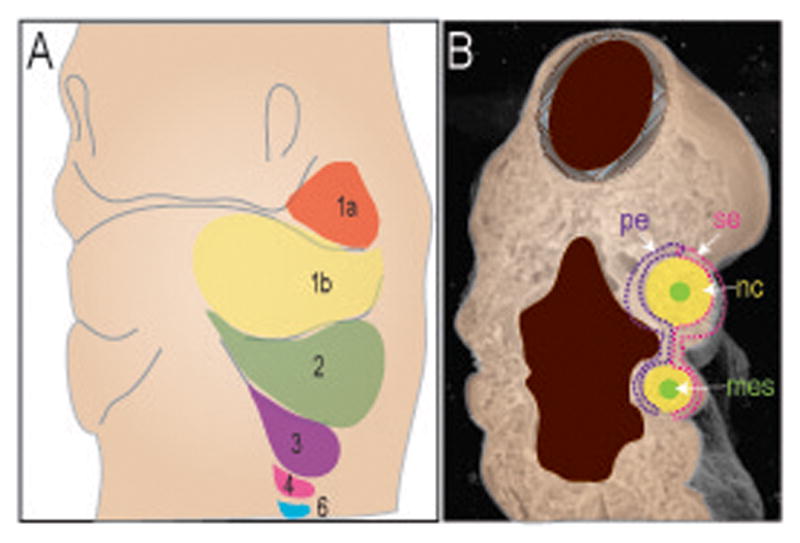
Schematic diagram of the pharyngeal arches. (A) The arches are indicated by different colors. The first arch is divided into maxillary (1a, orange) and mandibular (1b, yellow) component. The second arch (2, green); third arch (3, purple); forth arch (4, pink) and the residuals sixth arch (6, blue). B. Coronal cut through the embryo reveals the tissue contribution to each arch. The arches (1,2,3,4) are composed of a core of neural crest (nc, yellow) and mesoderm (mes, green) surrounded by both surface ectoderm (se, pink) and pharyngeal endoderm (pe, purple).

References

    1. Acloque H, Adams MS, Fishwick K, Bronner-Fraser M, Nieto MA. Epithelial-mesenchymal transitions: the importance of changing cell state in development and disease. J Clin Invest. 2009;119:1438–1449. - PMC - PubMed
    1. Anderson RM, Stottmann RW, Choi M, Klingensmith J. Endogenous bone morphogenetic protein antagonists regulate mammalian neural crest generation and survival. Dev Dyn. 2006;235:2507–2520. - PMC - PubMed
    1. Bajpai R, Chen DA, Rada-Iglesias A, Zhang J, Xiong Y, Helms J, Chang CP, Zhao Y, Swigut T, Wysocka J. CHD7 cooperates with PBAF to control multipotent neural crest formation. Nature. 2010;463:958–962. - PMC - PubMed
    1. Basch ML, Bronner-Fraser M. Neural crest inducing signals. Adv Exp Med Biol. 2006;589:24–31. - PubMed
    1. Basch ML, Bronner-Fraser M, Garcia-Castro MI. Specification of the neural crest occurs during gastrulation and requires Pax7. Nature. 2006;441:218–222. - PubMed

Publication types

MeSH terms