


Concomitant and antecedent deep venous thrombosis and cancer survival in male US veterans
- PMID: 21271864
- PMCID: PMC3138221
- DOI: 10.3109/10428194.2010.551572
Concomitant and antecedent deep venous thrombosis and cancer survival in male US veterans
Abstract
Survival is reportedly worse in patients with cancer concurrently diagnosed with deep venous thrombosis. However, information on specific malignancies is limited. From a cohort study of male US veterans we identified incident cancer cases (n = 412,008) and compared survival patterns among those with versus without a history of deep venous thrombosis. Using Cox proportional hazard models, we estimated hazard ratios (HRs) and 95% confidence intervals as measures of the relative risk of dying. Individuals with (versus without) a concomitant deep venous thrombosis and cancer diagnosis had a higher risk of dying (HR = 1.38; 1.28-1.49). The most prominent excess mortality (HR = 1.29-2.55) was observed among patients diagnosed with deep venous thrombosis at the time of diagnosis of lung, gastric, prostate, bladder, or kidney cancer. Increased risk of dying was also found among cancer patients diagnosed with deep venous thrombosis 1 year (HR = 1.14; 1.07-1.22), 1-5 years (HR = 1.14; 1.10-1.19), and >5 years (HR = 1.27; 1.23-1.31) before cancer; this was true for most cancer sites (HR = 1.17-1.64). In summary, antecedent deep venous thrombosis confers a worse prognosis upon cancer patients. Advanced stage at diagnosis, treatment effects, lifestyle factors, and comorbidity could explain differences by cancer site and time frame between a prior deep venous thrombosis diagnosis and cancer outcome.
Conflict of interest statement
Figures
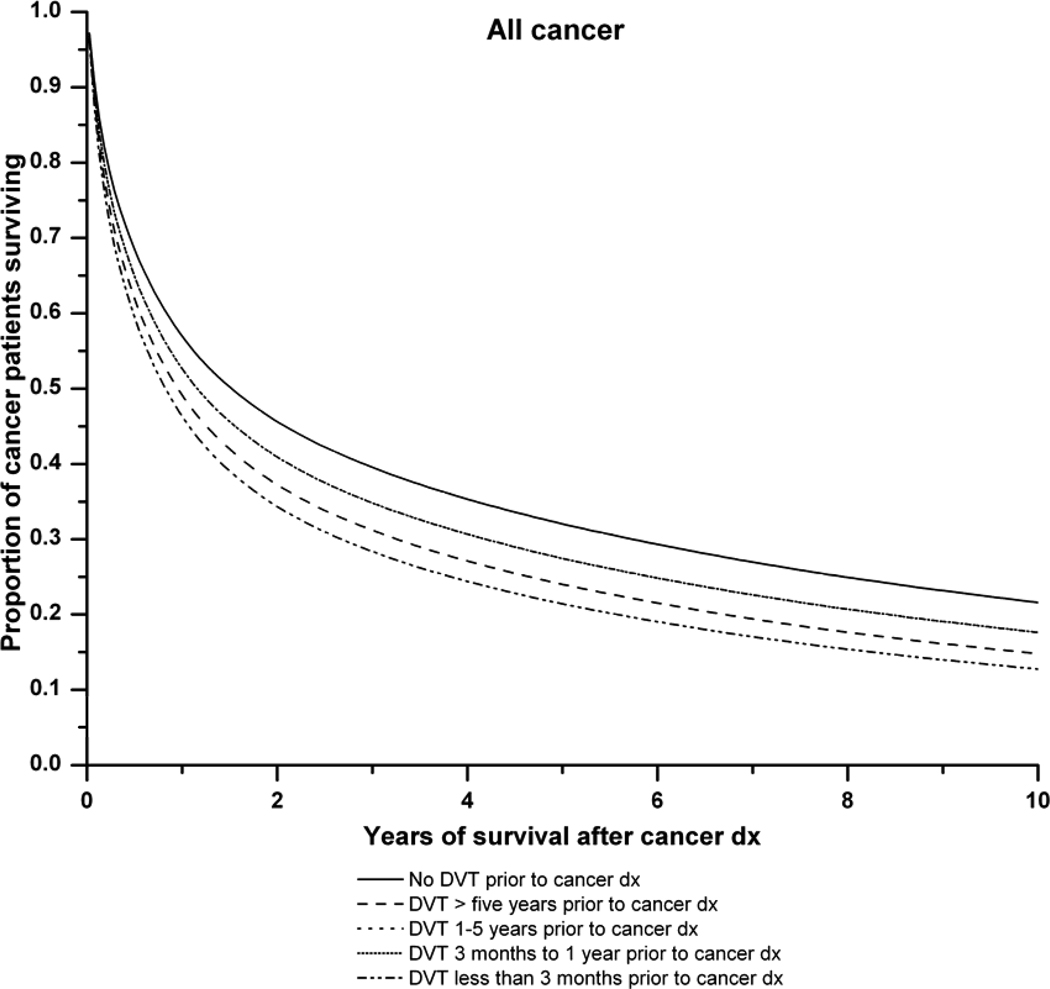
 ), DVT 1–5 years before cancer diagnosis (
 ), DVT 1 year before cancer diagnosis (
 ) and DVT at cancer diagnosis (
 ). The lines for DVT 1–5 years before cancer diagnosis and DVT 1 year before cancer diagnosis are superimposed. P-value (likelihood ratio test) for difference in survival according to pre-existing DVT status: P<0.0001. B: Survival curves for lung cancer patients with, and without, a history of deep venous thrombosis (DVT). Adjusted survival curves are presented. The solid line represents lung cancer patients with no history of DVT. The dashed lines represent lung cancer patients with: DVT more than 5 years prior to cancer diagnosis (), DVT 1–5 years before cancer diagnosis (), DVT 1 year before cancer diagnosis () and DVT at cancer diagnosis (). P-value (likelihood ratio test) for difference in survival according to pre-existing DVT status: P<0.0001. C: Survival curves for colorectal cancer patients with, and without, a history of deep venous thrombosis (DVT). Adjusted survival curves are presented. The solid line represents colorectal cancer patients with no history of DVT. The dashed lines represent colorectal cancer patients with: DVT more than 5 years prior to cancer diagnosis (), DVT 1–5 years before cancer diagnosis (), DVT 1 year before cancer diagnosis () and DVT at cancer diagnosis (). P-value (likelihood ratio test) for difference in survival according to pre-existing DVT status: P<0.0001. D: Survival curves for prostate cancer patients with, and without, a history of deep venous thrombosis (DVT). Adjusted survival curves are presented. The solid line represents prostate cancer patients with no family of DVT. The dashed lines represent prostate cancer patients with: DVT more than 5 years prior to cancer diagnosis (), DVT 1–5 years before cancer diagnosis (), DVT 1 year before cancer diagnosis () and DVT at cancer diagnosis (P-value (likelihood ratio test) for difference in survival according to pre-existing DVT status: P<0.0001.
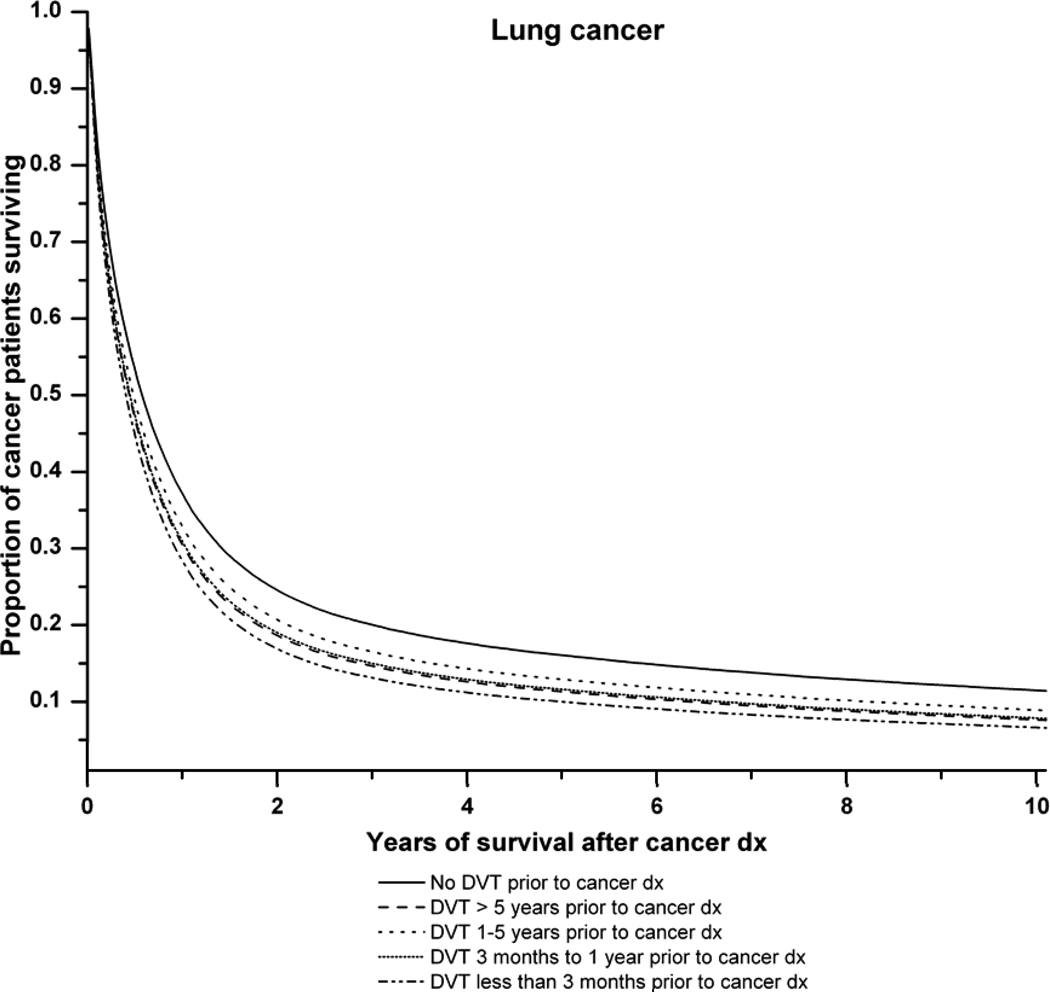 ), DVT 1–5 years before cancer diagnosis (), DVT 1 year before cancer diagnosis () and DVT at cancer diagnosis (). The lines for DVT 1–5 years before cancer diagnosis and DVT 1 year before cancer diagnosis are superimposed. P-value (likelihood ratio test) for difference in survival according to pre-existing DVT status: P<0.0001. B: Survival curves for lung cancer patients with, and without, a history of deep venous thrombosis (DVT). Adjusted survival curves are presented. The solid line represents lung cancer patients with no history of DVT. The dashed lines represent lung cancer patients with: DVT more than 5 years prior to cancer diagnosis (), DVT 1–5 years before cancer diagnosis (), DVT 1 year before cancer diagnosis () and DVT at cancer diagnosis (). P-value (likelihood ratio test) for difference in survival according to pre-existing DVT status: P<0.0001. C: Survival curves for colorectal cancer patients with, and without, a history of deep venous thrombosis (DVT). Adjusted survival curves are presented. The solid line represents colorectal cancer patients with no history of DVT. The dashed lines represent colorectal cancer patients with: DVT more than 5 years prior to cancer diagnosis (), DVT 1–5 years before cancer diagnosis (), DVT 1 year before cancer diagnosis () and DVT at cancer diagnosis (). P-value (likelihood ratio test) for difference in survival according to pre-existing DVT status: P<0.0001. D: Survival curves for prostate cancer patients with, and without, a history of deep venous thrombosis (DVT). Adjusted survival curves are presented. The solid line represents prostate cancer patients with no family of DVT. The dashed lines represent prostate cancer patients with: DVT more than 5 years prior to cancer diagnosis (), DVT 1–5 years before cancer diagnosis (), DVT 1 year before cancer diagnosis () and DVT at cancer diagnosis (P-value (likelihood ratio test) for difference in survival according to pre-existing DVT status: P<0.0001.
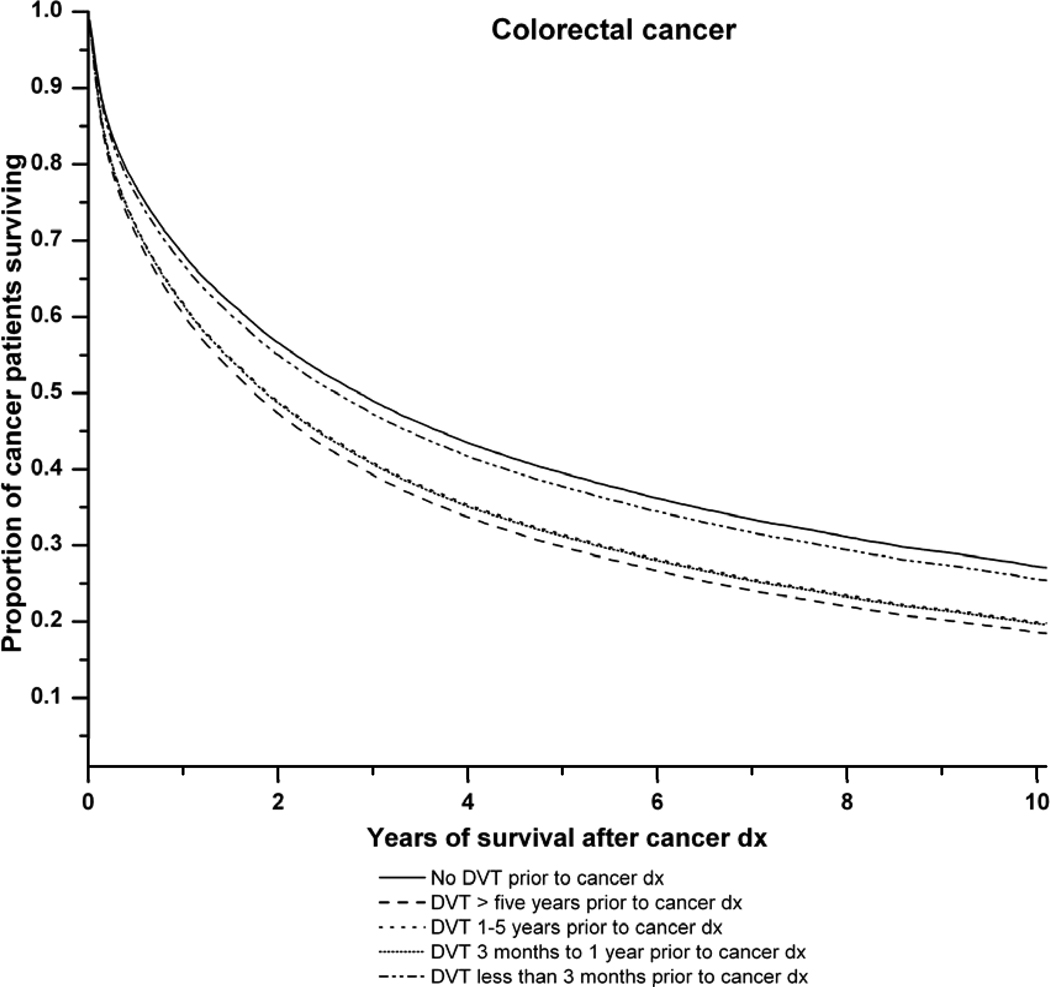 ), DVT 1–5 years before cancer diagnosis (), DVT 1 year before cancer diagnosis () and DVT at cancer diagnosis (). The lines for DVT 1–5 years before cancer diagnosis and DVT 1 year before cancer diagnosis are superimposed. P-value (likelihood ratio test) for difference in survival according to pre-existing DVT status: P<0.0001. B: Survival curves for lung cancer patients with, and without, a history of deep venous thrombosis (DVT). Adjusted survival curves are presented. The solid line represents lung cancer patients with no history of DVT. The dashed lines represent lung cancer patients with: DVT more than 5 years prior to cancer diagnosis (), DVT 1–5 years before cancer diagnosis (), DVT 1 year before cancer diagnosis () and DVT at cancer diagnosis (). P-value (likelihood ratio test) for difference in survival according to pre-existing DVT status: P<0.0001. C: Survival curves for colorectal cancer patients with, and without, a history of deep venous thrombosis (DVT). Adjusted survival curves are presented. The solid line represents colorectal cancer patients with no history of DVT. The dashed lines represent colorectal cancer patients with: DVT more than 5 years prior to cancer diagnosis (), DVT 1–5 years before cancer diagnosis (), DVT 1 year before cancer diagnosis () and DVT at cancer diagnosis (). P-value (likelihood ratio test) for difference in survival according to pre-existing DVT status: P<0.0001. D: Survival curves for prostate cancer patients with, and without, a history of deep venous thrombosis (DVT). Adjusted survival curves are presented. The solid line represents prostate cancer patients with no family of DVT. The dashed lines represent prostate cancer patients with: DVT more than 5 years prior to cancer diagnosis (), DVT 1–5 years before cancer diagnosis (), DVT 1 year before cancer diagnosis () and DVT at cancer diagnosis (P-value (likelihood ratio test) for difference in survival according to pre-existing DVT status: P<0.0001.
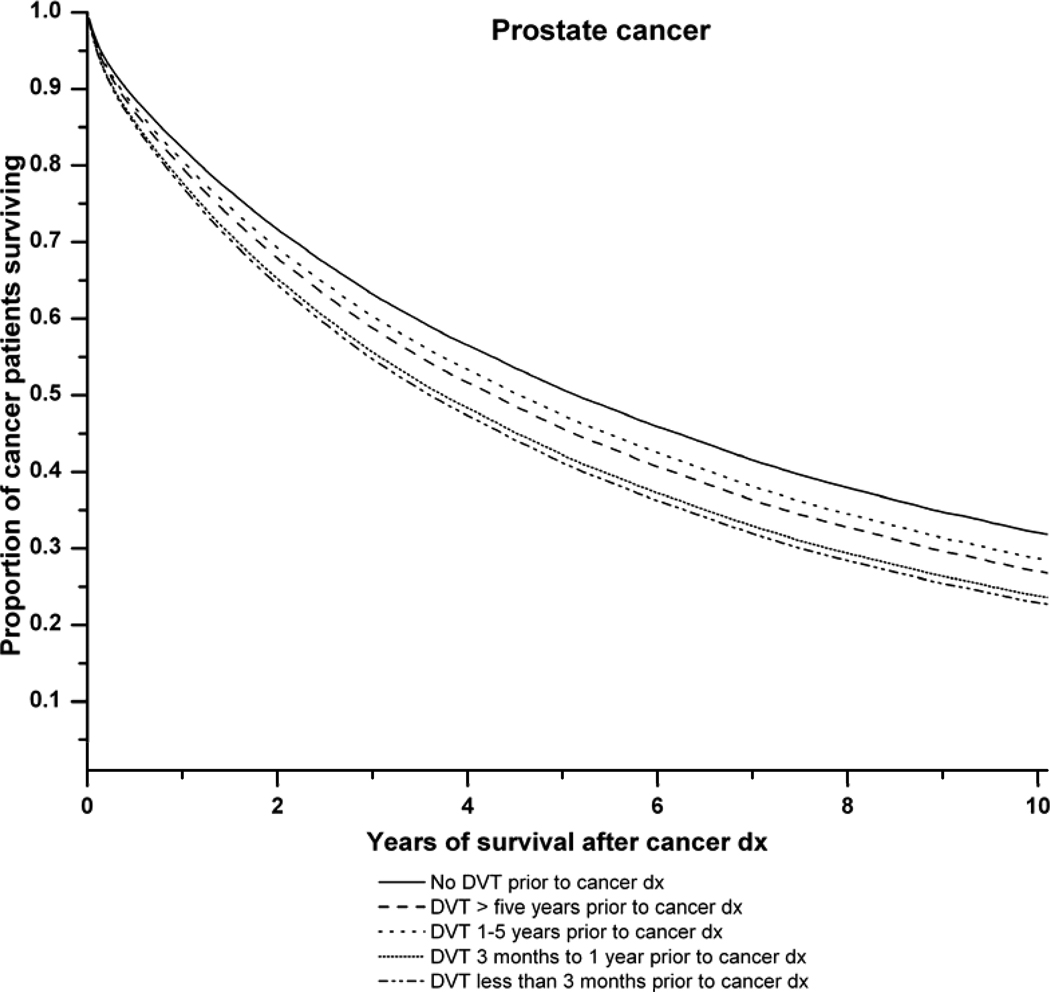 ), DVT 1–5 years before cancer diagnosis (), DVT 1 year before cancer diagnosis () and DVT at cancer diagnosis (). The lines for DVT 1–5 years before cancer diagnosis and DVT 1 year before cancer diagnosis are superimposed. P-value (likelihood ratio test) for difference in survival according to pre-existing DVT status: P<0.0001. B: Survival curves for lung cancer patients with, and without, a history of deep venous thrombosis (DVT). Adjusted survival curves are presented. The solid line represents lung cancer patients with no history of DVT. The dashed lines represent lung cancer patients with: DVT more than 5 years prior to cancer diagnosis (), DVT 1–5 years before cancer diagnosis (), DVT 1 year before cancer diagnosis () and DVT at cancer diagnosis (). P-value (likelihood ratio test) for difference in survival according to pre-existing DVT status: P<0.0001. C: Survival curves for colorectal cancer patients with, and without, a history of deep venous thrombosis (DVT). Adjusted survival curves are presented. The solid line represents colorectal cancer patients with no history of DVT. The dashed lines represent colorectal cancer patients with: DVT more than 5 years prior to cancer diagnosis (), DVT 1–5 years before cancer diagnosis (), DVT 1 year before cancer diagnosis () and DVT at cancer diagnosis (). P-value (likelihood ratio test) for difference in survival according to pre-existing DVT status: P<0.0001. D: Survival curves for prostate cancer patients with, and without, a history of deep venous thrombosis (DVT). Adjusted survival curves are presented. The solid line represents prostate cancer patients with no family of DVT. The dashed lines represent prostate cancer patients with: DVT more than 5 years prior to cancer diagnosis (), DVT 1–5 years before cancer diagnosis (), DVT 1 year before cancer diagnosis () and DVT at cancer diagnosis (P-value (likelihood ratio test) for difference in survival according to pre-existing DVT status: P<0.0001.
Comment in
-
The association of cancer and venous thrombosis: yes, Trousseau is right...again!Leuk Lymphoma. 2011 May;52(5):734-5. doi: 10.3109/10428194.2011.560311. Epub 2011 Apr 4. Leuk Lymphoma. 2011. PMID: 21463126 No abstract available.
References
-
- Stein PD, Beemath A, Olson RE. Trends in the incidence of pulmonary embolism and deep venous thrombosis in hospitalized patients. Am J Cardiol. 2005;95:1525–1526. - PubMed
-
- Green KB, Silverstein RL. Hypercoagulability in cancer. Hematol Oncol Clin North Am. 1996;10(2):499–530. - PubMed
-
- Donati MB. Cancer and thrombosis. Haemostasis. 1994;24(2):128–131. - PubMed
-
- White RH, Chew HK, Zhou H, Parikh-Patel A, Harris D, Harvey D, Wun T. Incidence of venous thromboembolism in the year before the diagnosis of cancer in 528,693 adults. Arch Intern Med. 2005;165(15):1782–1787. - PubMed
Publication types
MeSH terms
Grants and funding
LinkOut - more resources
Full Text Sources
Medical
