Meta-Analysis
. 2011 Apr 15;20(8):1660-71.
doi: 10.1093/hmg/ddr035. Epub 2011 Jan 27.

Genome-wide association analysis and fine mapping of NT-proBNP level provide novel insight into the role of the MTHFR-CLCN6-NPPA-NPPB gene cluster

Affiliations
Meta-Analysis

Genome-wide association analysis and fine mapping of NT-proBNP level provide novel insight into the role of the MTHFR-CLCN6-NPPA-NPPB gene cluster

Fabiola Del Greco M et al. Hum Mol Genet. .

Abstract

High blood concentration of the N-terminal cleavage product of the B-type natriuretic peptide (NT-proBNP) is strongly associated with cardiac dysfunction and is increasingly used for heart failure diagnosis. To identify genetic variants associated with NT-proBNP level, we performed a genome-wide association analysis in 1325 individuals from South Tyrol, Italy, and followed up the most significant results in 1746 individuals from two German population-based studies. A genome-wide significant signal in the MTHFR-CLCN6-NPPA-NPPB gene cluster was replicated, after correction for multiple testing (replication one-sided P-value = 8.4 × 10(-10)). A conditional regression analysis of 128 single-nucleotide polymorphisms in the region of interest identified novel variants in the CLCN6 gene as independently associated with NT-proBNP. In this locus, four haplotypes were associated with increased NT-proBNP levels (haplotype-specific combined P-values from 8.3 × 10(-03) to 9.3 × 10(-11)). The observed increase in the NT-proBNP level was proportional to the number of haplotype copies present (i.e. dosage effect), with an increase associated with two copies that varied between 20 and 100 pg/ml across populations. The identification of novel variants in the MTHFR-CLCN6-NPPA-NPPB cluster provides new insights into the biological mechanisms of cardiac dysfunction.


Figures
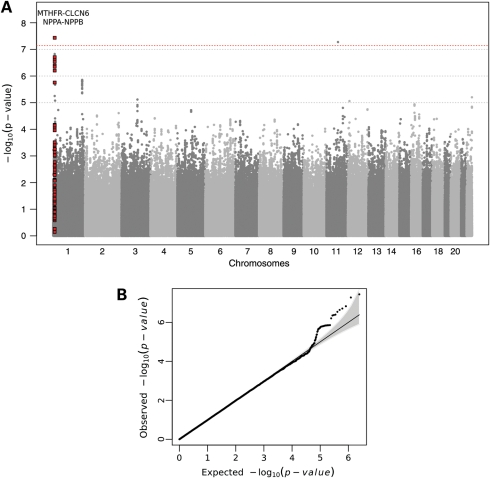
Figure 1.
Figure 1.
(A) Manhattan plot of the results of the GWA analysis in the MICROS study. The locus marked in red satisfied the replication criterion. (B) The QQ plot in the upper-right corner compares expected versus observed –log10(P-value) for all 2.5 million SNPs included in the GWA analysis, with the dashed line corresponding to the null hypothesis of no association.
Figure 2.
Figure 2.
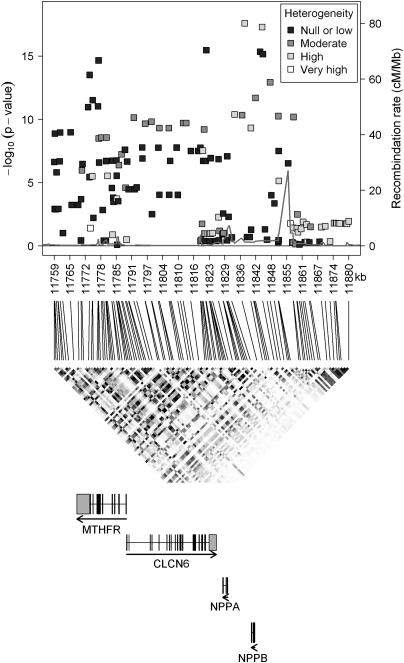
Results of the inverse-variance-weighted fixed-effect meta-analysis of the discovery and replication studies (combined analysis) on the MTHFR-CLCN6-NPPA-NPPB gene cluster on chromosome 1. Upper panel: Plot of –log10(P-values) against SNP physical position; the density of the colouring indicates the between-study heterogeneity of the effect size estimates, based on the I2 statistics. Heterogeneity is classified into four categories: null or low (I2≤ 25%), moderate (25% < I2≤ 50%), high (50% < I2≤ 75%) and very high (I2> 75%) (44). The recombination intensity was estimated from phased haplotypes in HapMap Release 22 (NCBI build 36) (45), and is reported as a light-grey line. Middle panel: LD (r2) in the HapMap-CEU population Release 22 (NCBI build 36). Colours vary between white (r2= 0) and black (r2= 1). Lower panel: Structure of the four genes in the locus according to the UCSC Table browser (46), which is based on NCBI build 36. This graph was in part created using utilities from the SNAP software (47).
Figure 3.
Figure 3.
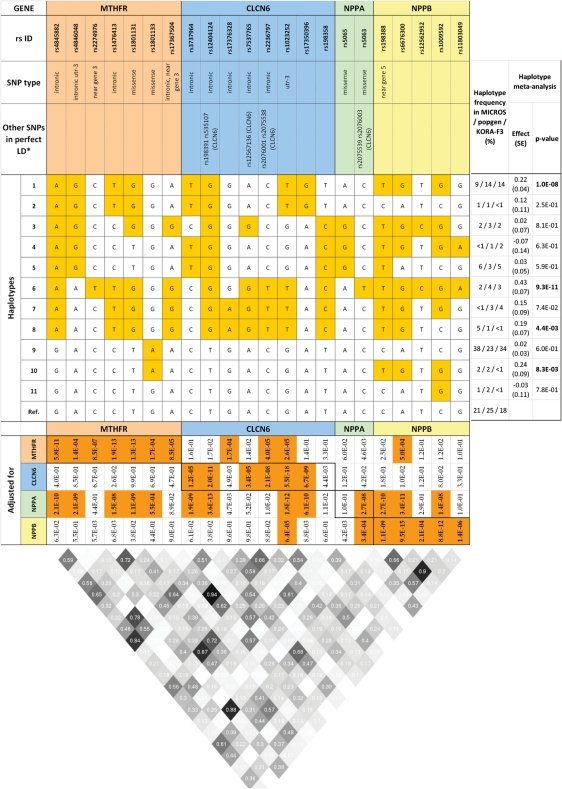
Haplotype distribution of the 22 SNPs selected for haplotype analysis of the MTHFR-CLCN6-NPPA-NPPB gene cluster. Different colours were used to distinguish the four genes. In the ‘haplotype' panel, alleles that differ from the reference haplotype alleles are highlighted in yellow. In the ‘adjusted for' panel, the P-values of the conditional association analysis are reported. Significant associations (P-values ≤ 0.003, see Materials and Methods) are highlighted in bold on an orange background. In the diagonal cells, results of the unadjusted association between NT-proBNP and the SNP in the relative column are reported. Out of the diagonal, results from conditional analyses are reported, where association at each particular variant is adjusted for SNPs in the gene indicated on the left side of the figure. In the right panel, study-specific haplotype frequencies and results of the haplotype association analysis are reported, with significant P-values given in bold. In the bottom panel, the LD structure (r2) for the three studies is reported.
Figure 4.
Figure 4.
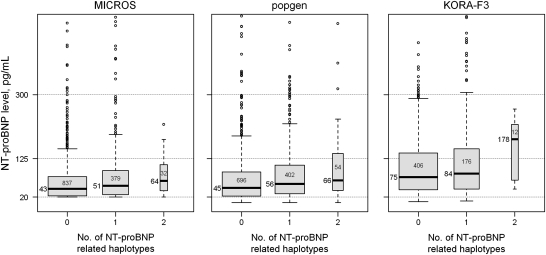
Study-specific distribution of (untransformed) NT-proBNP levels by number of significantly associated haplotypes, carried by the subject. 0: no copies; 1, 2: one or two copies of any significant haplotype. The number of individuals per category is indicated within the boxes; the median NT-proBNP level (pg/ml) is reported close to the black horizontal line in the middle of the box.

References

    1. Nakagawa O., Ogawa Y., Itoh H., Suga S., Komatsu Y., Kishimoto I., Nishino K., Yoshimasa T., Nakao K. Rapid transcriptional activation and early mRNA turnover of brain natriuretic peptide in cardiocyte hypertrophy. Evidence for brain natriuretic peptide as an emergency cardiac hormone against ventricular overload. J. Clin. Invest. 1995;96:1280–1287. - PMC - PubMed
    1. de Bold A.J., Ma K.K., Zhang Y., de Bold M.L., Bensimon M., Khoshbaten A. The physiological and pathophysiological modulation of the endocrine function of the heart. Can. J. Physiol. Pharmacol. 2001;79:705–714. - PubMed
    1. Clerico A., Emdin M. Diagnostic accuracy and prognostic relevance of the measurement of the cardiac natriuretic peptides: a review. Clin. Chem. 2004;50:33–50. - PubMed
    1. Jortani S.A., Prabhu S.D., Valdes R., Jr. Strategies for developing biomarkers of heart failure. Clin. Chem. 2004;50:265–278. - PubMed
    1. Mueller T., Gegenhuber A., Poelz W., Haltmayer M. Head-to-head comparison of the diagnostic utility of BNP and NT-proBNP in symptomatic and asymptomatic structural heart disease. Clin. Chim. Acta. 2004;341:41–48. - PubMed

Publication types

MeSH terms