


Association of necrotizing enterocolitis with anemia and packed red blood cell transfusions in preterm infants
- PMID: 21273983
- PMCID: PMC3234132
- DOI: 10.1038/jp.2010.145
Association of necrotizing enterocolitis with anemia and packed red blood cell transfusions in preterm infants
Abstract
Objective: To determine association of anemia and red blood cell (RBC) transfusions with necrotizing enterocolitis (NEC) in preterm infants.
Study design: A total of 111 preterm infants with NEC ≥ stage 2a were compared with 222 matched controls. In all, 28 clinical variables, including hematocrit (Hct) and RBC transfusions were recorded. Propensity scores and multivariate logistic regression models were created to examine effects on the risk of NEC.
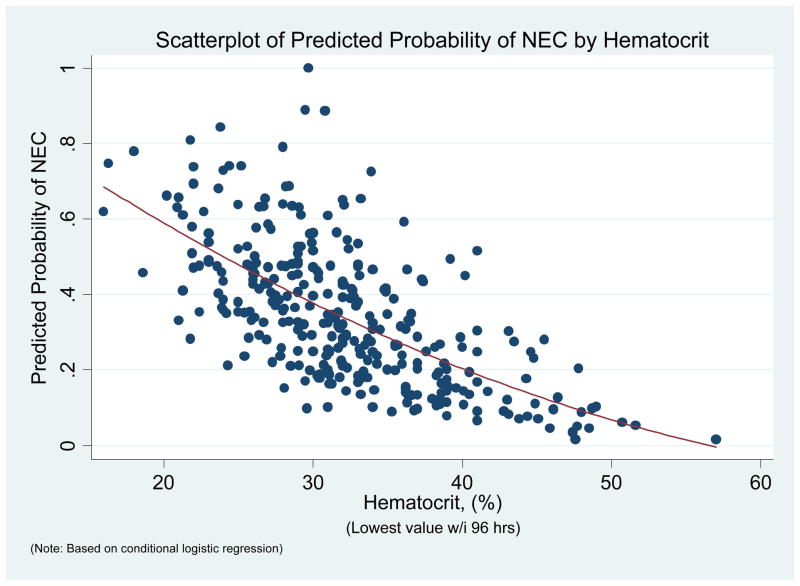
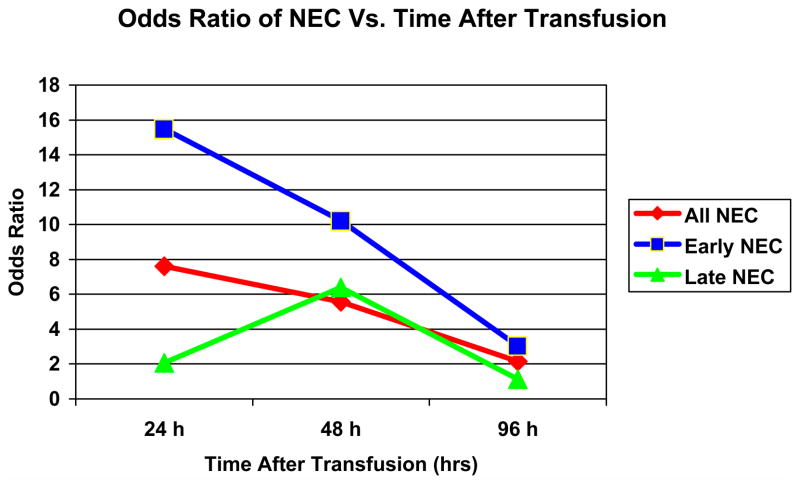
Result: Controlling for other factors, lower Hct was associated with increased odds of NEC (odds ratio (OR)=1.10, P=0.01). RBC transfusion has a temporal relationship with NEC onset. Transfusion within 24 h (OR=7.60, P=0.001) and 48 h (OR=5.55, P=0.001) has a higher odds of developing NEC but this association is not significant by 96 h (OR=2.13, P=0.07), post-transfusion.
Conclusion: Anemia may increase the risk of developing NEC in preterm infants. RBC transfusions are temporally related to NEC. Prospective studies are needed to better evaluate the potential influence of transfusions on the development of NEC.
Conflict of interest statement
Figures
References
-
- Luig M, Lui K. Epidemiology of necrotizing enterocolitis-Part II: Risk and susceptibility of premature infants during the surfactant era: regional study. J Paediatr Child Health. 2005;41(4):174–79. - PubMed
-
- Kafetzis DA, Skevaki C, Costalos C. Neonatal necrotizing enterocolitis: an overview. Curr Opinions in Infectious Disease. 2003 Aug;16(4):349–55. - PubMed
-
- Kennedy KA, Tyson JE, Chamnanvanakij S. Rapid versus slow rate of advancement of feedings for promoting growth and preventing necrotizing enterocolitis in parenterally fed low-birth-weight infants. Cochrane Database Syst Rev. 2000;(2):CD001241. - PubMed
Publication types
MeSH terms
Grants and funding
LinkOut - more resources
Full Text Sources
Other Literature Sources
Medical
