Review
. 2011 Apr;11(2):146-62.
doi: 10.1007/s11882-011-0180-0.

Actual concepts in rhinosinusitis: a review of clinical presentations, inflammatory pathways, cytokine profiles, remodeling, and management

Affiliations
Review

Actual concepts in rhinosinusitis: a review of clinical presentations, inflammatory pathways, cytokine profiles, remodeling, and management

Philippe Eloy et al. Curr Allergy Asthma Rep. 2011 Apr.

Abstract

Rhinosinusitis (RS) is a heterogeneous group of diseases. It is a significant and increasing health problem that affects about 15% of the population in Western countries. It has a substantial impact on patients' health-related quality of life and daily functioning and represents a huge financial burden to society and the health care system as a result of the direct and indirect costs. In addition, RS is not well-understood, and little is known about the etiology and pathophysiology. In the past decade, many papers have been published that have changed our understanding of RS. RS is commonly classified into acute and chronic RS based on symptom duration. In acute RS, an inflammatory reaction initiated by a viral infection characterizes most uncomplicated, mild to moderate cases. Therefore, the first line of treatment for these cases are intranasal steroids and not antibiotics. In severe and complicated cases, antibiotics combined with topical steroids remain the treatment of choice. On the other hand, chronic RS is actually subdivided into two distinct entities (chronic rhinosinusitis with and without polyps), as growing evidence indicates that these entities have specific inflammatory pathways and cytokine profiles. The authors review recent data regarding the clinical presentations, cytokine profiles, tissue remodeling, and modalities of treatment for each form of RS.


Figures
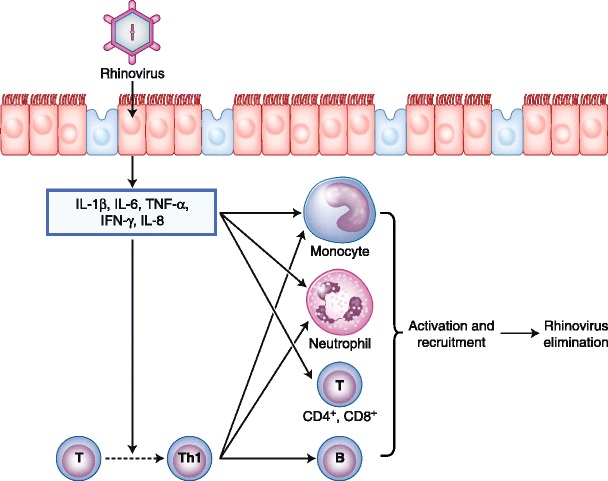
Fig. 1
Fig. 1
Schematic of the inflammatory cascade in the case of a rhinovirus infection. IFN—interferon; IL—interleukin; Th1—T-helper type 1; TNF—tumor necrosis factor
Fig. 2
Fig. 2
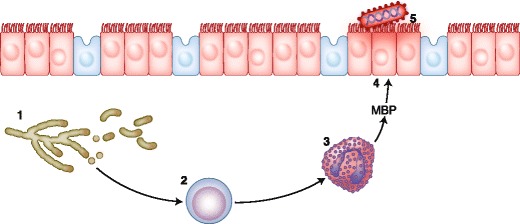
Role of fungi in chronic rhinosinusitis. Fungi (1) elicit an inflammatory response by lymphocytes (2). The lymphocytes then trigger the release of major basic protein (MBP, 4) by eosinophils (3). The MBP is normally synthesized to destroy foreign agents such as viruses or parasites. In this case, the MBP causes ulcers in the mucus membrane (5) of the nose and sinuses, giving rise to bacterial sinusitis. (Adapted from Ponikau et al. [32])
Fig. 3
Fig. 3
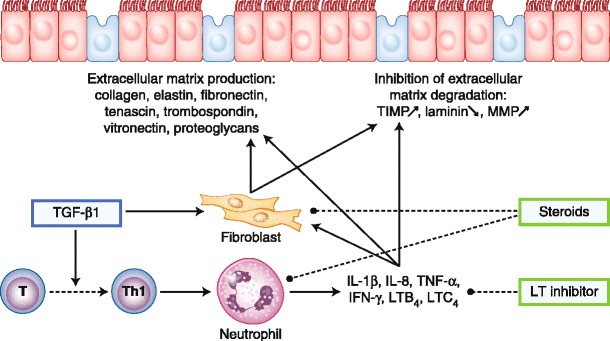
Inflammation mediators and tissue remodeling in chronic rhinosinusitis (CRS) without polyps. Transforming growth factor (TGF)-β1 is thought to play a critical role in the development of CRS without polyps. TGF-β1 stimulates fibroblast proliferation and collagen deposition and inhibits matrix metalloproteinases (MMPs) by enhancing tissue inhibitor of metalloproteinases (TIMP). IFN—interferon; IL—interleukin; LT—leukotriene; Th1—T-helper type 1; TNF—tumor necrosis factor
Fig. 4
Fig. 4
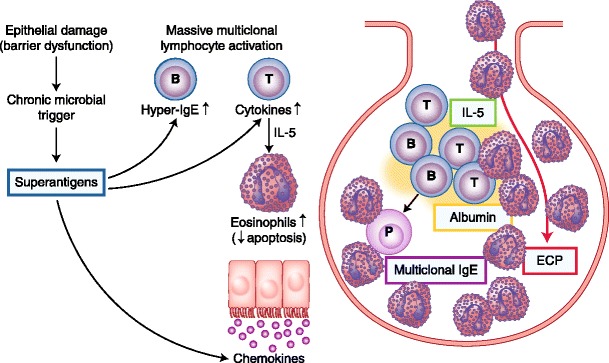
Possible role of enterotoxins producing Staphylococcus aureus in the pathophysiology of nasal polyps. Enterotoxins from S. aureus act locally as superantigens on T lymphocytes and induce a multiclonal B-cell activation. Release of cytokines (interleukin [IL]-5) from T-helper type 2 cells results in an eosinophilic activation with release of eosinophilic cationic protein (ECP). ECP causes tissue damage, edema formation, and albumin accumulation. B-cell activation will result in the production of multiclonal IgE by plasma. In contrast, in patients with chronic rhinosinusitis without polyps, there is no evidence of increased prevalence of enterotoxin-specific IgE antibodies. (Adapted from Van Zele et al. [31], Verbruggen et al. [85], Bachert et al. [86], Gevaert et al. [87], and Perez-Novo et al. [91])
Fig. 5
Fig. 5
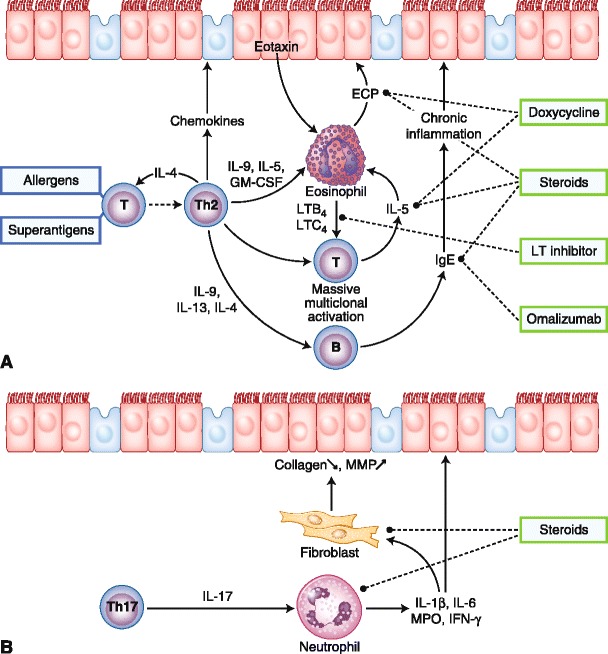
Putative mechanisms, cells, and mediators implied in white patients with chronic rhinosinusitis (CRS) with polyps (a) and polyps of Chinese patients (b). Treatments are indicated in the frames. In white patients, nasal polyposis is thought to be orchestrated by T-helper type 2 (Th2) cells, with interleukin (IL)-5 as the major cytokine. IL-5 has a critical role in the activation of eosinophils and the production of IgE. Steroids, anti-leukotrienes (LTs), antihistamines, and anti-IgE (omalizumab) may inhibit polyps disease at different levels. Downregulation of transforming growth factor (TGF)-β is observed in Asian and white individuals with nasal polyps. The predominant T-effector cell in Asian patients is the Th17 cell, which secretes IL-17, resulting in a predominance of neutrophils. Inflammation mediators and tissue remodeling in CRS without polyps are shown. TGF-β is thought to play a critical role in the development of CRS without polyps. TGF-β stimulates fibroblast proliferation and collagen deposition and inhibits matrix metalloproteinases (MMPs) by enhancing tissue inhibitor of metalloproteinases. ECP—eosinophil cationic protein; GM-CSF—granulocyte-macrophage colony-stimulating factor; IFN—interferon; MPO—myeloperoxidase

References

    1. Fokkens WJ, Lund VJ, Mullol J, et al. European position paper on nasal polyps. Rhinology. 2007;45(suppl. 20):1–139. - PubMed
    1. Vancauwenberge P, Watelet JB. Epidemiology of chronic rhinosinusitis. Thorax. 2000;55(Suppl 2):S20–1. doi: 10.1136/thorax.55.suppl_2.S20. - DOI - PMC - PubMed
    1. Hadley J, Sharp BS, Denman D, Puumala S, Leopold DA. Treatment of acute and chronic rhinosinusitis in the United States, 1999–2002. Arch Otolaryngol Head Neck Surg. 2007;133(3):260–5. doi: 10.1001/archotol.133.3.260. - DOI - PubMed
    1. Benson V, Marano MA. Current estimates from the National Health Interview Survey, 1992. Vital Health Stat. 1994;10(189):1–269. - PubMed
    1. Bachert C, Meltzer EO. Effect of mometasone furoate nasal spray on quality of life of patients with acute rhinosinusitis. Rhinology. 2007;45:190–6. - PubMed