


Cellular thermotolerance is associated with heat shock protein 70.1 genetic polymorphisms in Holstein lactating cows
- PMID: 21274669
- PMCID: PMC3118824
- DOI: 10.1007/s12192-011-0257-7
Cellular thermotolerance is associated with heat shock protein 70.1 genetic polymorphisms in Holstein lactating cows
Abstract
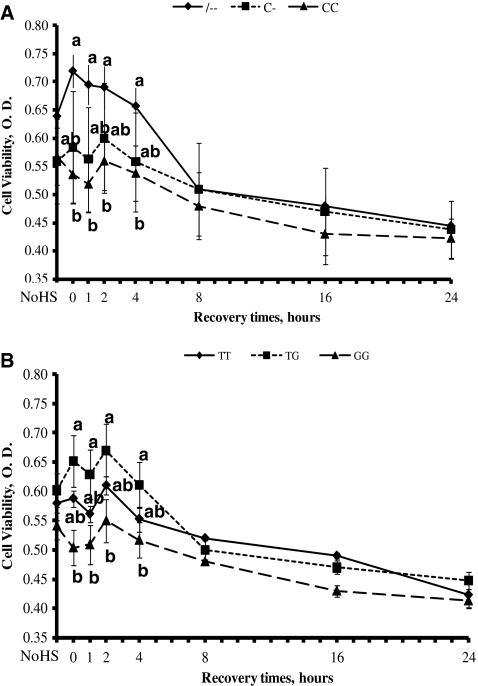
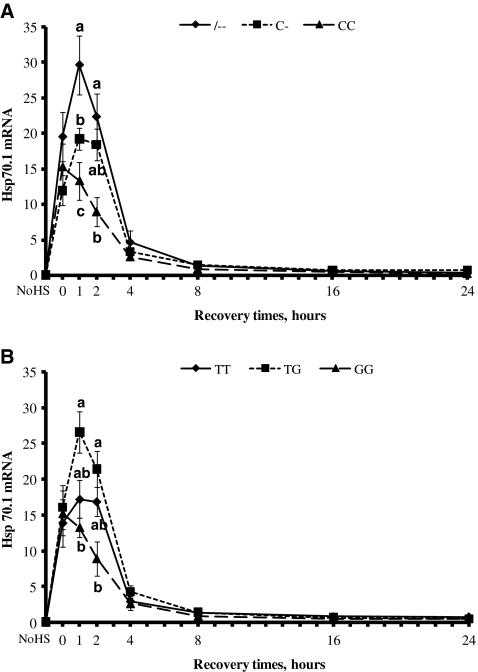
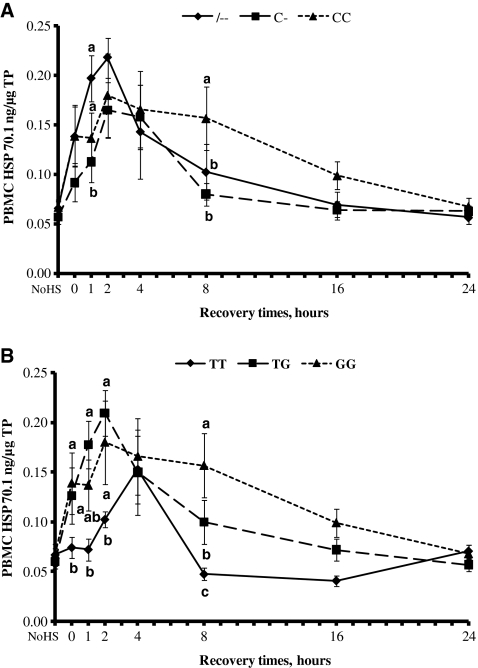
Heat shock proteins (Hsp) are known to protect cells from several stressors. Nucleotide changes in the flanking regions [5'- and 3'-untranslated region (UTR)] of Hsp gene might affect inducibility, degree of expression, or stability of Hsp70 mRNA. The present study aimed to investigate the association between inducible Hsp70.1 single nucleotide polymorphisms (SNPs) and heat shock (HS) response of peripheral blood mononuclear cells (PBMC) in dairy cows. Four hundred forty-six Italian Holstein cows were genotyped for four Hsp70.1 SNPs: g895 C/- and g1128 G/T in 5'-UTR, and g2154 G/A and g64 G/T in 3'-UTR. Genetic polymorphisms in 3'-UTR of bovine Hsp70.1 gene resulted monomorphic. Distribution of alleles of the nucleotide sequence polymorphism within the 5'-UTR of the bovine Hsp70.1 gene were 81.2% and 18.8% for C and -, respectively, and 77.8% and 22.2% for G and T, respectively. Among the 446 genotyped animals, a group of cows balanced for days in milk and parity was selected to be representative of the following genotypes: CC (n = 8), C- (n = 7), and -- (n = 7) and GG (n = 8), GT (n = 11), and TT (n = 3) in 5'-UTR. PBMC were isolated from blood samples and heated at 43°C in thermal bath for 1 h and then incubated at 39°C in atmosphere of 5% CO(2) for 1, 2, 4, 8, 16, and 24 h (recovery times). Cell viability was determined by XTT assay. Gene and protein expression of Hsp70.1 was determined by real-time reverse transcription-polymerase chain reaction and by ELISA assay, respectively. For the two SNPs detected, one allele was the most frequent (C, 66.8% and G, 56.8%). Genotypes -- and TG showed higher (P < 0.05) viability compared with CC and GG, respectively. Genotypes C- and TT had intermediate viability. Gene expression of Hsp70.1 showed higher (P < 0.001) levels in -- and TG genotype compared with their counterparts. Genotypes -- and TG showed the higher level of inducible Hsp70.1 protein in respect to C-, TT and CC, GG. In conclusion, exposure to HS differently affected cell viability and gene and protein expression of Hsp70.1 in the selected genotypes. These results indicate that the presence of SNPs (C/- and G/T) in the 5'-UTR region of inducible Hsp70.1 ameliorates HS response and tolerance to heat of bovine PBMC. These mutation sites may be useful as molecular genetic markers to assist selection for heat tolerance.
Figures
References
-
- Banks A, Looper ML, Reiter S, Starkey L, Flores R, Hallford D, Rosenkrans C., Jr Identification of single nucleotide polymorphisms within the promoter region of the bovine heat shock protein 70 gene and associations with pregnancy. Am Soc Anim Sci South Sect Meet. 2007;85(Suppl. 2):10.
-
- Beckham JT, Mackanos MA, Crooke C, Takahashi T, O'Connell-Rodwell C, Contag CH, Jansen ED. Assessment of cellular response to thermal laser injury through bioluminescence imaging of heat shock protein 70. Photochem Photobiol. 2004;79:76–85. - PubMed
Publication types
MeSH terms
Substances
LinkOut - more resources
Full Text Sources
Other Literature Sources
Miscellaneous
