


"It depends": viewpoints of patients, physicians, and nurses on patient-practitioner prayer in the setting of advanced cancer
- PMID: 21276700
- PMCID: PMC3391979
- DOI: 10.1016/j.jpainsymman.2010.07.008
"It depends": viewpoints of patients, physicians, and nurses on patient-practitioner prayer in the setting of advanced cancer
Abstract
Context: Although prayer potentially serves as an important practice in offering religious/spiritual support, its role in the clinical setting remains disputed. Few data exist to guide the role of patient-practitioner prayer in the setting of advanced illness.
Objectives: To inform the role of prayer in the setting of life-threatening illness, this study used mixed quantitative-qualitative methods to describe the viewpoints expressed by patients with advanced cancer, oncology nurses, and oncology physicians concerning the appropriateness of clinician prayer.
Methods: This is a cross-sectional, multisite, mixed-methods study of advanced cancer patients (n=70), oncology physicians (n=206), and oncology nurses (n=115). Semistructured interviews were used to assess respondents' attitudes toward the appropriate role of prayer in the context of advanced cancer. Theme extraction was performed based on interdisciplinary input using grounded theory.
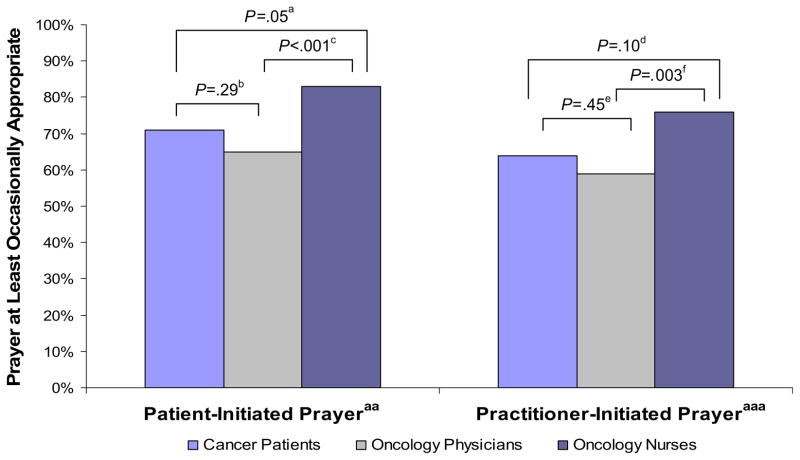
Results: Most advanced cancer patients (71%), nurses (83%), and physicians (65%) reported that patient-initiated patient-practitioner prayer was at least occasionally appropriate. Furthermore, clinician prayer was viewed as at least occasionally appropriate by the majority of patients (64%), nurses (76%), and physicians (59%). Of those patients who could envision themselves asking their physician or nurse for prayer (61%), 86% would find this form of prayer spiritually supportive. Most patients (80%) viewed practitioner-initiated prayer as spiritually supportive. Open-ended responses regarding the appropriateness of patient-practitioner prayer in the advanced cancer setting revealed six themes shaping respondents' viewpoints: necessary conditions for prayer, potential benefits of prayer, critical attitudes toward prayer, positive attitudes toward prayer, potential negative consequences of prayer, and prayer alternatives.
Conclusion: Most patients and practitioners view patient-practitioner prayer as at least occasionally appropriate in the advanced cancer setting, and most patients view prayer as spiritually supportive. However, the appropriateness of patient-practitioner prayer is case specific, requiring consideration of multiple factors.
Copyright © 2011 U.S. Cancer Pain Relief Committee. Published by Elsevier Inc. All rights reserved.
Figures
References
-
- Alcorn SA, Balboni MJ, Prigerson HG, et al. “If God wanted me yesterday, I wouldn’t be here today”: religious and spiritual themes in patients’ experiences of advanced cancer. J Palliat Med. 2010;13:581–588. - PubMed
-
- Koenig HG. Religious attitudes and practices of hospitalized medically ill older adults. Int J Geriatr Psychiatry. 1998;13:213–224. - PubMed
-
- King DE, Bushwick B. Beliefs and attitudes of hospital inpatients about faith healing and prayer. J Fam Pract. 1994;39:349–352. - PubMed
Publication types
MeSH terms
Grants and funding
LinkOut - more resources
Full Text Sources
Medical
