


CaMKII in myocardial hypertrophy and heart failure
- PMID: 21276796
- PMCID: PMC3158288
- DOI: 10.1016/j.yjmcc.2011.01.012
CaMKII in myocardial hypertrophy and heart failure
Abstract
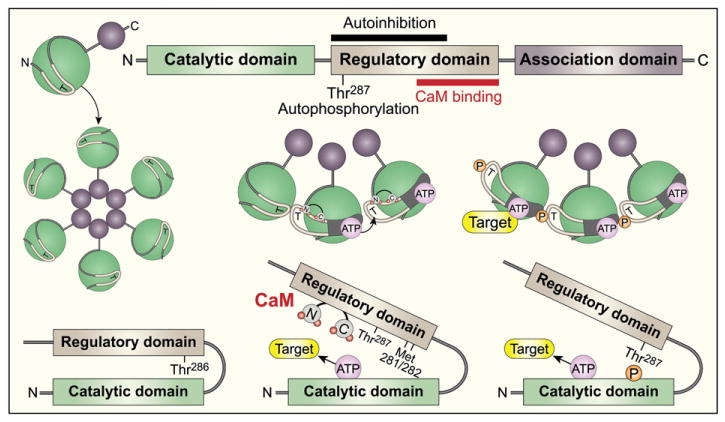
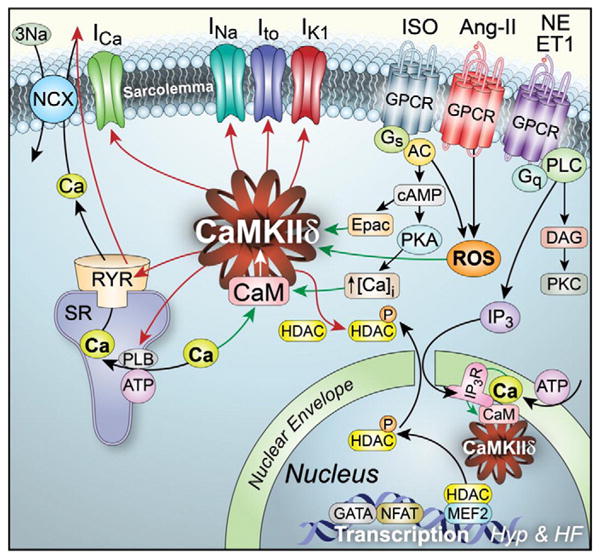
Many signals have risen and fallen in the tide of investigation into mechanisms of myocardial hypertrophy and heart failure (HF). In our opinion, the multifunctional Ca and calmodulin-dependent protein kinase II (CaMKII) has emerged as a molecule to watch, in part because a solid body of accumulated data essentially satisfy Koch's postulates, showing that the CaMKII pathway is a core mechanism for promoting myocardial hypertrophy and heart failure. Multiple groups have now confirmed the following: (1) that CaMKII activity is increased in hypertrophied and failing myocardium from animal models and patients; (2) CaMKII overexpression causes myocardial hypertrophy and HF and (3) CaMKII inhibition (by drugs, inhibitory peptides and gene deletion) improves myocardial hypertrophy and HF. Patients with myocardial disease die in equal proportion from HF and arrhythmias, and a major therapeutic obstacle is that drugs designed to enhance myocardial contraction promote arrhythmias. In contrast, inhibiting the CaMKII pathway appears to reduce arrhythmias and improve myocardial responses to pathological stimuli. This brief paper will introduce the molecular physiology of CaMKII and discuss the impact of CaMKII on ion channels, Ca handling proteins and transcription in myocardium. This article is part of a special issue entitled "Key Signaling Molecules in Hypertrophy and Heart Failure".
Copyright © 2011 Elsevier Ltd. All rights reserved.
Figures
References
-
- Zhang T, Johnson EN, Gu Y, Morissette MR, Sah VP, Gigena M, et al. The cardiac-specific nuclear δB isoform of Ca2+/calmodulin-dependent protein kinase II induces hypertrophy and dilated cardiomyopathy associated with increased PP2A activity. J Biol Chem. 2002;277(2):1261–7. - PubMed
-
- Zhang T, Kohlhaas M, Backs J, Mishra S, Phillips W, Dybkova N, et al. CaMKIIδ isoforms differentially affect calcium handling but similarly regulate HDAC/MEF2 transcriptional responses. J Biol Chem. 2007;282(48):35078–87. - PubMed
-
- Zhang T, Maier LS, Dalton ND, Miyamoto S, Ross J, Jr, Bers DM, et al. The deltaC isoform of CaMKII is activated in cardiac hypertrophy and induces dilated cardiomyopathy and heart failure. Circ Res. 2003;92(8):912–9. - PubMed
-
- Edman CF, Schulman H. Identification and characterization of delta B-CaM kinase and delta C-CaM kinase from rat heart, two new multifunctional Ca2+/calmodulin-dependent protein kinase isoforms. Biochem Biophys Acta. 1994;1221(1):89–101. - PubMed
Publication types
MeSH terms
Substances
Grants and funding
LinkOut - more resources
Full Text Sources
Other Literature Sources
Medical
Research Materials
Miscellaneous
