. 2011 Mar;86(3):320-9.
doi: 10.1016/j.biopsycho.2010.12.012. Epub 2011 Jan 27.

Physiological correlates and emotional specificity of human piloerection

Affiliations

Physiological correlates and emotional specificity of human piloerection

Mathias Benedek et al. Biol Psychol. 2011 Mar.

Abstract

Piloerection is known as an indicator of strong emotional experiences. However, little is known about the physiological and emotional specificity of this psychophysiological response. In the presented study, piloerection was elicited by audio stimuli taken from music and film episodes. The physiological response accompanying the incidence of piloerection was recorded with respect to electrodermal, cardiovascular and respiratory measures and compared to a matched control condition. The employment of an optical recording system allowed for a direct and objective assessment of visible piloerection. The occurrence of piloerection was primarily accompanied by an increase of phasic electrodermal activity and increased respiration depth as compared to a matched control condition. This physiological response pattern is discussed in the context of dominant theories of human piloerection. Consideration of all available evidence suggests that emotional piloerection represents a valuable indicator of the state of being moved or touched.


Figures

Fig. 1
Fig. 1
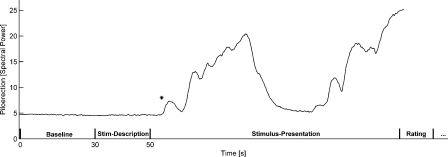
A sample recording of relative piloerection intensity is depicted over the time course of a single trial including baseline period (30 s), stimulus description (20 s), stimulus presentation (variable duration) and rating (variable duration). The initial stable level of piloerection intensity indicates no visible piloerection. In this trial, piloerection occurs shortly after the onset of stimulus presentation; after some time it fades away, before it occurs for a second period of time. The asterisk marks the first detected onset of piloerection within this trial. This point in time is used for the analysis of the short-term physiological response.
Fig. 2
Fig. 2
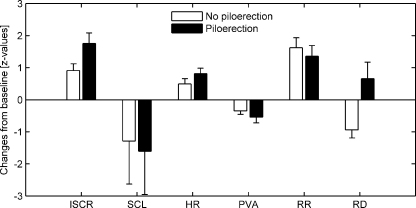
General physiological response (standardized change from baseline to stimulus) of trials which elicited visible piloerection (dark bars) as compared to matched trials (no piloerection, light bars). Whiskers indicate the standard error of mean. ISCR: integrated skin conductance response, SCL: skin conductance level, HR: heart rate, PVA: pulse volume amplitude, RR: respiratory rate, RD: respiration depth.
Fig. 3
Fig. 3
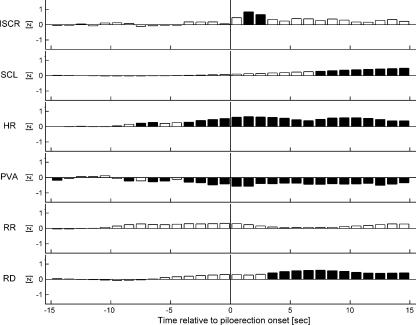
Time course of the short-term response of physiological measures for a time range of ±15 s around the first onset of piloerection within a trial. The bars indicate the standardized change (relative to the averaged value in the 15–10 s period before piloerection onset) at 1-s time steps. Dark bars indicate significant deviations from zero; white bars indicate non-significant deviations. ISCR: integrated skin conductance response, SCL: skin conductance level, HR: heart rate, PVA: pulse volume amplitude, RR: respiratory rate, RD: respiration depth.

References

    1. Benedek M., Kaernbach C. A continuous measure of phasic electrodermal activity. Journal of Neuroscience Methods. 2010;190:80–91. - PMC - PubMed
    1. Benedek M., Kaernbach C. Decomposition of skin conductance data by means of nonnegative deconvolution. Psychophysiology. 2010;47:647–658. - PMC - PubMed
    1. Benedek M., Wilfling B., Lukas-Wolfbauer R., Katzur B., Kaernbach C. Objective and continuous measurement of piloerection. Psychophysiology. 2010;47:989–993. - PubMed
    1. Blood A., Zatorre R.J. Intensely pleasurable responses to music correlate with activity in brain regions implicated in reward and emotion. Proceedings of the National Academy of Sciences of the United States of America. 2001;98:11818–11823. - PMC - PubMed
    1. Bradley M.M., Lang P.J. Measuring emotion: the self-assessment manikin and the semantic differential. Journal of Behavioral Therapy & Experimental Psychiatry. 1994;25(1):49–59. - PubMed

Publication types