. 2011 Aug 1;25(2):59-69.
doi: 10.1016/j.niox.2011.01.006. Epub 2011 Jan 26.

Effects of T- and R-state stabilization on deoxyhemoglobin-nitrite reactions and stimulation of nitric oxide signaling

Affiliations

Effects of T- and R-state stabilization on deoxyhemoglobin-nitrite reactions and stimulation of nitric oxide signaling

Nadiezhda Cantu-Medellin et al. Nitric Oxide. .

Abstract

Recent data suggest that transitions between the relaxed (R) and tense (T) state of hemoglobin control the reduction of nitrite to nitric oxide (NO) by deoxyhemoglobin. This reaction may play a role in physiologic NO homeostasis and be a novel consideration for the development of the next generation of hemoglobin-based blood oxygen carriers (HBOCs, i.e. artificial blood substitutes). Herein we tested the effects of chemical stabilization of bovine hemoglobin in either the T- (THb) or R-state (RHb) on nitrite-reduction kinetics, NO-gas formation and ability to stimulate NO-dependent signaling. These studies were performed over a range of fractional saturations that is expected to mimic biological conditions. The initial rate for nitrite-reduction decreased in the following order RHb>bHb>THb, consistent with the hypothesis that the rate constant for nitrite reduction is faster with R-state Hb and slower with T-state Hb. Moreover, RHb produced more NO-gas and inhibited mitochondrial respiration more potently than both bHb and THb. Interestingly, at low oxygen fractional saturations, THb produced more NO and stimulated nitrite-dependent vasodilation more potently than bHb despite both derivatives having similar initial rates for nitrite reduction and a more negative reduction potential in THb versus bHb. These data suggest that cross-linking of bovine hemoglobin in the T-state conformation leads to a more effective coupling of nitrite reduction to NO-formation. Our results support the model of allosteric regulation of nitrite reduction by deoxyhemoglobin and show that cross-linking hemoglobins in distinct quaternary states can generate products with increased NO yields from nitrite reduction that could be harnessed to promote NO-signaling in vivo.


Figures

Figure 1
Figure 1
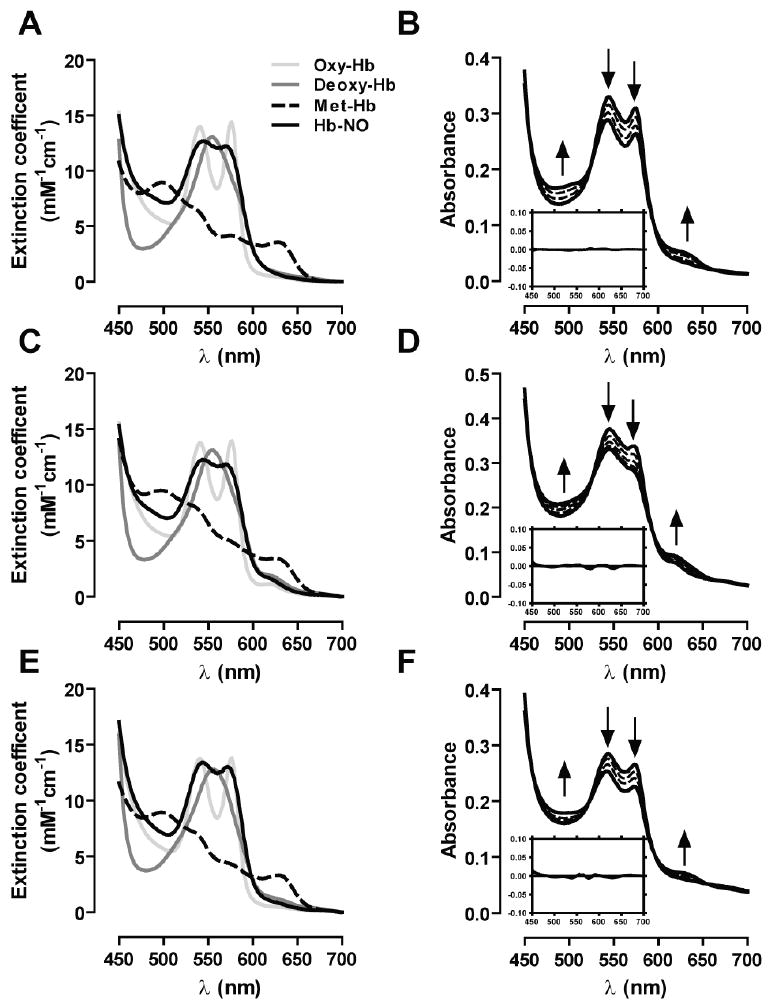
Reference visible spectra for the hemoglobin species expected to be involved in the reaction with nitrite corresponding to A) bHb, C) Thb and E) RHb. Panels B, D and F show representative spectral changes in the reaction of hemoglobin and nitrite for bHb, THb and RHb respectively. Experiments were performed using 30μM hemoglobin and 750μM nitrite with the exception of RHb where 250μM nitrite was used instead. Fractional saturations were bHb: 0.45, THb: 0.4 and RHb: 0.49. Spectra were collected every 30 seconds for 15 minutes. In the interest of clarity, only data collected every 4 minutes is shown in the graph. Inserts show respective residual plots obtained from fitting the experimental data to the reference spectra.
Figure 2
Figure 2
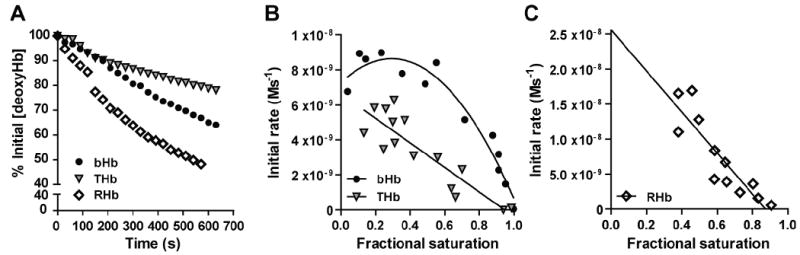
A) Representative kinetic traces showing the consumption of the indicated deoxyhemoglobins (30μM) after the addition of sodium nitrite (750μM for bHb and THb, and 250μM for RHb) in PBS pH 7.4, 37°C and a fractional saturation of 0.45 – 0.5. B) Initial rate for the reaction between nitrite and deoxygenated bHb and THb as function of fractional saturation were calculated using the initial 10% of the deoxyhemoglobin consumption traces shown in panel A. The reaction was performed using 30μM Hb and a nitrite addition of 750μM. C) Initial rate for the reaction between nitrite and deoxygenated RHb as function of fractional saturation were calculated using the initial 10% of the deoxyhemoglobin consumption traces shown in panel A. The reaction was performed using 30μM Hb and a nitrite addition of 250μM.
Figure 3
Figure 3
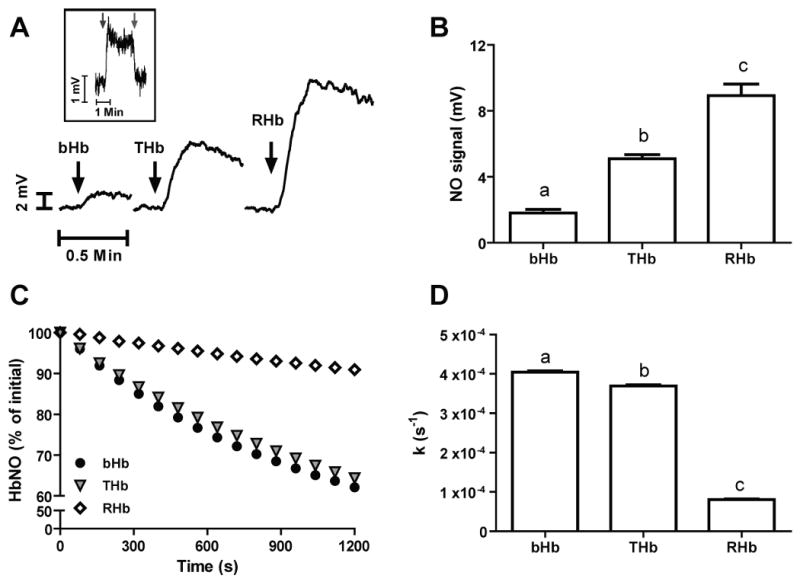
A) Representative traces indicating NO-formation at 0% fractional saturation from the reaction between 0.5μM hemoglobins (as indicated) with 1mM sodium nitrite in PBS pH 7.4 at 37°C. Inset: Representative trace showing the effect of CPTIO addition (25μM, right arrow) to the chemiluminiscence signal generated by the reaction between 0.5μM bHb and 1mM nitrite. Similar results are observed with THb and RHb (not shown). B) Summarized data showing the yield of NO formation by the indicated hemoglobins. Data are means ± SEM, n = 3-5. Different letters denote P < 0.001 versus the other two hemoglobins as determined by one-way ANOVA and Bonferroni's post-test. C) Traces showing the percent decrease of HbNO in 20 minutes for bHb, THb and RHb. Initial concentrations were 22μM, 20μM and 26μM, for bHb, THb, and RHb, respectively. Data are mean ± SEm (n=3) D) First order rate constants for HbNO decomposition. Data are means ± SEM, n = 3. Different letters denote P < 0.001 versus the other two hemoglobins as determined by one-way ANOVA and Bonferroni's post-test.
Figure 4
Figure 4
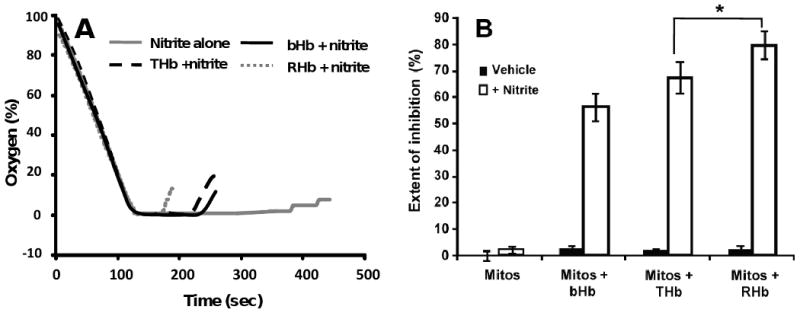
A) Typical oxygen tension traces showing inhibition of mitochondrial respiration by the combination of 25 μM nitrite and 20 μM of the indicated hemoglobins. A shorter time between lid removal (t = 120s) and increases in oxygen levels above zero imply higher degree of inhibition and hence NO formation. B) Summarized data showing the extent of mitochondrial respiration inhibition attained with the indicated hemoglobins. Data are means ± SEM, n = 5, * p <0.05.
Figure 5
Figure 5
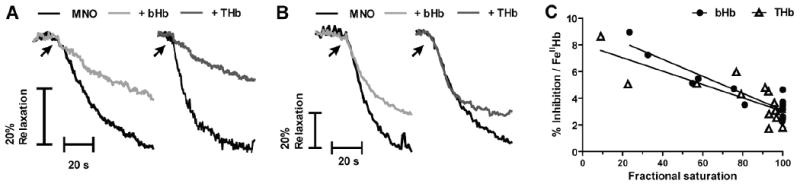
Representative vessel tension traces showing the inhibitory effects of bHb and THb on MNO-dependent vasodilation at A) fractional saturations of 0.54 and 0.57 (bHb and THb, respectively) and B) 0.99 fractional saturations for each hemoglobin. C) bHb and THb mediated inhibition of MNO dependent dilation as a function of fractional saturation. Percent inhibition was calculated by ratio of MNO-induced vasodilation in the presence and absence of hemoglobins and then normalized to the amount of ferrous heme in the vessel bath. Each point corresponds to a single measurement using an individual vessel segment. Lines show linear regression fits with r2 equal to 0.85 and 0.63 for bHb and THb respectively. Both slopes are significantly different from zero with p = < 0.001.
Figure 6
Figure 6
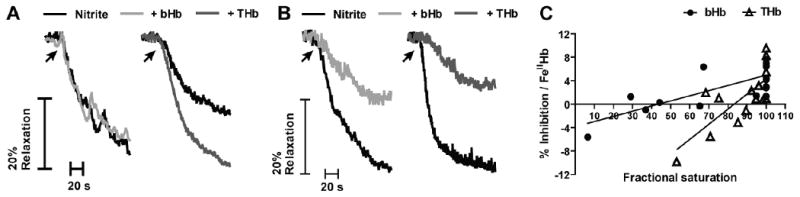
Representative vessel bioassay traces showing the effects of bHb and THb on nitrite-dependent vasodilation at A) 0.45 and 0.53 fractional saturation (bHb and THb, respectively), and B) 0.99 fractional saturation for each hemoglobin. C) bHb and THb mediated inhibition of nitrite-dependent dilation as a function of fractional saturation. Percent inhibition was calculated by ratio of nitrite-induced vasodilation in the presence and absence of hemoglobins and then normalized to the amount of ferrous heme in the vessel bath. Each point corresponds to a single measurement using an individual vessel segment. Lines show linear regression fits with r2 equal to 0.58 and 0.57 for bHb and THb respectively. Both slopes are significantly different from zero with p = 0.0003 and p = 0.0018 for bHb and THb respectively.

References

    1. Gladwin MT, Raat NJ, Shiva S, Dezfulian C, Hogg N, Kim-Shapiro DB, Patel RP. Nitrite as a vascular endocrine nitric oxide reservoir that contributes to hypoxic signaling, cytoprotection, and vasodilation. Am J Physiol Heart Circ Physiol. 2006;291:H2026–35. - PubMed
    1. Singel DJ, Stamler JS. Chemical physiology of blood flow regulation by red blood cells: the role of nitric oxide and S-nitrosohemoglobin. Annu Rev Physiol. 2005;67:99–145. - PubMed
    1. Cosby K, Partovi KS, Crawford JH, Patel RP, Reiter CD, Martyr S, Yang BK, Waclawiw MA, Zalos G, Xu X, Huang KT, Shields H, Kim-Shapiro DB, Schechter AN, Cannon RO, 3rd, Gladwin MT. Nitrite reduction to nitric oxide by deoxyhemoglobin vasodilates the human circulation. Nat Med. 2003;9:1498–505. - PubMed
    1. Crawford JH, Isbell TS, Huang Z, Shiva S, Chacko BK, Schechter AN, Darley-Usmar VM, Kerby JD, Lang JD, Jr, Kraus D, Ho C, Gladwin MT, Patel RP. Hypoxia, red blood cells, and nitrite regulate NO-dependent hypoxic vasodilation. Blood. 2006;107:566–74. - PMC - PubMed
    1. Kleinbongard P, Dejam A, Lauer T, Rassaf T, Schindler A, Picker O, Scheeren T, Godecke A, Schrader J, Schulz R, Heusch G, Schaub GA, Bryan NS, Feelisch M, Kelm M. Plasma nitrite reflects constitutive nitric oxide synthase activity in mammals. Free Radic Biol Med. 2003;35:790–6. - PubMed

Publication types

MeSH terms

LinkOut - more resources