


Compromised myocardial energetics in hypertrophied mouse hearts diminish the beneficial effect of overexpressing SERCA2a
- PMID: 21278384
- PMCID: PMC3060468
- DOI: 10.1074/jbc.M110.210757
Compromised myocardial energetics in hypertrophied mouse hearts diminish the beneficial effect of overexpressing SERCA2a
Abstract
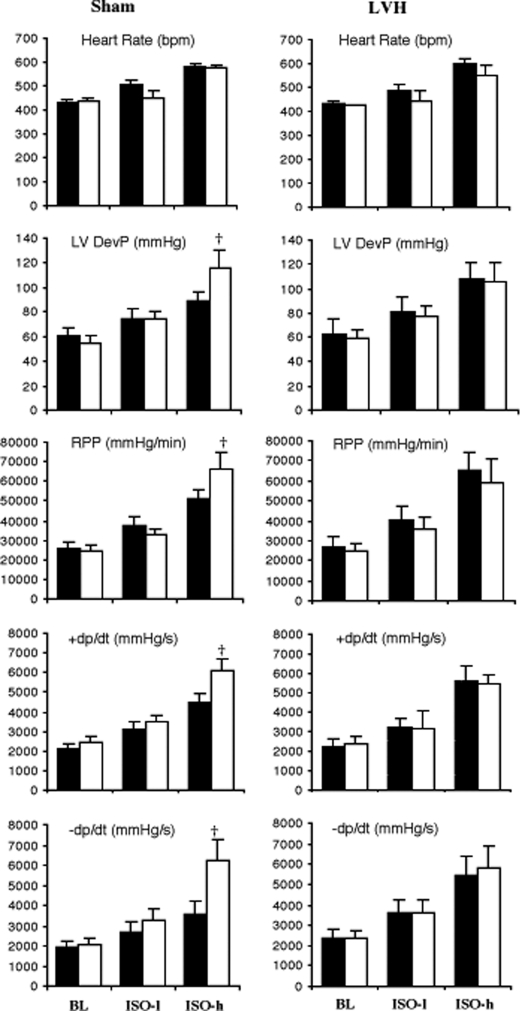
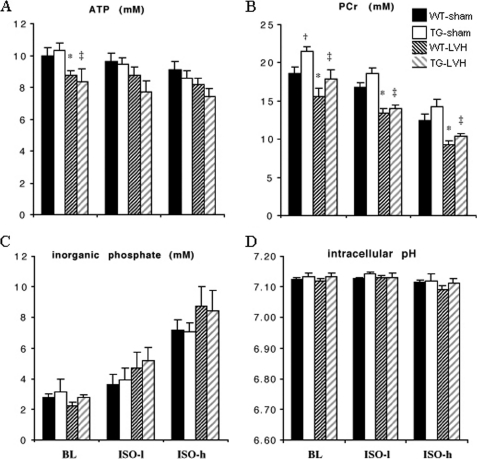
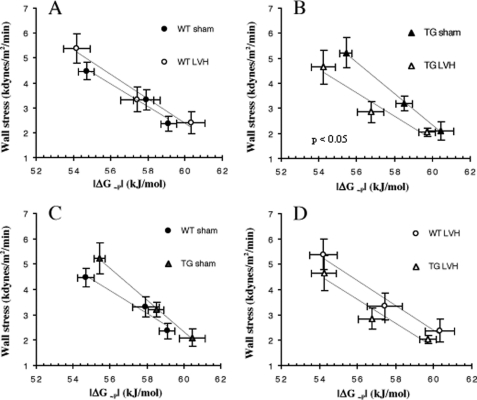
The sarcoplasmic reticulum calcium ATPase (SERCA) plays a central role in regulating intracellular Ca(2+) homeostasis and myocardial contractility. Several studies show that improving Ca(2+) handling in hypertrophied rodent hearts by increasing SERCA activity results in enhanced contractile function. This suggests that SERCA is a potential target for gene therapy in cardiac hypertrophy and failure. However, it raises the issue of increased energy cost resulting from a higher ATPase activity. In this study, we determined whether SERCA overexpression alters the energy cost of increasing myocardial contraction in mouse hearts with pressure-overload hypertrophy using (31)P NMR spectroscopy. We isolated and perfused mouse hearts from wild-type (WT) and transgenic (TG) mice overexpressing the cardiac isoform of SERCA (SERCA2a) 8 weeks after ascending aortic constriction (left ventricular hypertrophy (LVH)) or sham operation. We found that overexpressing SERCA2a enhances myocardial contraction and relaxation in normal mouse hearts during inotropic stimulation with isoproterenol. Energy consumption was proportionate to the increase in contractile function. Thus, increasing SERCA2a expression in the normal heart allows an enhanced inotropic response with no compromise in energy supply and demand. However, this advantage was not sustained in LVH hearts in which the energetic status was compromised. Although the overexpression of SERCA2a prevented the down-regulation of SERCA protein in LVH hearts, TG-LVH hearts showed no increase in inotropic response when compared with WT-LVH hearts. Our results suggest that energy supply may be a limiting factor for the benefit of SERCA overexpression in hypertrophied hearts. Thus, strategies combining energetic support with increasing SERCA activity may improve the therapeutic effectiveness for heart failure.
Figures
References
-
- Ito K., Yan X., Feng X., Manning W. J., Dillmann W. H., Lorell B. H. (2001) Circ. Res. 89, 422–429 - PubMed
-
- Müller O. J., Lange M., Rattunde H., Lorenzen H. P., Müller M., Frey N., Bittner C., Simonides W., Katus H. A., Franz W. M. (2003) Cardiovasc Res. 59, 380–389 - PubMed
-
- Bers D. M., Perez-Reyes E. (1999) Cardiovasc Res. 42, 339–360 - PubMed
-
- Kammermeier H. (1987) Basic Res. Cardiol. 82, Suppl. 2, 31–36 - PubMed
MeSH terms
Substances
LinkOut - more resources
Full Text Sources
Other Literature Sources
Miscellaneous
