


Food insufficiency and health services utilization in a national sample of homeless adults
- PMID: 21279455
- PMCID: PMC3101971
- DOI: 10.1007/s11606-011-1638-4
Food insufficiency and health services utilization in a national sample of homeless adults
Abstract
Background: Homeless people have high rates of hospitalization and emergency department (ED) use. Obtaining adequate food is a common concern among homeless people and may influence health care utilization.
Objective: We tested the hypothesis that food insufficiency is related to higher rates of hospitalization and ED use in a national sample of homeless adults.
Design: We analyzed data from the 2003 Health Care for the Homeless (HCH) User Survey.
Participants: Participants were 966 adults surveyed at 79 HCH clinic sites throughout the US. The study sample was representative of over 436,000 HCH clinic users nationally.
Measures: We determined the prevalence and characteristics of food insufficiency among respondents. Using multivariable logistic regression, we examined the association between food insufficiency and four past-year acute health services utilization outcomes: (1) hospitalization for any reason, (2) psychiatric hospitalization, (3) any ED use, and (4) high ED use (≥ 4 visits).
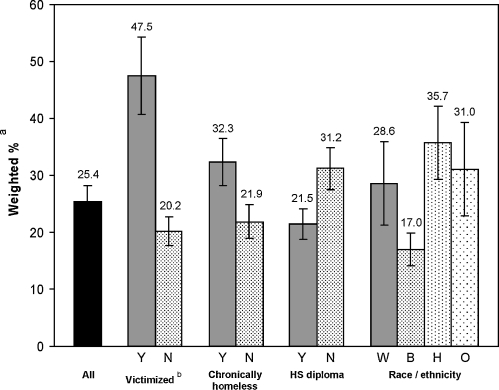
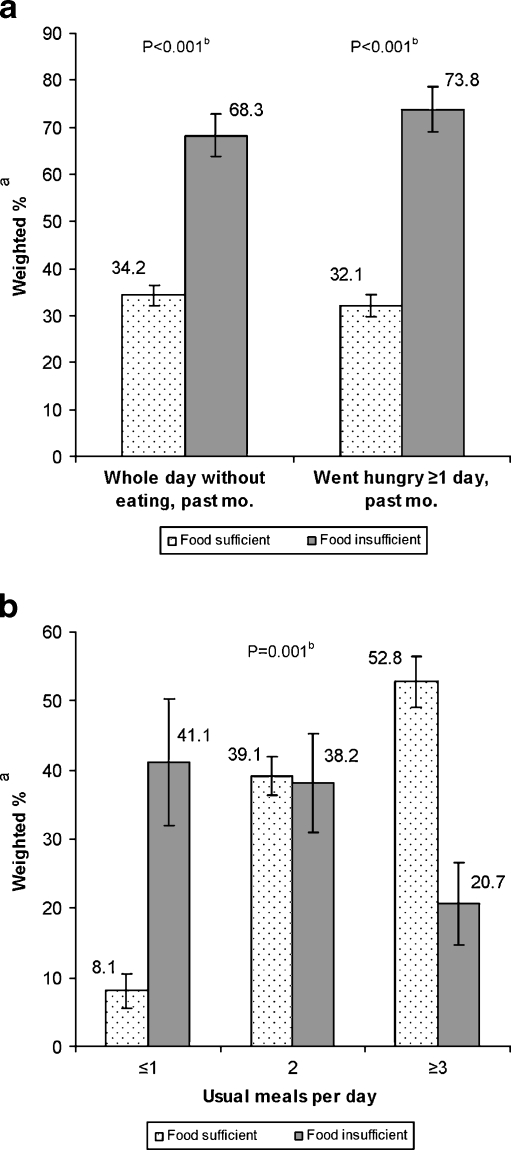
Results: Overall, 25% of respondents reported food insufficiency. Among them, 68% went a whole day without eating in the past month. Chronically homeless (p = 0.01) and traumatically victimized (p = 0.001) respondents were more likely to be food insufficient. In multivariable analyses, food insufficiency was associated with significantly greater odds of hospitalization for any reason (AOR 1.59, 95% CI 1.07, 2.36), psychiatric hospitalization (AOR 3.12, 95% CI 1.73, 5.62), and high ED utilization (AOR 2.83, 95% CI 1.32, 6.08).
Conclusions: One-fourth of homeless adults in this national survey were food insufficient, and this was associated with increased odds of acute health services utilization. Addressing the adverse health services utilization patterns of homeless adults will require attention to the social circumstances that may contribute to this issue.
Figures
References
-
- Martell JV, Seitz RS, Harada JK, Kobayashi J, Sasaki VK, Wong C. Hospitalization in an urban homeless population: the Honolulu Urban Homeless Project. Ann. Intern. Med. 1992;116(4):299–303. - PubMed
-
- Stark LR. Barriers to health care for homeless people. In: Jahiel RI, editor. Homelessness: a Prevention-Oriented Approach. Baltimore: Johns Hopkins University Press; 1992. pp. 151–164.
Publication types
MeSH terms
Grants and funding
LinkOut - more resources
Full Text Sources
Medical
Miscellaneous
