


Wikipedia: a key tool for global public health promotion
- PMID: 21282098
- PMCID: PMC3221335
- DOI: 10.2196/jmir.1589
Wikipedia: a key tool for global public health promotion
Abstract
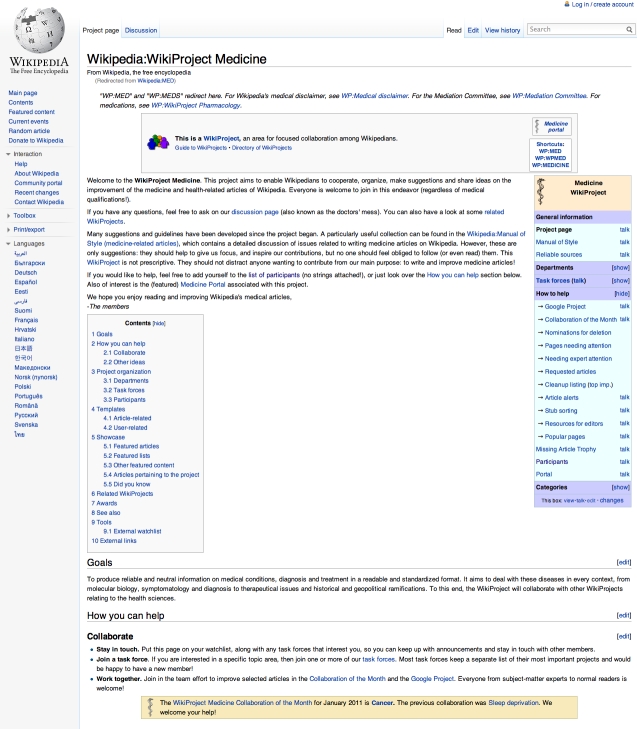
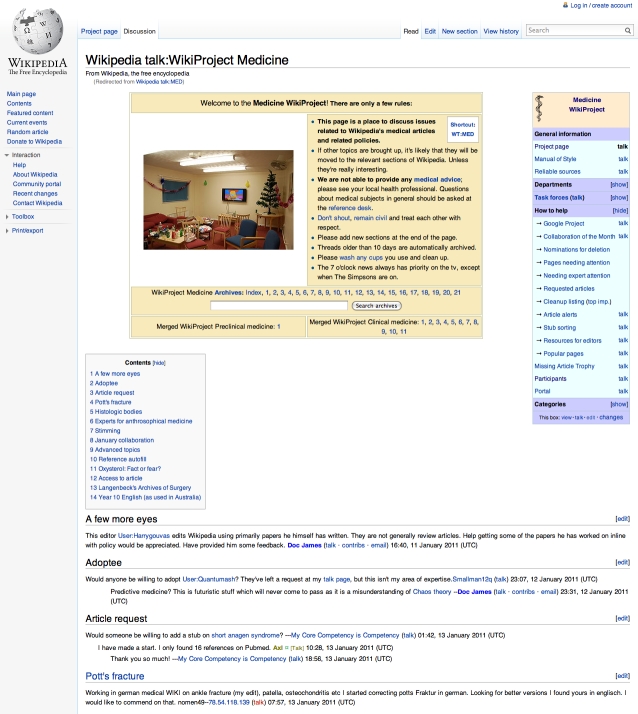
The Internet has become an important health information resource for patients and the general public. Wikipedia, a collaboratively written Web-based encyclopedia, has become the dominant online reference work. It is usually among the top results of search engine queries, including when medical information is sought. Since April 2004, editors have formed a group called WikiProject Medicine to coordinate and discuss the English-language Wikipedia's medical content. This paper, written by members of the WikiProject Medicine, discusses the intricacies, strengths, and weaknesses of Wikipedia as a source of health information and compares it with other medical wikis. Medical professionals, their societies, patient groups, and institutions can help improve Wikipedia's health-related entries. Several examples of partnerships already show that there is enthusiasm to strengthen Wikipedia's biomedical content. Given its unique global reach, we believe its possibilities for use as a tool for worldwide health promotion are underestimated. We invite the medical community to join in editing Wikipedia, with the goal of providing people with free access to reliable, understandable, and up-to-date health information.
Conflict of interest statement
All authors are members of the English Wikipedia's WikiProject Medicine and have contributed to Wikipedia and various other wikis. Michael F Martone is involved in the development of an iPhone application that may in the future integrate Wikipedia content. Tim Vickers is Director of the Molecular and Cellular Biology WikiProject. Dr Bertalan Meskó is the founder and managing director of Webicina.com, a company providing web 2.0 services to medical professionals and patients.
Figures
References
-
- Kummervold PE, Chronaki CE, Lausen B, Prokosch HU, Rasmussen J, Santana S, Staniszewski A, Wangberg SC. eHealth trends in Europe 2005-2007: a population-based survey. J Med Internet Res. 2008;10(4):e42. doi: 10.2196/jmir.1023. http://www.jmir.org/2008/4/e42/v10i4e42 - DOI - PMC - PubMed
-
- Hesse BW, Nelson DE, Kreps GL, Croyle RT, Arora NK, Rimer BK, Viswanath K. Trust and sources of health information: the impact of the Internet and its implications for health care providers: findings from the first Health Information National Trends Survey. Arch Intern Med. 2005;165(22):2618–24. doi: 10.1001/archinte.165.22.2618. http://archinte.ama-assn.org/cgi/pmidlookup?view=long&pmid=16344419165/22/2618 - DOI - PubMed
-
- Fox S, Jones S. Pew Internet. Washington, DC: Pew Internet & American Life Project; 2009. [2010-07-12]. The social life of health information http://www.pewinternet.org/~/media//Files/Reports/2009/PIP_Health_2009.pdf.
-
- Iverson SA, Howard KB, Penney BK. Impact of internet use on health-related behaviors and the patient-physician relationship: a survey-based study and review. J Am Osteopath Assoc. 2008 Dec;108(12):699–711. http://www.jaoa.org/cgi/pmidlookup?view=long&pmid=19075034108/12/699 - PubMed
Publication types
MeSH terms
LinkOut - more resources
Full Text Sources
Medical
Miscellaneous
