


Changes in blood-borne infection risk among injection drug users
- PMID: 21282191
- PMCID: PMC3072736
- DOI: 10.1093/infdis/jiq112
Changes in blood-borne infection risk among injection drug users
Abstract
Background: Population-level hepatitis C virus (HCV) infection incidence is a surrogate for community drug-related risk.
Methods: We characterized trends in human immunodeficiency virus (HIV) and HCV infection incidence and HCV infection prevalence among injection drug users (IDUs) recruited over 4 periods: 1988-1989, 1994-1995, 1998, and 2005-2008. We calculated HIV and HCV infection incidence within the first year of follow-up among IDUs whose test results were negative for these viruses at baseline (n = 2061 and n = 373, respectively). We used Poisson regression to compare trends across groups.
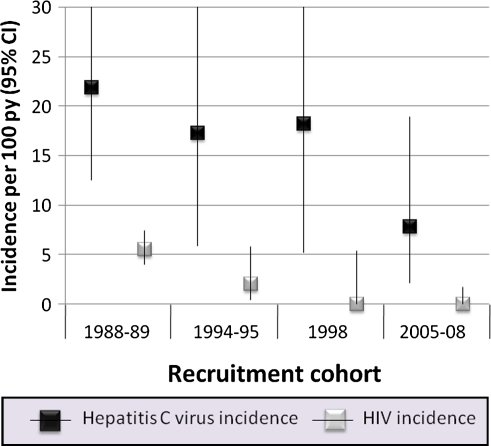
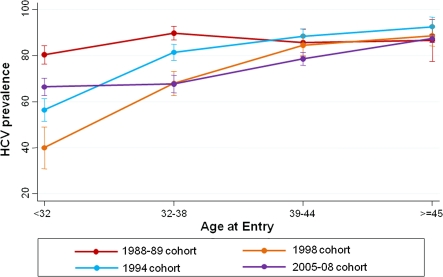
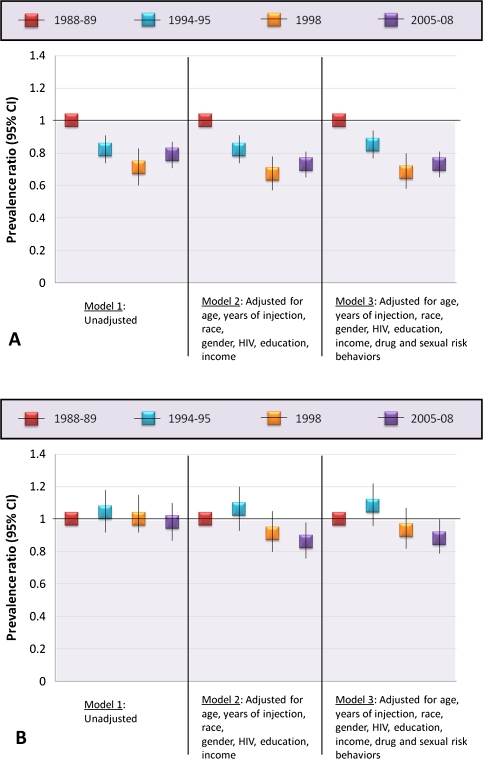
Results: HIV infection incidence declined significantly from 5.5 cases/100 person-years (py) in the 1988-1989 group to 2.0 cases/100 py in the 1994-1995 group to 0 cases/100 py in the 1998 and 2005-2008 groups. Concurrently, HCV infection incidence declined but remained robust (22.0 cases/100 py in the 1988-1989 cohort to 17.2 cases/100 py in the 1994-1995 cohort, 17.9 cases/100 py in the 1998 cohort, and 7.8 cases/100 py in the 2005-2008 cohort; P = .07). Likewise, HCV infection prevalence declined, but chiefly in younger IDUs. For persons aged <39 years, relative to the 1988-1989 cohort, all groups exhibited significant declines (adjusted prevalence ratio [PR] for the 2005-08 cohort, .73; 95% confidence interval [CI], .65-.81). However, for persons aged ≥ 39 years, only the 2005-2008 cohort exhibited declining prevalence compared with the 1988-1989 cohort (adjusted PR, .87; 95% CI, .77-.99).
Conclusions: Although efforts to reduce blood-borne infection incidence have had impact, this work will need to be intensified for the most transmissible viruses, such as HCV.
Figures
Comment in
-
Prevention of hepatitis C virus in injecting drug users: a narrow window of opportunity.J Infect Dis. 2011 Mar 1;203(5):571-4. doi: 10.1093/infdis/jiq111. Epub 2011 Jan 31. J Infect Dis. 2011. PMID: 21282190 Free PMC article. No abstract available.
References
-
- Fleming PL, Ward JW, Karon JM, Hanson DL, De Cock KM. Declines in AIDS incidence and deaths in the USA: A signal change in the epidemic. AIDS. 1998;12:S55–61. - PubMed
-
- Centers for Disease Control and Prevention. HIV and AIDS–United States, 1981–2000. MMWR Morb Mortal Wkly Rep. 2001;50:430–4. - PubMed
-
- Longshore D, Anglin MD. Seroprevalence stable and seroconversions rare among injection drug users in Los Angeles. J Acquir Immune Defic Syndr. 1992;5:212–3. - PubMed
-
- Watters JK. Trends in risk behavior and HIV seroprevalence in heterosexual injection drug users in San Francisco, 1986–1992. J Acquir Immune Defic Syndr. 1994;7:1276–81. - PubMed
Publication types
MeSH terms
Grants and funding
LinkOut - more resources
Full Text Sources
Medical
Research Materials
