


Ageing reduces the compensatory vasodilatation during hypoxic exercise: the role of nitric oxide
- PMID: 21282292
- PMCID: PMC3082105
- DOI: 10.1113/jphysiol.2010.203539
Ageing reduces the compensatory vasodilatation during hypoxic exercise: the role of nitric oxide
Abstract
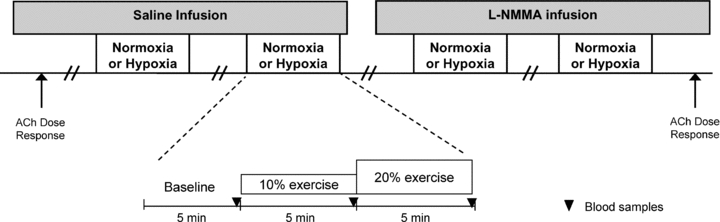
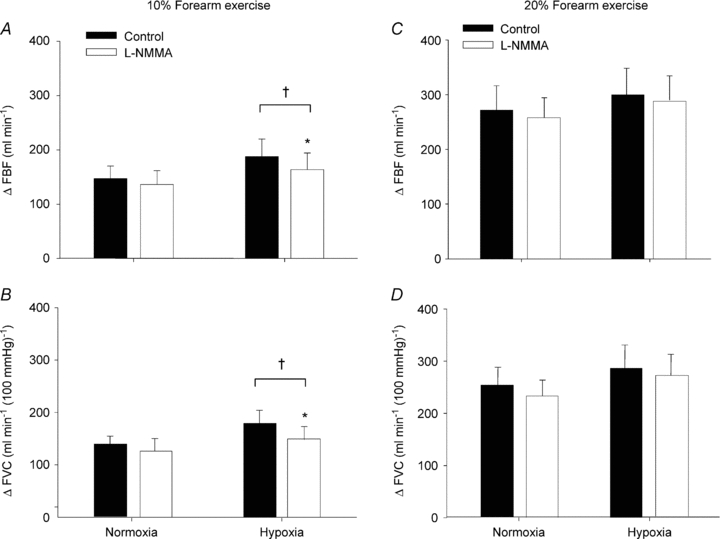
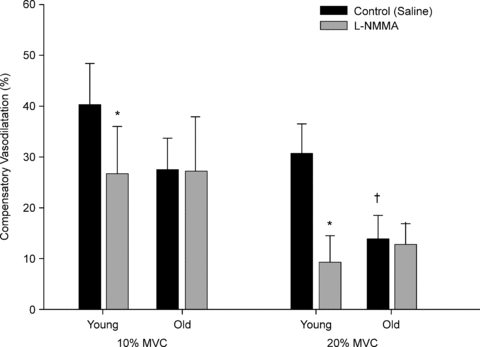
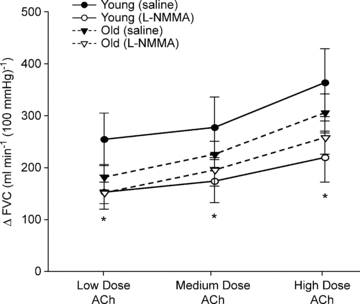
We tested the hypotheses that (1) the compensatory vasodilatation in skeletal muscle during hypoxic exercise is attenuated in ageing humans and (2) local inhibition of nitric oxide (NO) synthesis in the forearm of ageing humans will have less impact on the compensatory dilatation during rhythmic exercise with hypoxia, due to a smaller compensatory dilator response. Eleven healthy older subjects (61 ± 2 years) performed forearm exercise (10% and 20% of maximum) during saline infusion (control) and NO synthase inhibition (NG-monomethyl-L-arginine; L-NMMA) under normoxic and normocapnic hypoxic (80% arterial O2 saturation) conditions. Forearm vascular conductance (FVC; ml min⁻¹ (100 mmHg)⁻¹) was calculated from forearm blood flow(ml min⁻¹) and blood pressure (mmHg). To further examine the effects of ageing on the compensatory vasodilator response to hypoxic exercise we compared the difference in ΔFVC (% change compared to respective normoxic exercise trial) between the older subjects (present study) and previously published data from an identical protocol in young subjects. During the control condition, the compensatory vasodilator response to hypoxia was similar between the old and young groups at 10% exercise (28 ± 6% vs. 40 ± 8%, P =0.11) but attenuated at 20% exercise (14 ± 4% vs. 31 ± 6%, P <0.05). L-NMMA during hypoxic exercise only blunted the compensatory vasodilator response in the young group (P <0.05). Our data suggest that ageing reduces the compensatory vasodilator response to hypoxic exercise via blunted NO signalling.
Figures
References
-
- Al-Shaer MH, Choueiri NE, Correia ML, Sinkey CA, Barenz TA, Haynes WG. Effects of aging and atherosclerosis on endothelial and vascular smooth muscle function in humans. Int J Cardiol. 2006;109:201–206. - PubMed
-
- Banzett RB, Garcia RT, Moosavi SH. Simple contrivance “clamps” end-tidal PCO2 and PO2 despite rapid changes in ventilation. J Appl Physiol. 2000;88:1597–1600. - PubMed
-
- Beere PA, Russell SD, Morey MC, Kitzman DW, Higginbotham MB. Aerobic exercise training can reverse age-related peripheral circulatory changes in healthy older men. Circulation. 1999;100:1085–1094. - PubMed
-
- Calbet JA, Boushel R, Radegran G, Sondergaard H, Wagner PD, Saltin B. Determinants of maximal oxygen uptake in severe acute hypoxia. Am J Physiol Regul Integr Comp Physiol. 2003;284:R291–R303. - PubMed
Publication types
MeSH terms
Substances
Grants and funding
LinkOut - more resources
Full Text Sources
Medical
Miscellaneous
