. 2011 Mar;60(3):775-83.
doi: 10.2337/db10-1416. Epub 2011 Jan 31.

Inflammatory induction of human resistin causes insulin resistance in endotoxemic mice

Affiliations

Inflammatory induction of human resistin causes insulin resistance in endotoxemic mice

Hyeong-Kyu Park et al. Diabetes. 2011 Mar.

Abstract

Objective: Although adipocyte-derived murine resistin links insulin resistance to obesity, the role of human resistin, predominantly expressed in mononuclear cells and induced by inflammatory signals, remains unclear. Given the mounting evidence that obesity and type 2 diabetes are inflammatory diseases, we sought to determine the relationship between inflammatory increases in human resistin and insulin resistance.

Research design and methods: To investigate the role of human resistin on glucose homeostasis in inflammatory states, we generated mice lacking murine resistin but transgenic for a bacterial artificial chromosome containing human resistin (BAC-Retn), whose expression was similar to that in humans. The metabolic and molecular phenotypes of BAC-Retn mice were assessed after acute and chronic endotoxemia (i.e., exposure to inflammatory lipopolysaccharide).

Results: We found that BAC-Retn mice have circulating resistin levels within the normal human range, and similar to humans, lipopolysaccharide markedly increased serum resistin levels. Acute endotoxemia caused hypoglycemia in mice lacking murine resistin, and this was attenuated in BAC-Retn mice. In addition, BAC-Retn mice developed severe hepatic insulin resistance under chronic endotoxemia, accompanied by increased inflammatory responses in liver and skeletal muscle.

Conclusions: These results strongly support the role of human resistin in the development of insulin resistance in inflammation. Thus, human resistin may link insulin resistance to inflammatory diseases such as obesity, type 2 diabetes, and atherosclerosis.


Figures
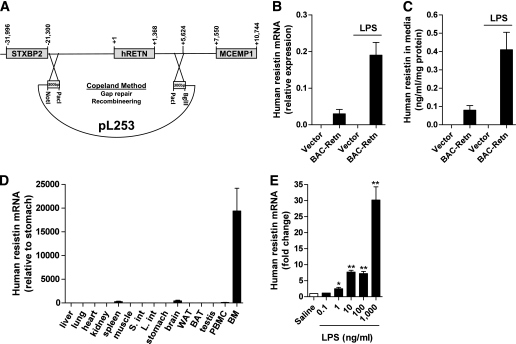
FIG. 1.
FIG. 1.
Generation and characterization of BAC-transgenic (BAC-Retn) mice. A: A BAC that contains the human resistin gene plus all the DNA elements up to 21,300 bp upstream and 4,248 bp downstream relative to the human resistin start site is used to generate the mice. The fusion construct was excised using NotI/BglII and injected into the pronucleus of fertilized C57BL/6 J mouse oocytes. B: Induction of human resistin gene by LPS (100 ng/mL) in transfected RAW.264 macrophages. C: LPS (100 ng/mL) induced secretion of resistin in transfected RAW.264 macrophages. D: Expression profile of human resistin in different tissues in BAC-Retn mice. E: LPS induced human resistin in vitro in peritoneal macrophages from BAC-Retn mice (n = 5 per group). Data are presented with the SEM. BAT, brown adipose tissue; BM, bone marrow; L. int, large intestine; PBMC, peripheral blood mononuclear cells; S. int, small intestine. *P < 0.05, **P < 0.01 vs. saline.
FIG. 2.
FIG. 2.
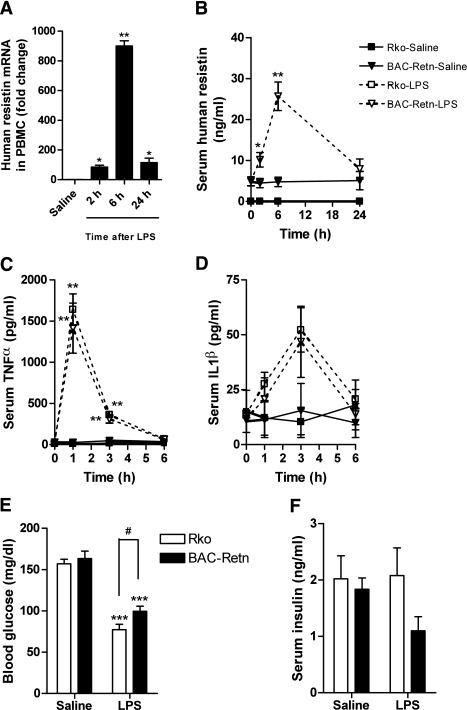
Changes in resistin, cytokines, and glucose in acute endotoxemia in BAC-Retn mice. Acute LPS (0.2 mg/kg) or normal saline (0.9%) intraperitoneal administration to Rko (□) and BAC-Retn (■) mice (n = 5–7 per group). A and B: Human resistin was induced in response to LPS in vivo in BAC-Retn mice. C and D: Serum TNF-α and IL1β levels increased similarly in Rko and BAC-Retn mice. E: LPS-induced hypoglycemia is less severe in BAC-Retn than in Rko mice at 6 h after LPS injection. F: Serum insulin levels in 6 h after LPS injection. PBMC, peripheral blood mononuclear cells. Data are presented with the SEM. *P < 0.05, **P < 0.01, ***P < 0.001 vs. saline; #P < 0.05 vs. Rko.
FIG. 3.
FIG. 3.
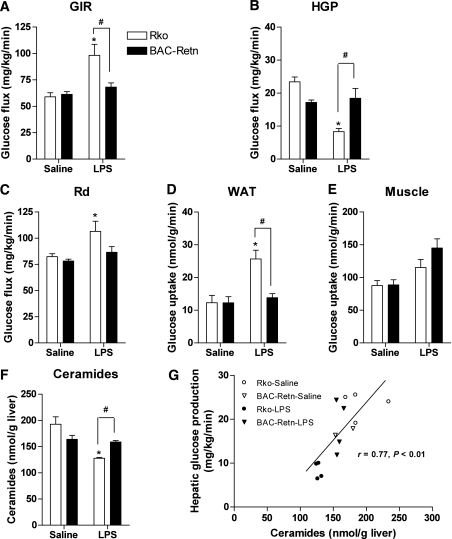
Acute endotoxemia induces hepatic and adipose tissue insulin resistance in BAC-Retn mice. A–C: Hyperinsulinemic-euglycemic clamp analysis of BAC-Retn (■) vs. Rko (□) mice (n = 4 per group) in 6 h after LPS administration. D and E: Rate of insulin-stimulated glucose uptake in WAT (D) and skeletal muscle (E). F: Total ceramides content in liver. G: Correlation between hepatic ceramide content and hepatic glucose production (HGP) during the clamp study. Data are presented with the SEM. GIR, glucose infusion rate; Rd, whole-body rate of glucose disposal. *P < 0.05 vs. saline; #P < 0.05 vs. Rko.
FIG. 4.
FIG. 4.
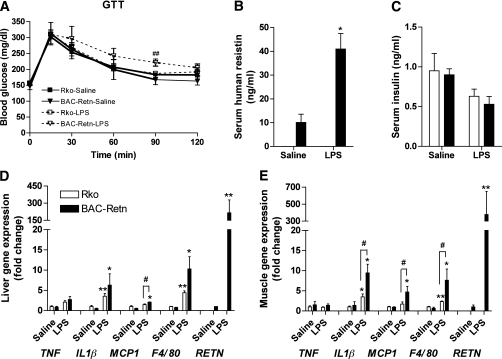
Impaired glucose tolerance and exacerbated inflammation in chronically endotoxemic BAC-Retn mice. A: With chronic LPS (2 mg/kg/day) subcutaneous infusion, BAC-Retn mice show impaired glucose tolerance compared with Rko mice (n = 5–7 per group). B and C: Serum resistin (B) and insulin (C) levels in Rko (□) and BAC-Retn (■) mice. D and E: Gene-expression analysis in liver (D) and skeletal muscle (E). Data are presented with the SEM. GTT, glucose tolerance test; RETN, human resistin. *P < 0.05, **P < 0.01 vs. saline; #P < 0.05, ##P < 0.01 vs. Rko.
FIG. 5.
FIG. 5.
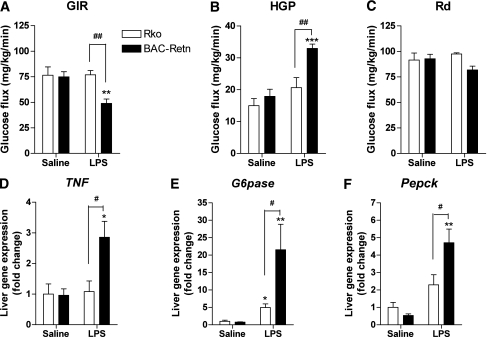
Hepatic insulin resistance in BAC-Retn mice in chronic endotoxemia. A–C: Hyperinsulinemic-euglycemic clamp analysis of BAC-Retn (■) mice vs. Rko (□) mice (n = 5–8 per group) in chronic endotoxemia. D–F: Gene-expression analysis in liver. Data are presented with the SEM. GIR, glucose infusion rate; HGP, hepatic glucose production; Rd, whole-body rate of glucose disposal. *P < 0.05, **P < 0.01, ***P < 0.001 vs. saline; #P < 0.05, ##P < 0.01 vs. Rko.

References

    1. Zimmet P, Alberti KG, Shaw J. Global and societal implications of the diabetes epidemic. Nature 2001;414:782–787 10.1038/414782a - DOI - PubMed
    1. Weisberg SP, McCann D, Desai M, Rosenbaum M, Leibel RL, Ferrante AW., Jr Obesity is associated with macrophage accumulation in adipose tissue. J Clin Invest 2003;112:1796–1808 - PMC - PubMed
    1. Wellen KE, Hotamisligil GS. Inflammation, stress, and diabetes. J Clin Invest 2005;115:1111–1119 - PMC - PubMed
    1. Kahn SE, Hull RL, Utzschneider KM. Mechanisms linking obesity to insulin resistance and type 2 diabetes. Nature 2006;444:840–846 10.1038/nature05482 - DOI - PubMed
    1. Steppan CM, Bailey ST, Bhat S, et al. The hormone resistin links obesity to diabetes. Nature 2001;409:307–312 10.1038/35053000 - DOI - PubMed

Publication types

MeSH terms