


The ENPP1 Q121 variant predicts major cardiovascular events in high-risk individuals: evidence for interaction with obesity in diabetic patients
- PMID: 21282363
- PMCID: PMC3046818
- DOI: 10.2337/db10-1300
The ENPP1 Q121 variant predicts major cardiovascular events in high-risk individuals: evidence for interaction with obesity in diabetic patients
Abstract
Objective: Insulin resistance (IR) and cardiovascular disease may share a common genetic background. We investigated the role of IR-associated ENPP1 K121Q polymorphism (rs1044498) on cardiovascular disease in high-risk individuals.
Research design and methods: A prospective study (average follow-up, 37 months) was conducted for major cardiovascular events (myocardial infarction [MI], stroke, cardiovascular death) from the Gargano Heart Study (GHS; n = 330 with type 2 diabetes and coronary artery disease), the Tor Vergata Atherosclerosis Study (TVAS; n = 141 who had MI), and the Cardiovascular Risk Extended Evaluation in Dialysis (CREED) database (n = 266 with end-stage renal disease). Age at MI was investigated in cross-sectional studies of 339 type 2 diabetic patients (n = 169 from Italy, n = 170 from the U.S.).
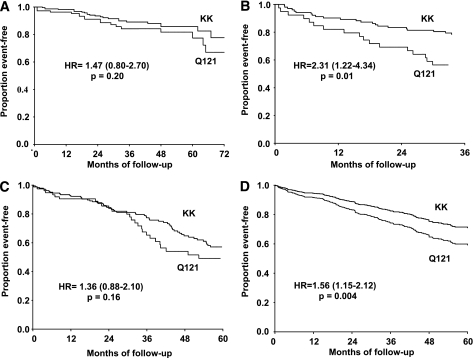
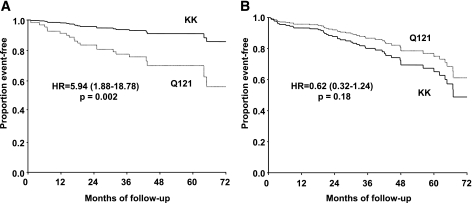
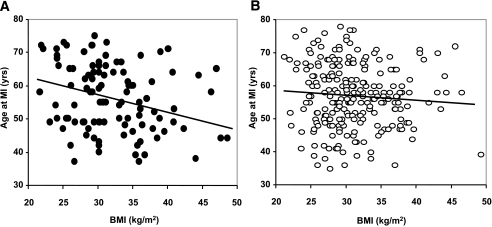
Results: Incidence of cardiovascular events per 100 person--years was 4.2 in GHS, 10.8 in TVAS, and 11.7 in CREED. Hazard ratios (HRs) for KQ+QQ versus individuals carrying the K121/K121 genotype (KK) individuals were 1.47 (95% CI 0.80-2.70) in GHS, 2.31 (95% CI 1.22-4.34) in TVAS, and 1.36 (95% CI 0.88-2.10) in CREED, and 1.56 (95% CI 1.15-2.12) in the three cohorts combined. In the 395 diabetic patients, the Q121 variant predicted cardiovascular events among obese but not among nonobese individuals (HR 5.94 vs. 0.62, P = 0.003 for interaction). A similar synergism was observed in cross-sectional studies, with age at MI being 3 years younger in Q121 carriers than in KK homozygotes among obese but not among nonobese patients (P = 0.035 for interaction).
Conclusions: The ENPP1 K121Q polymorphism is an independent predictor of major cardiovascular events in high-risk individuals. In type 2 diabetes, this effect is exacerbated by obesity. Future larger studies are needed to confirm our finding.
Figures
References
-
- Lloyd-Jones D, Adams RJ, Brown TM, et al. Writing Group Members. American Heart Association Statistics Committee and Stroke Statistics Subcommittee Heart disease and stroke statistics—2010 update: a report from the American Heart Association. Circulation 2010;121:e46–e215 - PubMed
-
- Smyth S, Heron A. Diabetes and obesity: the twin epidemics. Nat Med 2006;12:75–80 - PubMed
-
- Goya Wannamethee S, Gerald Shaper A, Whincup PH, Walker M. Overweight and obesity and the burden of disease and disability in elderly men. Int J Obes Relat Metab Disord 2004;28:1374–1382 - PubMed
-
- Wang Y, Beydoun MA, Liang L, Caballero B, Kumanyika SK. Will all Americans become overweight or obese? Estimating the progression and cost of the US obesity epidemic. Obesity (Silver Spring) 2008;16:2323–2330 - PubMed
-
- Hamsten A, Eriksson P. Identifying the susceptibility genes for coronary artery disease: from hyperbole through doubt to cautious optimism. J Intern Med 2008;263:538–552 - PubMed
Publication types
MeSH terms
Substances
Grants and funding
LinkOut - more resources
Full Text Sources
Medical
Miscellaneous
