Case Reports
doi: 10.1128/AAC.01498-10.
Epub 2011 Jan 31.
Successful treatment of Old World cutaneous leishmaniasis caused by Leishmania infantum with posaconazole
Affiliations
- PMID: 21282455
- PMCID: PMC3067187
- DOI: 10.1128/AAC.01498-10
Item in Clipboard
Case Reports
Successful treatment of Old World cutaneous leishmaniasis caused by Leishmania infantum with posaconazole
Antimicrob Agents Chemother.
2011 Apr.
Abstract
Old World cutaneous leishmaniasis is a widespread and potentially disfiguring protozoal infection that is endemic in the Mediterranean basin, Africa, and parts of Asia. Human infection is caused by several species of Leishmania parasites, such as Leishmania infantum. Available systemic and topical treatments vary in efficacy and are often unjustified due to their toxicity. We report on a case that was treated with posaconazole, a drug typically considered an antifungal agent but which also targets specific metabolic pathways of the parasite.
Figures
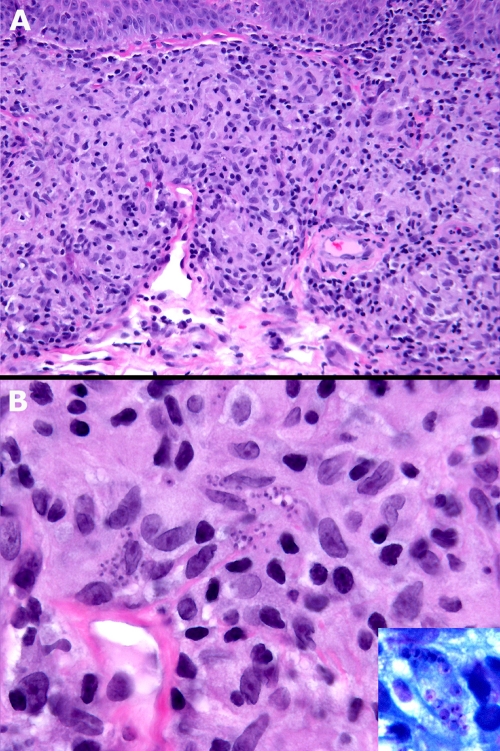
(A) Diffuse mixed granulomatous dermal infiltrate, mainly lymphoid-histiocytic (hematoxylin and eosin stain; magnification, ×20). (B) Clusters of basophilic microorganisms (amastigotes) within the histiocytes (hematoxilin and eosin stain; magnification, ×60). Inset, amastigotes within a vacuolated histiocyte. The nuclei of L. infantum are clearly visible (Giemsa stain; magnification, ×100).
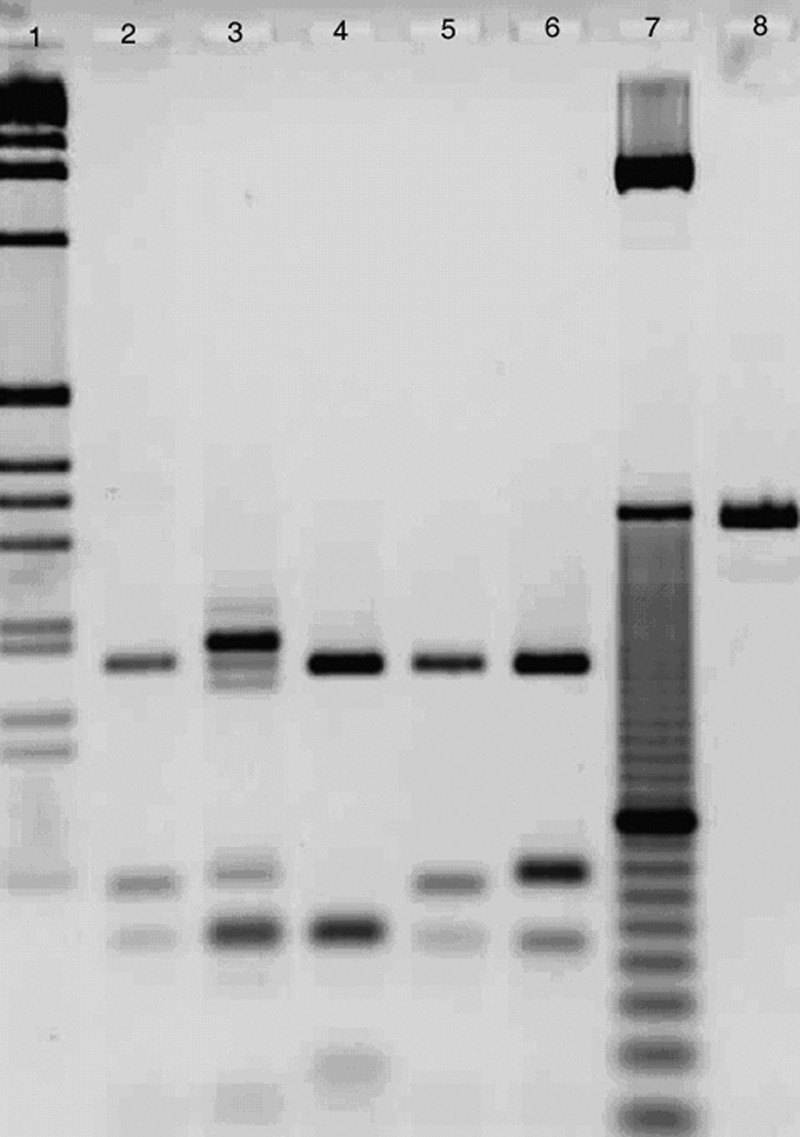
Species identification by ITS1 PCR-restriction fragment length polymorphism analysis with HaeIII enzyme digestion. Lanes: 1 and 7, 1-kb and 10-bp DNA ladders, respectively; 8, undigested ITS1 PCR product; 2, strain MHOM/US/2010/SLRCHCL isolated from the patient with CL; 3 to 6, reference strains belonging to different Leishmania species (L. aethiopica [MHOM/ET/1994/Gere], L. tropica [MHOM/PS/2001/ISL590], L. infantum [MHOM/ES/1993/PM1], and L. donovani [MHOM/SD/1993/LEM338], respectively).
References
-
- Beach, D. H., L. J. Goad, and G. G. Holz, Jr. 1988. Effects of antimycotic azoles on growth and sterol biosynthesis of Leishmania promastigotes. Mol. Biochem. Parasitol. 31:149-162. - PubMed
-
- Benaim, G., et al. 2006. Amiodarone has intrinsic anti-Trypanosoma cruzi activity and acts synergistically with posaconazole. J. Med. Chem. 49:892-899. - PubMed
-
- Blum, J., P. Desjeux, E. Schwartz, B. Beck, and C. Hatz. 2004. Treatment of cutaneous leishmaniasis among travellers. J. Antimicrob. Chemother. 53:158-166. - PubMed
-
- Blum, J. A., and C. F. Hatz. 2009. Treatment of cutaneous leishmaniasis in travelers 2009. J. Travel Med. 16:123-131. - PubMed
Publication types
MeSH terms
Substances
Associated data
- Actions
LinkOut - more resources
Full Text Sources