


Adding ROS quenchers to cold K+ cardioplegia reduces superoxide emission during 2-hour global cold cardiac ischemia
- PMID: 21282477
- PMCID: PMC3226871
- DOI: 10.1177/1074248410389815
Adding ROS quenchers to cold K+ cardioplegia reduces superoxide emission during 2-hour global cold cardiac ischemia
Abstract
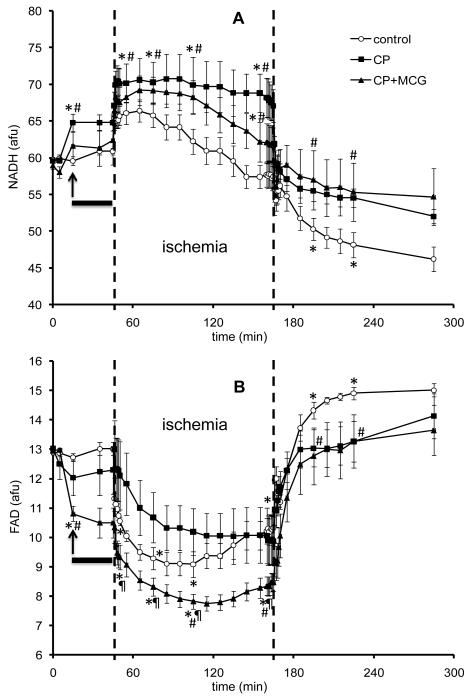
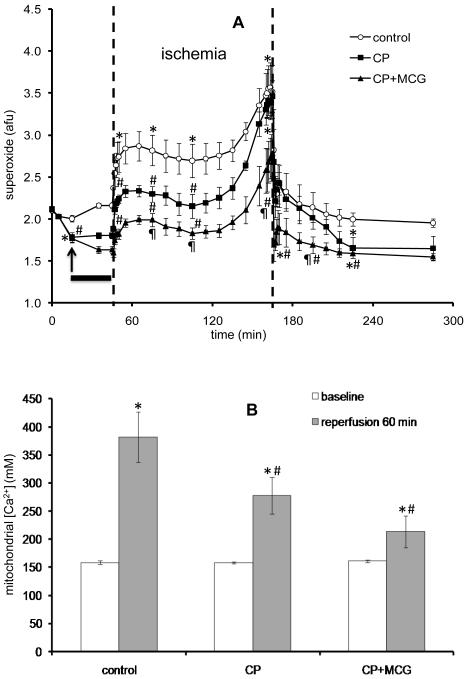
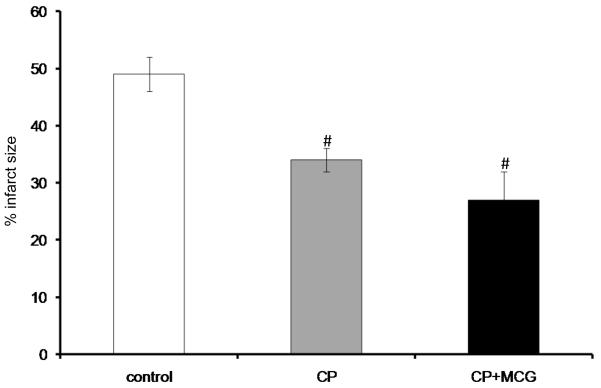
We reported that the combination of reactive oxygen species (ROS) quenchers Mn(III) tetrakis (4-benzoic acid) porphyrin (MnTBAP), catalase, and glutathione (MCG) given before 2 hours cold ischemia better protected cardiac mitochondria against cold ischemia and warm reperfusion (IR)-induced damage than MnTBAP alone. Here, we hypothesize that high K(+) cardioplegia (CP) plus MCG would provide added protection of mitochondrial bioenergetics and cardiac function against IR injury. Using fluorescence spectrophotometry, we monitored redox balance, ie reduced nicotinamide adenine dinucleotide and flavin adenine dinucleotide (NADH/FAD), superoxide (O(2) (•-)), and mitochondrial Ca(2+) (m[Ca(2+)]) in the left ventricular free wall. Guinea pig isolated hearts were perfused with either Krebs Ringer's (KR) solution, CP, or CP + MCG, before and during 27°C perfusion followed immediately by 2 hours of global ischemia at 27°C. Drugs were washed out with KR at the onset of 2 hours 37°C reperfusion. After 120 minutes warm reperfusion, myocardial infarction was lowest in the CP + MCG group and highest in the KR group. Developed left ventricular pressure recovery was similar in CP and CP + MCG and was better than in the KR group. O(2) (•-), m[Ca(2+)], and NADH/FAD were significantly different between the treatment and KR groups. O(2) (•-) was lower in CP + MCG than in the CP group. This study suggests that CP and ROS quenchers act in parallel to improve mitochondrial function and to provide protection against IR injury at 27°C.
Figures

References
-
- Riess ML, Camara AK, Kevin LG, An J, Stowe DF. Reduced reactive O2 species formation and preserved mitochondrial NADH and [Ca2+] levels during short-term 17°C ischemia in intact hearts. Cardiovasc Res. 2004;61(3):580–590. - PubMed
-
- Camara AK, Aldakkak M, Heisner JS, et al. ROS scavenging before 27°C ischemia protects hearts and reduces mitochondrial ROS, Ca2+ overload, and changes in redox state. Am J Physiol Cell Physiol. 2007;292(6):C2021–2031. - PubMed
-
- Menasche P, Grousset C, Gauduel Y, Mouas C, Piwnica A. [Protective effects of inhibitors of oxygen free radicals on the ischemic and reperfused heart. Applications to cardioplegia] Archives des maladies du coeur et des vaisseaux. 1986;79(13):1918–1923. - PubMed
-
- Tossios P, Bloch W, Huebner A, et al. N-acetylcysteine prevents reactive oxygen species-mediated myocardial stress in patients undergoing cardiac surgery: results of a randomized, double-blind, placebo-controlled clinical trial. J Thorac Cardiovasc Surg. 2003;126(5):1513–1520. - PubMed
-
- Vento AE, Nemlander A, Aittomaki J, Salo J, Karhunen J, Ramo OJ. N-acetylcysteine as an additive to crystalloid cardioplegia increased oxidative stress capacity in CABG patients. Scand Cardiovasc J. 2003;37(6):349–355. - PubMed
Publication types
MeSH terms
Substances
Grants and funding
LinkOut - more resources
Full Text Sources
Other Literature Sources
Miscellaneous
