Comparative Study

Draft genome of the red harvester ant Pogonomyrmex barbatus

Chris R Smith et al. Proc Natl Acad Sci U S A. .

Abstract

We report the draft genome sequence of the red harvester ant, Pogonomyrmex barbatus. The genome was sequenced using 454 pyrosequencing, and the current assembly and annotation were completed in less than 1 y. Analyses of conserved gene groups (more than 1,200 manually annotated genes to date) suggest a high-quality assembly and annotation comparable to recently sequenced insect genomes using Sanger sequencing. The red harvester ant is a model for studying reproductive division of labor, phenotypic plasticity, and sociogenomics. Although the genome of P. barbatus is similar to other sequenced hymenopterans (Apis mellifera and Nasonia vitripennis) in GC content and compositional organization, and possesses a complete CpG methylation toolkit, its predicted genomic CpG content differs markedly from the other hymenopterans. Gene networks involved in generating key differences between the queen and worker castes (e.g., wings and ovaries) show signatures of increased methylation and suggest that ants and bees may have independently co-opted the same gene regulatory mechanisms for reproductive division of labor. Gene family expansions (e.g., 344 functional odorant receptors) and pseudogene accumulation in chemoreception and P450 genes compared with A. mellifera and N. vitripennis are consistent with major life-history changes during the adaptive radiation of Pogonomyrmex spp., perhaps in parallel with the development of the North American deserts.


Conflict of interest statement

The authors declare no conflict of interest.

Figures
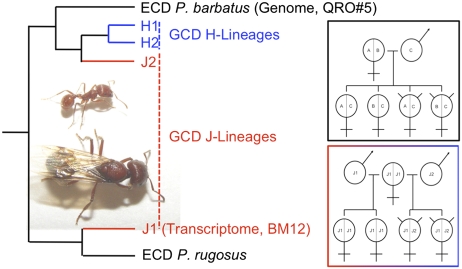
Fig. 1.
Fig. 1.
A pictorial description of the phylogenetic position of the samples used for the genome and transcriptome sequencing, with each put in the context of environmental and genetic caste determination (for a more complete phylogenetic tree, see SI Appendix, Chapter 1). The dependent lineages (H1/H2 or J1/J2) obligately co-occur because hybridization between them is necessary to produce workers, although within either J or H, the constituent lineages are reproductively isolated because interlineage hybrids cannot become queens (red/blue box). In the boxes to the right, workers are represented by “horned” female symbols. In all P. barbatus, the queen mates multiply; polyandry in genetic caste determining (GCD) colonies is obligate to produce both female castes (queens originate from intralineage matings and workers from interlineage matings). In environmental caste determination (ECD), alleles from any father have an equal chance to be in queens or workers (black box). Photo of gyne and worker P. barbatus by C. R. Smith.
Fig. 2.
Fig. 2.
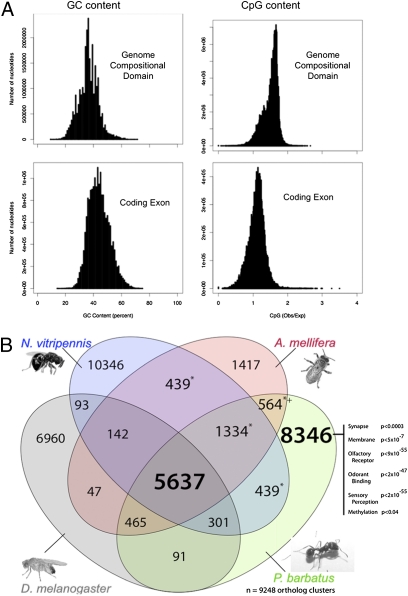
Genome-wide analyses of nucleotide and relative gene content. (A) Synopsis of GC and CpG(o/e) content of the P. barbatus genome. (Upper panels) Comparison of genome regions with the same GC composition. (Lower panels) Comparison of the same features for exons. These distributions are similar to those found in other hymenopterans, except that P. barbatus shows no evidence of bimodality in CpG(o/e) for either exons (like A. mellifera) or introns (like N. vitripennis) (for comparisons, see SI Appendix, Chapter 4). (B) A Venn diagram displaying overlap in orthologous genes in three hymenopteran and one dipteran insect (for a detailed description of the method, see SI Appendix, Chapter 5). A subset of gene ontology terms significantly enriched in P. barbatus are displayed at the right. (*) Hymenoptera-specific genes; (+) social Hymenoptera-specific genes.
Fig. 3.
Fig. 3.
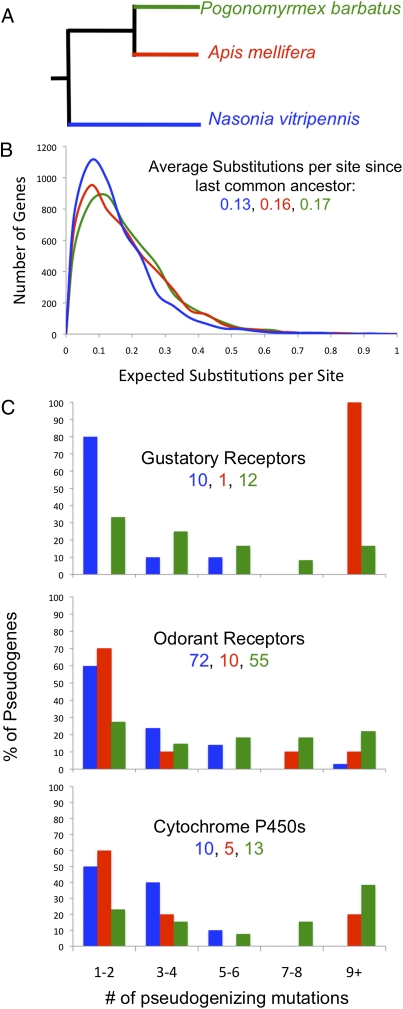
Evolutionary rate and the accumulation of pseudogene-causing (“pseudogenizing”) mutations in three gene families in the ant P. barbatus (green), the honey bee A. mellifera (red), and the jewel wasp N. vitripennis (blue). (A) The relationships among analyzed taxa. (B) A comparison of the evolutionary rates based amino acid substitutions in a set of 4,774 orthologs shared among the three species and D. melanogaster (the outgroup). (C) The accumulation of pseudogenizing mutations in three ecologically relevant gene families (Gr, Or, and cytochrome P450s). The number of pseudogenes found in each species is below the gene family name in each panel. Only one gene represents the Grs in A. mellifera; all other A. mellifera Gr pseudogenes had accrued a very high number of mutations and most are fragments. Of those analyzed here, the pseudogenes in P. barbatus tend to be much older than those in A. mellifera and N. vitripennis (ANOVA: F2,156 = 4.7, P = 0.01).

Comment in

  • The birth of ant genomics.
    Gadagkar R. Gadagkar R. Proc Natl Acad Sci U S A. 2011 Apr 5;108(14):5477-8. doi: 10.1073/pnas.1100765108. Epub 2011 Mar 28. Proc Natl Acad Sci U S A. 2011. PMID: 21444823 Free PMC article. No abstract available.

References

    1. Maynard Smith J, Szathmáry E. The Major Transitions in Evolution. New York: W. H. Freeman/Spektrum; 1995.
    1. Hölldobler B, Wilson EO. The Ants. Cambridge, MA: Belknap Press of Harvard University Press; 1990.
    1. Smith CR, Toth AL, Suarez AV, Robinson GE. Genetic and genomic analyses of the division of labour in insect societies. Nat Rev Genet. 2008;9:735–748. - PubMed
    1. Robinson GE, Grozinger CM, Whitfield CW. Sociogenomics: Social life in molecular terms. Nat Rev Genet. 2005;6:257–270. - PubMed
    1. Honeybee Genome Sequencing Consortium. Insights into social insects from the genome of the honeybee Apis mellifera. Nature. 2006;443:931–949. - PMC - PubMed

Publication types

Substances

LinkOut - more resources