. 2011 Jan-Feb;8(1):158-77.
doi: 10.4161/rna.8.1.14300. Epub 2011 Jan 1.

Deep-sequencing of human Argonaute-associated small RNAs provides insight into miRNA sorting and reveals Argonaute association with RNA fragments of diverse origin

Affiliations

Deep-sequencing of human Argonaute-associated small RNAs provides insight into miRNA sorting and reveals Argonaute association with RNA fragments of diverse origin

Alexander Maxwell Burroughs et al. RNA Biol. 2011 Jan-Feb.

Abstract

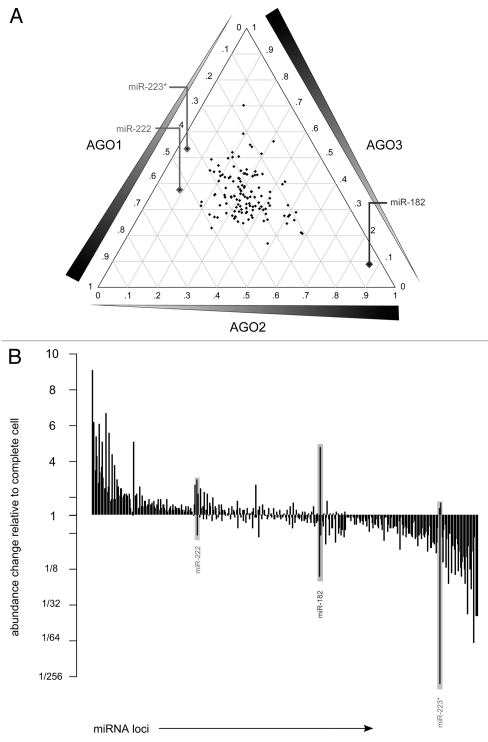
While several studies have focused on the relationship between individual miRNA loci or classes of small RNA with human Argonaute (AGO) proteins, a comprehensive, global analysis of the RNA content associating with different AGO proteins has yet to be performed. We have compared the content of deep sequenced RNA extracted from immunoprecipitation experiments with the AGO1, AGO2, and AGO3 proteins. Consistent with previous observations, sequence tags derived from miRNA loci globally associate in approximately equivalent amounts with AGO1, AGO2, and AGO3. Exceptions include miR-182, miR-222, and miR-223*, which could be coupled to processes targeting the loci for interaction with specific AGO proteins. A closer inspection of the data, however, supports the presence of an unusual sorting mechanism wherein a subset of miRNA loci give rise to distinct isomirs which preferentially associate with distinct AGO proteins in a significantly differential manner. We also identify the complete set of short RNA derived from non-miRNA sources including tRNA, snRNA, snoRNA, vRNA, and mRNA associating with the AGO proteins, many of which are predicted to play roles in post-transcriptional gene silencing. We also observe enrichment of tags mapping to promoter regions of genes, suggesting that a fraction of the recently-identified promoter-associated small RNAs in humans could function through interaction with AGO proteins. Finally, we observe antisense miRNA transcripts are frequently present in low copy numbers across a range of diverse miRNA loci and these transcripts appear to associate with AGO proteins.


Figures
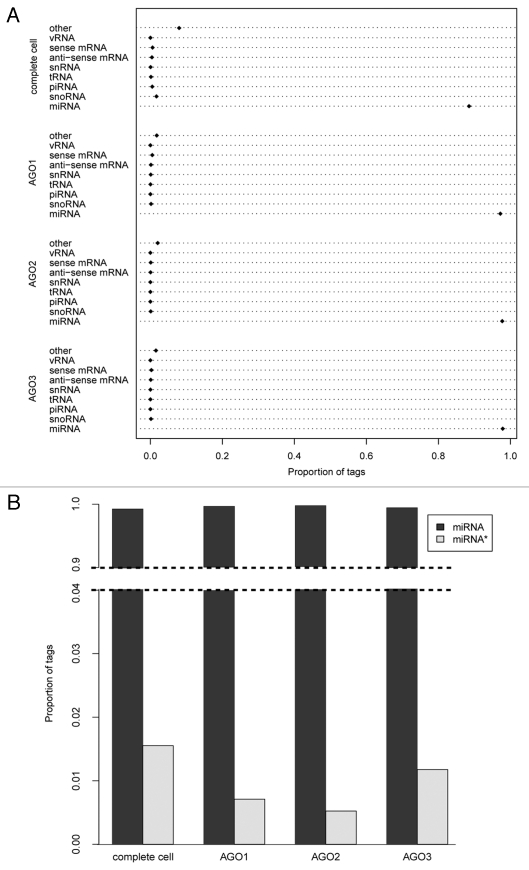
Figure 1
Figure 1
RNA associating with AGO proteins. (A) Overview of the classes of miRNA found in complete cell and associating with AGO proteins depicted as Cleveland dot plots. Classes of RNA are listed to the left, and proportion of total RNA derived from those classes is labeled along the x-axis. (B) Proportion of tags found across all libraries derived from the miRNA and miRNA* arm of the miRNA/miRNA* duplex.
Figure 2
Figure 2
Sorting of individual miRNA loci across different AGO libraries. (A) Ternary plot of the relative proportion of counts mapping to miRNA loci across the three AGO libraries, with each diamond representing a single miRNA locus. Each side of the ternary plot measures the relative proportion for a single labeled library. Gridlines corresponding to a library are plotted at a 120° angle from the side of the ternary plot with the library name. Right triangles along each axis illustrate the direction of increasing proportion. Less than 10% of the total counts derived from the miR-182 locus are found in both the AGO1 and AGO3 libraries, this diamond is outlined and labeled with the name. miRNA loci with less than 10% of the total counts in a single library are outlined and labeled. (B) Barplot measuring expression value of miRNA loci associating with each AGO library relative to the expression of the same loci in the complete cell. Each locus has three distinct bars for the AGO1, AGO2 and AGO3 libraries. Loci are ordered by summing fold change across the three libraries, with the loci showing the most increase on the left-hand side. Complete list of fold changes are provided in Supplemental Table S2. Loci displaying differential sorting in (A) are outlined and labeled.
Figure 3
Figure 3
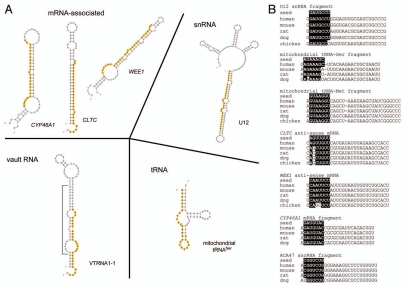
AGO association with sequences derived from various classes of non-coding RNA. (A) Two-dimensional structural diagrams of sequences identified in AGO libraries forming hairpin-like structures that conceivably are processed via DICE R1-mediated cleavage. Class of RNA is labeled at top of diagram. Name of specific RNA gene is given below diagram. Sequences identified in AGO libraries are highlighted by orange circles. In the diagram for VTRNA1-1, the sequence of the identified putative star sequence is enclosed in a bracket. (B) Conservation of putative seed sequences across vertebrate species for selected sequences listed in Table 2 (for complete list of alignments, see Sup. Fig. S3). Conserved regions in the seed sequence are colored in white and shaded in black.
Figure 4
Figure 4
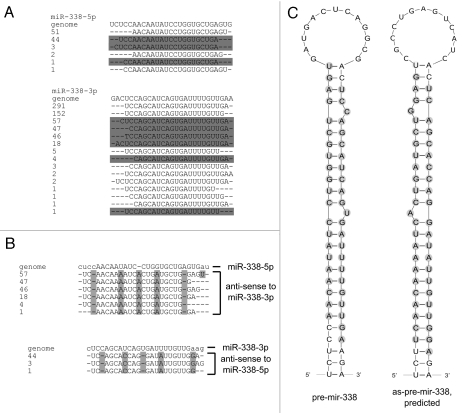
Sequences from the AGO2-associating short RNA library mapping anti-sense to the mir-338 locus. (A) Alignments of tags mapping to both the miR-338-5p and miR-338-3p mature miRNA loci. For mapping procedures, see Materials and Methods. Tags that map to the opposite (anti-sense) strand are shown as their complement sequence, and are shaded in gray. (B) Mapping the perfectly matching anti-sense tags to the opposite strand of the miRNA locus. In order for these tags to be derived from the opposite strand, several distinct post-transcriptional editing, insertion and deletion events would be required. (C) Mapping the tags to predicted anti-sense pre-miRNA-like secondary structures reveals 3′ overhangs, indicative of DICE R1-mediated processing of the mir-338 locus.
Figure 5
Figure 5
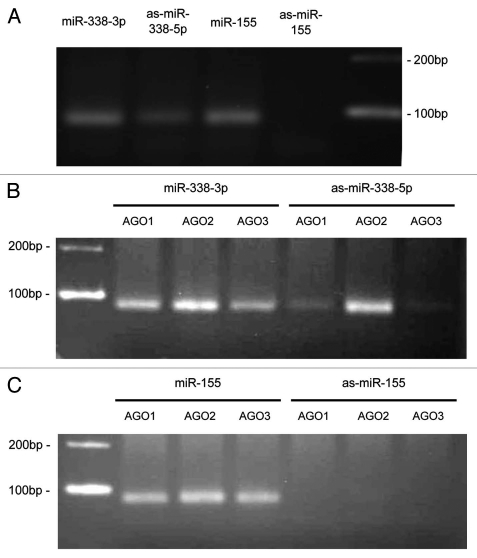
as-miR-338-5p is present in the complete cell and associates with AGO proteins. (A) Detection of as-miR-338-5p in the complete cell. (B) Detection of as-miR-338-5p in the IP extract of AGO1, AGO2 and AGO3. (C) Same as (B), but showing the absence of the negative control asmiR-155 in IP extracts.

References

    1. Lee Y, Ahn C, Han J, Choi H, Kim J, Yim J, et al. The nuclear RNase III Drosha initiates microRNA processing. Nature. 2003;425:415–419. - PubMed
    1. Han J, Lee Y, Yeom KH, Kim YK, Jin H, Kim VN. The Drosha-DGCR8 complex in primary microRNA processing. Genes Dev. 2004;18:3016–3027. - PMC - PubMed
    1. Okada C, Yamashita E, Lee SJ, Shibata S, Katahira J, Nakagawa A, et al. A high-resolution structure of the pre-microRNA nuclear export machinery. Science. 2009;326:1275–1279. - PubMed
    1. Yi R, Qin Y, Macara IG, Cullen BR. Exportin-5 mediates the nuclear export of pre-microRNAs and short hairpin RNAs. Genes Dev. 2003;17:3011–3016. - PMC - PubMed
    1. Bohnsack MT, Czaplinski K, Gorlich D. Exportin 5 is a RanGTP-dependent dsRNA-binding protein that mediates nuclear export of pre-miRNAs. RNA. 2004;10:185–191. - PMC - PubMed

Publication types

MeSH terms

LinkOut - more resources