


Biased but in doubt: conflict and decision confidence
- PMID: 21283574
- PMCID: PMC3026795
- DOI: 10.1371/journal.pone.0015954
Biased but in doubt: conflict and decision confidence
Erratum in
- PLoS One. 2011;6(2). doi: 10.1371/annotation/1ebd8050-5513-426f-8399-201773755683 doi: 10.1371/annotation/1ebd8050-5513-426f-8399-201773755683
Abstract
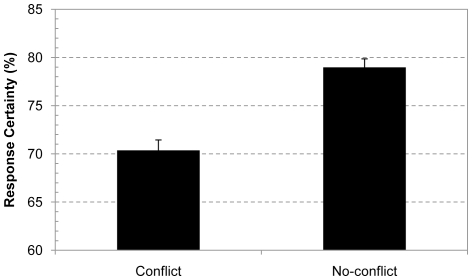
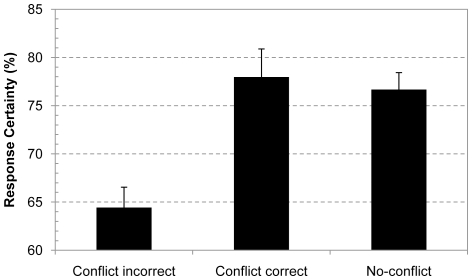
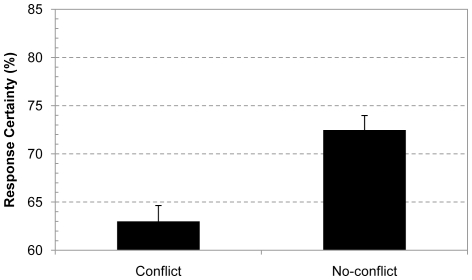
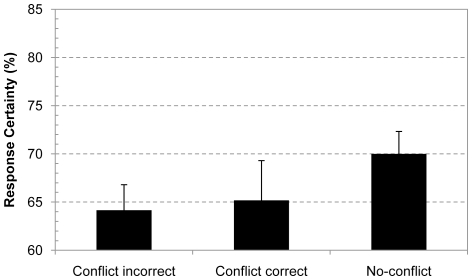
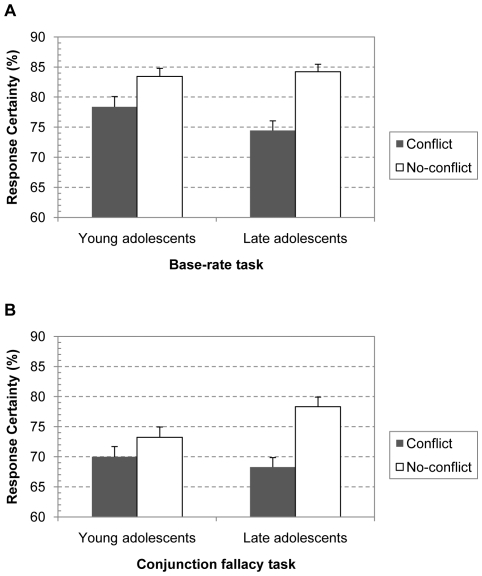
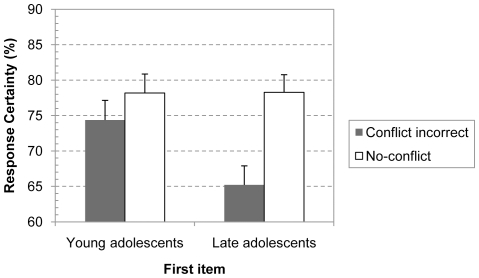
Human reasoning is often biased by intuitive heuristics. A central question is whether the bias results from a failure to detect that the intuitions conflict with traditional normative considerations or from a failure to discard the tempting intuitions. The present study addressed this unresolved debate by using people's decision confidence as a nonverbal index of conflict detection. Participants were asked to indicate how confident they were after solving classic base-rate (Experiment 1) and conjunction fallacy (Experiment 2) problems in which a cued intuitive response could be inconsistent or consistent with the traditional correct response. Results indicated that reasoners showed a clear confidence decrease when they gave an intuitive response that conflicted with the normative response. Contrary to popular belief, this establishes that people seem to acknowledge that their intuitive answers are not fully warranted. Experiment 3 established that younger reasoners did not yet show the confidence decrease, which points to the role of improved bias awareness in our reasoning development. Implications for the long standing debate on human rationality are discussed.
Conflict of interest statement
Figures
References
-
- Evans J. In two minds: dual-process accounts of reasoning. Trends in Cognitive Sciences. 2003;7:454–459. - PubMed
-
- Kahneman D, Tversky A. On the Psychology of Prediction. Psychological Review. 1973;80:237–251.
-
- Kahneman D, Frederick S. Representativeness revisited: Attribute substitution in intuitive judgement. In: Gilovich T, Griffin D, Kahneman D, editors. Heuristics and Biases: The Psychology of Intuitive Judgement. New York: Cambridge University Press; 2002. pp. 49–81.
-
- Denes-Ray V, Epstein S. Conflict between intuitive and rational processing: When people behave against their better judgment. Journal of Personality and Social Psychology. 1994;66:819–829. - PubMed
-
- Houde O. First insights on “neuropedagogy of reasoning”. Thinking & Reasoning. 2007;13:81–89.
Publication types
MeSH terms
LinkOut - more resources
Full Text Sources
