


Classifications for cesarean section: a systematic review
- PMID: 21283801
- PMCID: PMC3024323
- DOI: 10.1371/journal.pone.0014566
Classifications for cesarean section: a systematic review
Abstract
Background: Rising cesarean section (CS) rates are a major public health concern and cause worldwide debates. To propose and implement effective measures to reduce or increase CS rates where necessary requires an appropriate classification. Despite several existing CS classifications, there has not yet been a systematic review of these. This study aimed to 1) identify the main CS classifications used worldwide, 2) analyze advantages and deficiencies of each system.
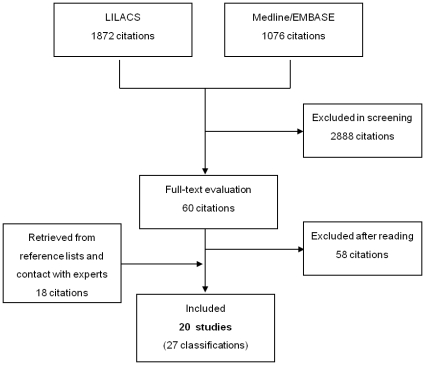
Methods and findings: Three electronic databases were searched for classifications published 1968-2008. Two reviewers independently assessed classifications using a form created based on items rated as important by international experts. Seven domains (ease, clarity, mutually exclusive categories, totally inclusive classification, prospective identification of categories, reproducibility, implementability) were assessed and graded. Classifications were tested in 12 hypothetical clinical case-scenarios. From a total of 2948 citations, 60 were selected for full-text evaluation and 27 classifications identified. Indications classifications present important limitations and their overall score ranged from 2-9 (maximum grade =14). Degree of urgency classifications also had several drawbacks (overall scores 6-9). Woman-based classifications performed best (scores 5-14). Other types of classifications require data not routinely collected and may not be relevant in all settings (scores 3-8).
Conclusions: This review and critical appraisal of CS classifications is a methodologically sound contribution to establish the basis for the appropriate monitoring and rational use of CS. Results suggest that women-based classifications in general, and Robson's classification, in particular, would be in the best position to fulfill current international and local needs and that efforts to develop an internationally applicable CS classification would be most appropriately placed in building upon this classification. The use of a single CS classification will facilitate auditing, analyzing and comparing CS rates across different settings and help to create and implement effective strategies specifically targeted to optimize CS rates where necessary.
Conflict of interest statement
Figures
References
-
- Belizan JM, Althabe F, Cafferata ML. Health consequences of the increasing caesarean section rates. Epidemiology. 2007;18:485–486. - PubMed
-
- Sachs BP, Kobelin C, Castro MA, Frigoletto F. The risks of lowering the cesarean-delivery rate. N Engl J Med. 1999;340:54–57. - PubMed
-
- Wagner M. Fish can't see water: the need to humanize birth. Int J Gynaecol Obstet. 2001;75(Suppl 1):S25–S37. - PubMed
-
- Thomas J, Paranhothy S. The National Sentinel Caesarean Section Audit Report. 2001.
-
- Betran AP, Merialdi M, Lauer JA, Bing-Shun W, Thomas J, et al. Rates of caesarean section: analysis of global, regional and national estimates. Paediatr Perinat Epidemiol. 2007;21:98–113. - PubMed
Publication types
MeSH terms
LinkOut - more resources
Full Text Sources
Medical
