


Re-evaluating the impact of tumor size on survival following pancreaticoduodenectomy for pancreatic adenocarcinoma
- PMID: 21283994
- PMCID: PMC3578317
- DOI: 10.1002/jso.21883
Re-evaluating the impact of tumor size on survival following pancreaticoduodenectomy for pancreatic adenocarcinoma
Abstract
Background and objectives: Following resection of pancreatic adenocarcinoma, tumor size has been considered a key prognostic feature; however, this remains controversial. We sought to examine the association of size with outcomes following resection of pancreatic adenocarcinoma.
Methods: Between 1970 and 2010, 1,697 patients with pancreatic adenocarcinoma at the Johns Hopkins Hospital underwent curative intent pancreaticoduodenectomy. Prognostic factors were identified by univariate and multivariate analyses.
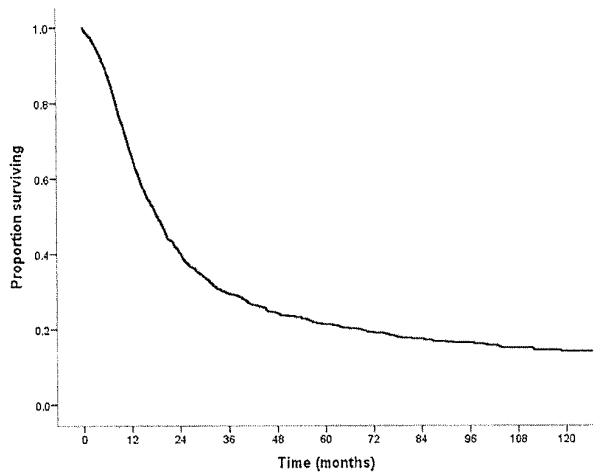
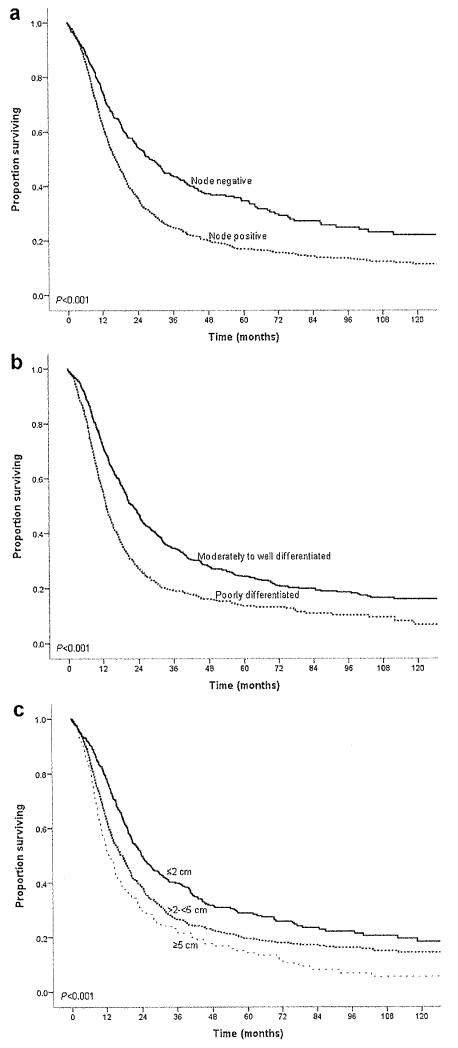
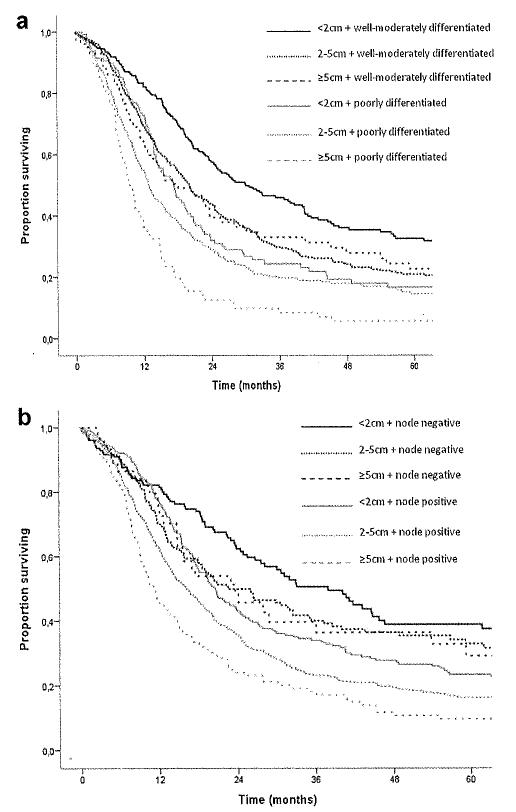
Results: Of 1,697 patients, tumor size was ≤ 2 cm in 418 (24.6%) patients, 2-5 cm in 1,070 (63.1%) patients, and ≥ 5 cm in 209 (12.3%) patients. On univariate analyses, 5-year survival was inversely proportional to tumor size (≤ 2 cm: 28.8% vs. 2-5 cm: 19.4% vs. ≥ 5 cm: 14.2%; P < 0.001). Size correlated with the risk of other adverse factors, with larger tumors being more likely to be associated with nodal disease and poor differentiation (both P < 0.05). On multivariate analysis, the 2 cm cut-off was not associated with survival, while nodal disease (HR = 1.59; P = 0.006) and poor differentiation (HR = 1.59; P = 0.04) remained predictive of outcome, regardless of size.
Conclusion: The cut-off value of 2 cm is not independently associated with outcome, however, tumor size was strongly associated with the risk of other adverse prognostic factors. The effect of size on prognosis was largely attributable to these other biologic factors rather than tumor size itself.
Copyright © 2011 Wiley-Liss, Inc.
Figures
References
-
- Jemal A, Siegel R, Ward E, et al. Cancer statistics, 2009. CA Cancer J Clin. 2009;59:225–249. - PubMed
-
- Lowenfels AB, Maisonneuve P, Whitcomb DC. Risk factors for cancer in hereditary pancreatitis. International Hereditary Pancreatitis Study Group. Med Clin North Am. 2000;84:565–573. - PubMed
-
- Jemal A, Siegel R, Ward E, et al. Cancer statistics, 2006. CA Cancer J Clin. 2006;56:106–130. - PubMed
-
- Bouvet M, Gamagami RA, Gilpin EA, et al. Factors influencing survival after resection for periampullary neoplasms. Am J Surg. 2000;180:13–17. - PubMed
-
- Cress RD, Yin D, Clarke L, et al. Survival among patients with adenocarcinoma of the pancreas: A population-based study (United States) Cancer Causes Control. 2006;17:403–409. - PubMed
MeSH terms
Grants and funding
LinkOut - more resources
Full Text Sources
Medical
