Review
. 2011 Sep;82(9):1223-37.
doi: 10.1902/jop.2011.100710. Epub 2011 Feb 2.

Cell- and gene-based therapeutic strategies for periodontal regenerative medicine

Affiliations
Review

Cell- and gene-based therapeutic strategies for periodontal regenerative medicine

Hector F Rios et al. J Periodontol. 2011 Sep.

Abstract

Inflammatory periodontal diseases are a leading cause of tooth loss and are linked to multiple systemic conditions, such as cardiovascular disease and stroke. Reconstruction of the support and function of affected tooth-supporting tissues represents an important therapeutic endpoint for periodontal regenerative medicine. An improved understanding of periodontal biology coupled with current advances in scaffolding matrices has introduced novel treatments that use cell and gene therapy to enhance periodontal tissue reconstruction and its biomechanical integration. Cell and gene delivery technologies have the potential to overcome limitations associated with existing periodontal therapies, and may provide a new direction in sustainable inflammation control and more predictable tissue regeneration of supporting alveolar bone, periodontal ligament, and cementum. This review provides clinicians with the current status of these early-stage and emerging cell- and gene-based therapeutics in periodontal regenerative medicine, and introduces their future application in clinical periodontal treatment. The paper concludes with prospects on the application of cell and gene tissue engineering technologies for reconstructive periodontology.


Conflict of interest statement

The authors report no conflicts of interest related to this review.

Figures
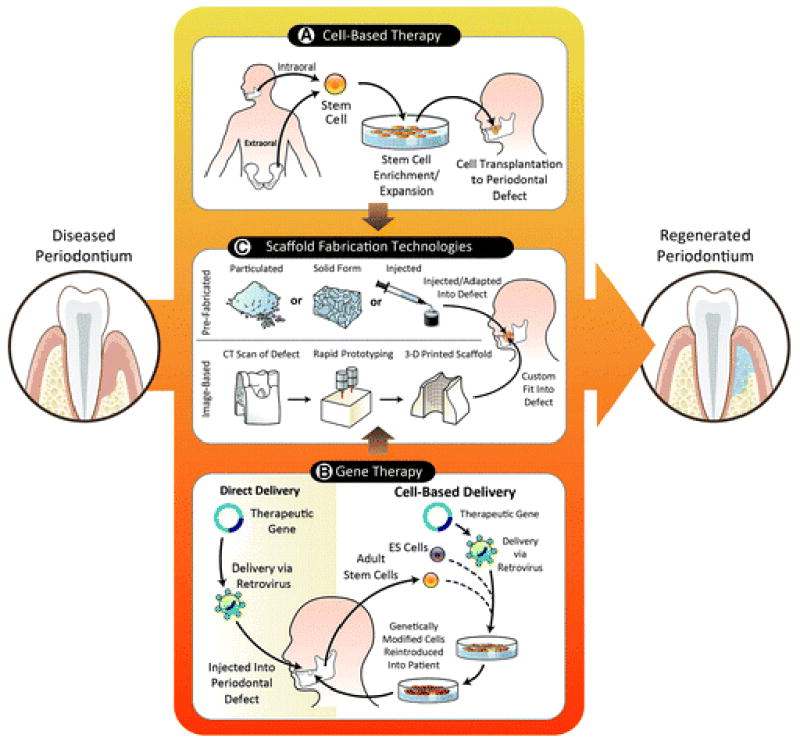
Figure 1
Figure 1
Cell- and gene-based technologies using scaffolding matrices for periodontal tissue engineering. A) Extraoral and intraoral stem cells represent a viable and accessible alternative source to harvest and expand multipotent colonies. Adequate cell density could be reached in vitro under a controlled environment and made readily available for reimplantation into a periodontal defect site. B) The available direct and cell-based delivery of a therapeutic gene has been shown to increase the regenerative potential and enhance the availability of important factors. The gene of interest is either injected directly into the periodontal defect via a retrovirus or alternatively could be incorporated into an embryonic stem cell (ES) or adult stem cell that is subsequently expanded and delivered into the area of interest. C) Prefabricated and image-based scaffolds are becoming an essential component in regenerative medicine. A defined supporting structure allows the localization and guidance of the appropriate cells and proteins and the establishment of a mechanically competent environment. Currently, scaffolds for periodontal regeneration are available in particulated, solid, and injectable forms. New developing technology has allowed the customization of scaffolds that fit into the periodontal defect and include an external and internal architecture that enhances tissue orientation and regeneration. This figure highlights the potential of integrating the available tissue engineering strategies to enhance the outcome of periodontal regenerative therapy.
Figure 2
Figure 2
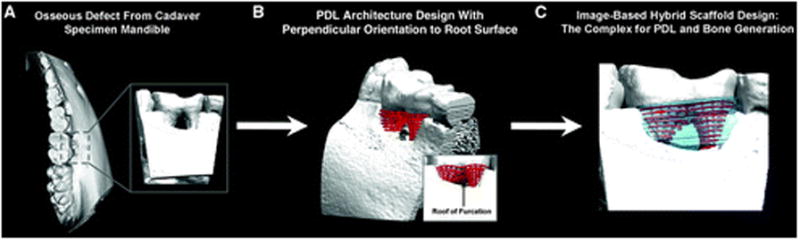
Hybrid scaffolds for periodontal cell and gene delivery. A through C) Surgically created Class III furcation defect is observed in this figure. The image-based scaffold aims at generating a three-dimensional polarity and patterning within the defect geometry to guide and establish cell tissue integration and directionality.
Figure 3
Figure 3
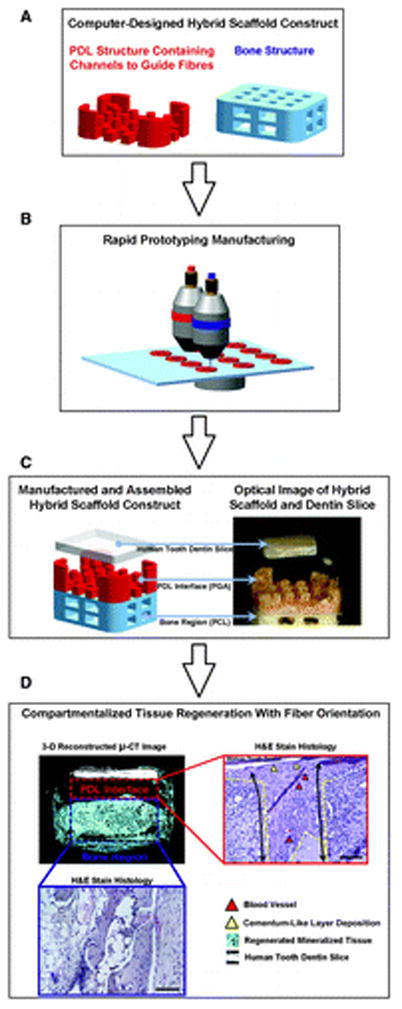
The hybrid scaffold concept has proved effective at establishing an adequate periodontal tissue interface that integrates the newly formed cementum, bone, and properly oriented PDL fibers. A) The main two compartments of the scaffold are depicted as PDL region (red) and bone region (blue). B) A rapid prototyping technique is used to generate the three-dimensional geometry. C) Wax molds for PDL and bone architectures are manufactured and fabricated to cast polymeric materials, poly-glycolide (PGA) for PDL and poly-ε-caprolactone (PCL) for bone of the hybrid scaffold. D) Microcomputed tomography (μ-CT) showed that the designed hybrid scaffold guides multiple tissue formation with the specific dimension in PDL interface (red dash-lined box) and bone region (blue dash-lined box). The hematoxylin and eosin staining was used to analyze mineralized tissue formation and fibrous connective tissue formation (scale bar = 50 μm original magnification ×10). In PDL interface, fibrous tissue orientation along the PDL topography (yellow dash-lined border) was found with blood vessel formations (red triangles) and limited cementum-like layer formation on the tooth dentin surface (yellow triangles).

References

    1. Discher DE, Mooney DJ, Zandstra PW. Growth factors, matrices, and forces combine and control stem cells. Science. 2009;324:1673–1677. - PMC - PubMed
    1. Taba M, Jr, Jin Q, Sugai JV, Giannobile WV. Current concepts in periodontal bioengineering. Orthod Craniofac Res. 2005;8:292–302. - PMC - PubMed
    1. Mao JJ, Giannobile WV, Helms JA, et al. Craniofacial tissue engineering by stem cells. J Dent Res. 2006;85:966–979. - PMC - PubMed
    1. Pittenger MF, Mackay AM, Beck SC, et al. Multilineage potential of adult human mesenchymal stem cells. Science. 1999;284:143–147. - PubMed
    1. Becker AJ, McCulloch EA, Till JE. Cytological demonstration of the clonal nature of spleen colonies derived from transplanted mouse marrow cells. Nature. 1963;197:452–454. - PubMed

Publication types

MeSH terms