


Selective transmission of R5 HIV-1 variants: where is the gatekeeper?
- PMID: 21284905
- PMCID: PMC3105506
- DOI: 10.1186/1479-5876-9-S1-S6
Selective transmission of R5 HIV-1 variants: where is the gatekeeper?
Abstract
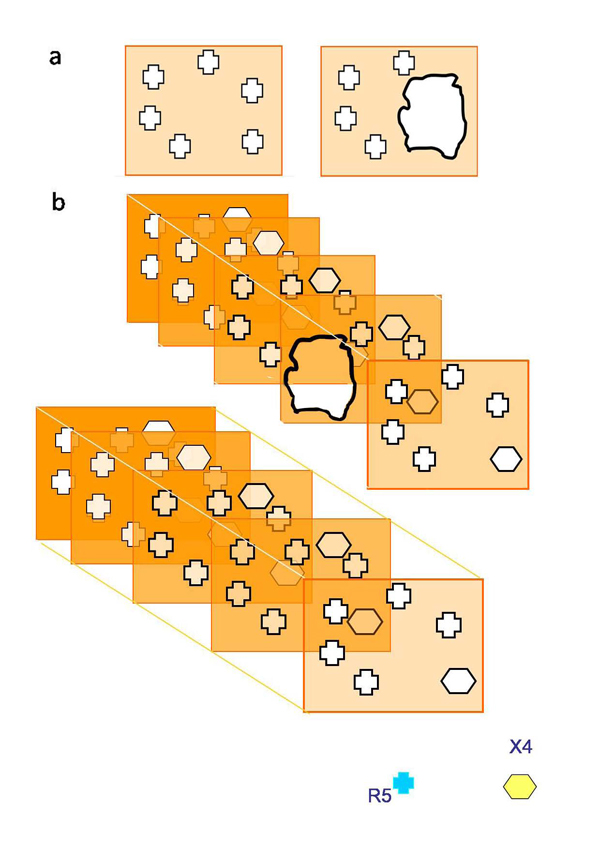
To enter target cells HIV-1 uses CD4 and a coreceptor. In vivo the coreceptor function is provided either by CCR5 (for R5) or CXCR4 (for X4 HIV-1). Although both R5 and X4 HIV-1 variants are present in body fluids (semen, blood, cervicovaginal and rectal secretions), R5 HIV-1 appears to transmit infection and dominates early stages of HIV disease. Moreover, recent sequence analysis of virus in acute infection shows that, in the majority of cases of transmission, infection is initiated by a single virus. Therefore, the existence of a "gatekeeper" that selects R5 over X4 HIV-1 and that operates among R5 HIV-1 variants has been suggested. In the present review we consider various routes of HIV-transmission and discuss potential gatekeeping mechanisms associated with each of these routes. Although many mechanisms have been identified none of them explains the almost perfect selection of R5 over X4 in HIV-1 transmission. We suggest that instead of one strong gatekeeper there are multiple functional gatekeepers and that their superimposition is sufficient to protect against X4 HIV-1 infection and potentially select among R5 HIV-1 variants. In conclusion, we propose that the principle of multiple barriers is more general and not restricted to protection against X4 HIV-1 but rather can be applied to other phenomena when one factor has a selective advantage over the other(s). In the case of gatekeepers for HIV-1 transmission, the task is to identify them and to decipher their molecular mechanisms. Knowledge of the gatekeepers' localization and function may enable us to enhance existing barriers against R5 transmission and to erect the new ones against all HIV-1 variants.
Figures
References
Publication types
MeSH terms
Substances
Grants and funding
LinkOut - more resources
Full Text Sources
Other Literature Sources
Medical
Research Materials
