. 2011 Mar;152(3):1180-91.
doi: 10.1210/en.2010-0900. Epub 2011 Feb 1.

Distinct roles of deiodinases on the phenotype of Mct8 defect: a comparison of eight different mouse genotypes

Affiliations

Distinct roles of deiodinases on the phenotype of Mct8 defect: a comparison of eight different mouse genotypes

Xiao-Hui Liao et al. Endocrinology. 2011 Mar.

Abstract

Mice deficient in the thyroid hormone (TH) transporter Mct8 (Mct8KO) have increased 5'-deiodination and impaired TH secretion and excretion. These and other unknown mechanisms result in the low-serum T(4), high T(3), and low rT(3) levels characteristic of Mct8 defects. We investigated to what extent each of the 5'-deiodinases (D1, D2) contributes to the serum TH abnormalities of the Mct8KO by generating mice with all combinations of Mct8 and D1 and/or D2 deficiencies and comparing the resulting eight genotypes. Adding D1 deficiency to that of Mct8 corrected the serum TH abnormalities of Mct8KO mice, normalized brain T(3) content, and reduced the impaired expression of TH-responsive genes. In contrast, Mct8D2KO mice maintained the serum TH abnormalities of Mct8KO mice. However, the serum TSH level increased 27-fold, suggesting a severely impaired hypothalamo-pituitary-thyroid axis. The brain of Mct8D2KO manifested a pattern of more severe impairment of TH action than Mct8KO alone. In triple Mct8D1D2KO mice, the markedly increased serum TH levels produced milder brain defect than that of Mct8D2KO at the expense of more severe liver thyrotoxicosis. Additionally, we observed that mice deficient in D2 had an unexplained marked reduction in the thyroid growth response to TSH. Our studies on these eight genotypes provide a unique insight into the complex interplay of the deiodinases in the Mct8 defect and suggest that D1 contributes to the increased serum T(3) in Mct8 deficiency, whereas D2 mainly functions locally, converting T(4) to T(3) to compensate for distinct cellular TH depletion in Mct8KO mice.


Figures
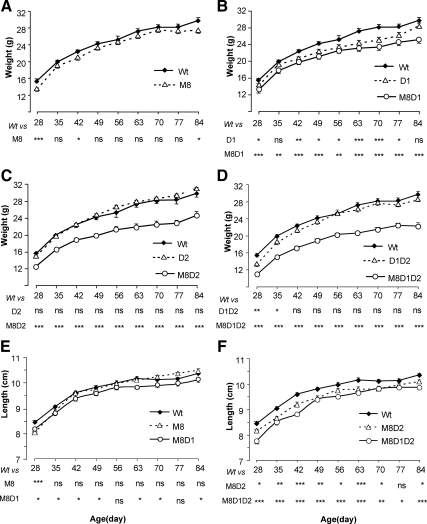
Fig. 1.
Fig. 1.
Growth curves for mice of the eight genotypes under investigation. Panels A through D show weights and E and F show lengths. Weights in each panel compare Wt to M8KO mice and with those deficient in D1, D2, or D1 and D2 in the presence and absence of Mct8. Length curves are shown only for the genotypes with Mct8 deficiency in comparison with the Wt mice. Results are expressed as mean ± se for nine to 13 animals for each data point. Statistical differences from the Wt mice are shown for each data point and in each genotype below the x-axis: *, P < 0.05; **, P < 0.01; ***, P < 0.001. ns, Not significant. Genotype nomenclatures are abridged as follows: M8, M8KO; D1, D1KO; M8D1, M8D1KO; D2, D2KO; M8D2, M8D2KO; D1D2, D1D2KO; and M8D1D2, M8D1D2KO.
Fig. 2.
Fig. 2.
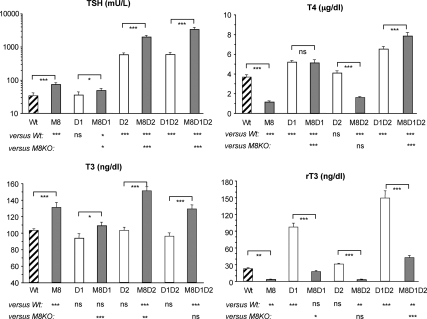
TSH, T4, T3, and rT3 concentrations in serum of mice of the eight genotypes under investigation. Results are expressed as mean ± se for 12–16 mice per group. Statistical differences between Wt and all genotypes of mice and between M8KO and all other three genotypes with Mct8 deficiency are shown below the x-axis; differences between littermates, with and without Mct8 deficiency, are indicated above the bars. *, P < 0.05; **, P < 0.01; ***, P < 0.001. ns, Not significant. Genotype nomenclatures are abridged as follows: M8, M8KO; D1, D1KO; M8D1, M8D1KO; D2, D2KO; M8D2, M8D2KO; D1D2, D1D2KO; and M8D1D2, M8D1D2KO.
Fig. 3.
Fig. 3.
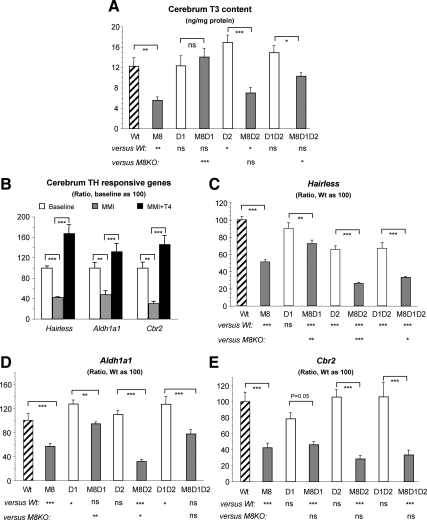
Effect of genotype on brain (cerebrum) T3 content and TH action. A, T3 content for nine to 13 mice per group. B, Expression of TH-responsive genes relative to baseline in Wt mice deprived of TH [in LoI/MMI/ClO4 treatment (MMI)] and treated with 10 μg l-T4 per 100 g body weight (MMI+T4). There were five to six animals per group and statistical differences are indicated above the bar. Hairless (C), Aldh1a1 (D), and Cbr2 (E) mRNA levels are shown relative to Wt mice. Results are expressed as mean ± se for six to seven mice per group. Statistical differences between Wt and all genotypes of mice and between M8KO and all other three genotypes with Mct8 deficiency are shown below the x-axis; differences between littermates, with and without Mct8 deficiency, are indicated above the bars. *, P < 0.05; **, P < 0.01; ***, P < 0.001. ns, Not significant. Genotype nomenclatures are abridged as follows: M8, M8KO; D1, D1KO; M8D1, M8D1KO; D2, D2KO; M8D2, M8D2KO; D1D2, D1D2KO; and M8D1D2, M8D1D2KO.
Fig. 4.
Fig. 4.
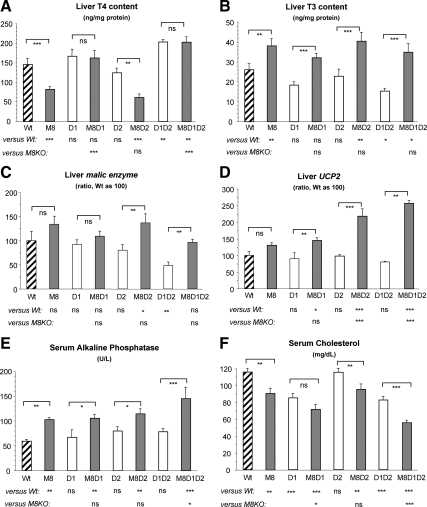
Effect of genotype on liver TH content and action. T4 content (A) and T3 content (B) for nine to 13 animals per group are shown. Liver ME (C) and UCP2 (D) mRNA levels relative to values of Wt mice are shown. Serum AP (E) and cholesterol (F) concentration in five to six mice per group are shown. Results are expressed as mean ± se. Statistical differences between Wt and all genotypes of mice and between M8KO and all other three genotypes with Mct8 deficiency are shown below the x-axis; differences between littermates, with and without Mct8 deficiency, are indicated above the bars. *, P < 0.05; **, P < 0.01; ***, P < 0.001. ns, Not significant. Genotype nomenclatures are abridged as follows: M8, M8KO; D1, D1KO; M8D1, M8D1KO; D2, D2KO; M8D2, M8D2KO; D1D2, D1D2KO; and M8D1D2, M8D1D2KO.
Fig. 5.
Fig. 5.
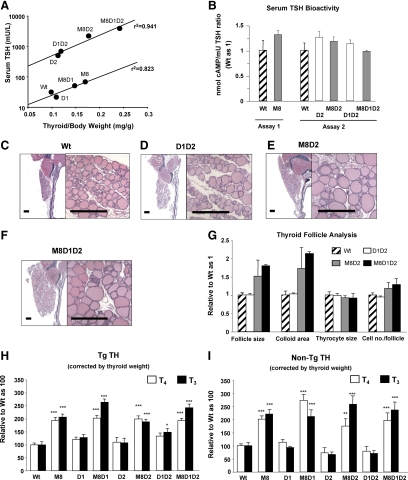
Effect of genotype on thyroid gland size, histology, and thyroidal TH content. A, Correlation of serum TSH concentration and thyroid gland weight corrected by body weight in the eight genotypes of mice under investigation. The mouse genotypes are indicated next to each data point. Data generated two exponential correlations are as follows: one involving mice with intact D2 (Wt, M8KO, D1KO, and M8D1KO), y = 6.1106 × 106.0151x (r2 = 0.823) and another involving mice with D2 deficiency (D2KO, M8D2KO, D1D2KO, and M8D1D2KO), y = 98.311 × 106.8113x (r2 = 0.941). There is a 19- to 25-fold difference in TSH for the same increase of thyroid gland size between mice with and without D2. B, Serum TSH bioactivity in different mouse genotypes (Wt, M8KO, D2KO, M8D2KO, D1D2KO, and M8D1D2KO). Activities were measured in six animals from each genotype and two independent assays. Data are expressed as the ratio of cAMP production relative to TSH immunoactivity, adjusted to unity for Wt mice. C–F, Low- (left panel) and high- (right panel) power views of hematoxylin/eosin-stained thyroid gland sections from Wt, D1D2KO, M8D2KO, and M8D1D2KO mice aged 90–100 d. Scale bar, 300 μm. G, Morphometric analysis of corresponding stained sections showing average thyroid follicle size, colloid area, thyrocyte size, and thyroid cell numbers per follicle. Tg TH (TH content within the Tg molecule) (H) and non-Tg TH (TH in thyroid gland not within the Tg molecule) (I) are shown after correction for thyroid weight and relative to those in Wt mice as 100. In Wt mice, Tg T4 and T3 were 232.2 ± 16.2 and 20.3 ± 2.5 ng/mg of thyroid weight, respectively; and non-Tg T4 and T3 were 3.35 ± 0.22 and 0.146 ± 0.017 ng/mg of thyroid weight, respectively. Results are expressed as mean ± se for six to nine mice per group. Significant differences for each genotype compared with Wt are presented above the bars. *, P < 0.05; **, P < 0.01; ***, P < 0.001. Genotype nomenclatures are abridged as follows: M8, M8KO; D1, D1KO; M8D1, M8D1KO; D2, D2KO; M8D2, M8D2KO; D1D2, D1D2KO; and M8D1D2, M8D1D2KO.

References

    1. Kopp P, Solis-Sainz JC. 2009. Thyroid hormone synthesis. In: Wondisford FE, Radovick S. eds. Clinical management of thyroid disease. Philadelphia: Saunders/Elsevier; 19–41
    1. Jansen J, Friesema EC, Milici C, Visser TJ. 2005. Thyroid hormone transporters in health and disease. Thyroid 15:757–768 - PubMed
    1. Gereben B, Zavacki AM, Ribich S, Kim BW, Huang SA, Simonides WS, Zeöld A, Bianco AC. 2008. Cellular and molecular basis of deiodinase-regulated thyroid hormone signaling. Endocr Rev 29:898–938 - PMC - PubMed
    1. Bianco AC, Salvatore D, Gereben B, Berry MJ, Larsen PR. 2002. Biochemistry, cellular and molecular biology, and physiological roles of the iodothyronine selenodeiodinases. Endocr Rev 23:38–89 - PubMed
    1. Friesema EC, Ganguly S, Abdalla A, Manning Fox JE, Halestrap AP, Visser TJ. 2003. Identification of monocarboxylate transporter 8 as a specific thyroid hormone transporter. J Biol Chem 278:40128–40135 - PubMed

Publication types