Trends in epidemiology of neonatal sepsis in a tertiary center in Korea: a 26-year longitudinal analysis, 1980-2005
- PMID: 21286023
- PMCID: PMC3031016
- DOI: 10.3346/jkms.2011.26.2.284
Trends in epidemiology of neonatal sepsis in a tertiary center in Korea: a 26-year longitudinal analysis, 1980-2005
Abstract
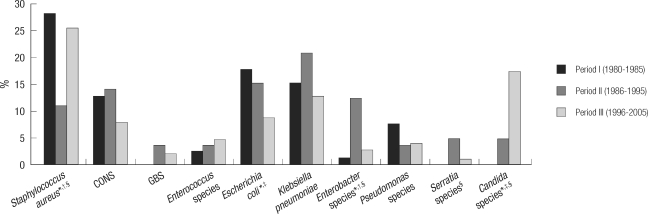
There were many reports of longitudinal changes in the causative organisms of neonatal sepsis in Western countries but few in Asia. We aimed to study longitudinal trends in the epidemiology of neonatal sepsis at Seoul National University Children's Hospital (SNUCH), a tertiary center in Korea, and compared the results to previous studies of Western countries. The medical records of all of the neonates who were hospitalized at SNUCH from 1996 to 2005 with positive blood cultures were reviewed. We also compared the findings to previous 16-yr (1980-1995). One hundred and forty-nine organisms were identified in 147 episodes from 134 infants. In comparison with the previous 16-yr studies, there was a decrease in the number of Escherichia coli infections (16.2% vs 8.7%: odds ratio [OR] 0.495; 95% confidence interval [CI], 0.255-0.962; P = 0.035), but an increase in Staphylococcus aureus (16.6% vs 25.5%: OR 1.720; 95% CI, 1.043-2.839; P = 0.033) and fungal infections (3.3% vs 18.7%: OR 6.740; 95% CI, 2.981-15.239; P < 0.001), predominantly caused by Candida species. In conclusion, the incidence of sepsis caused by E. coli decreases, but S. aureus and fungal sepsis increases significantly. Compared with Western studies, the incidence of sepsis caused by S. aureus and fungus has remarkably increased.
Keywords: Epidemiology; Organism; Sepsis.
Figures
References
-
- Bizzarro MJ, Raskind C, Baltimore RS, Gallagher PG. Seventy-five years of neonatal sepsis at Yale: 1928-2003. Pediatrics. 2005;116:595–602. - PubMed
-
- Stoll BJ, Hansen N, Fanaroff AA, Wright LL, Carlo WA, Ehrenkranz RA, Lemons JA, Donovan EF, Stark AR, Tyson JE, Oh W, Bauer CR, Korones SB, Shankaran S, Laptook AR, Stevenson DK, Papile LA, Poole WK. Late-onset sepsis in very low birth weight neonates: the experience of the NICHD Neonatal Research Network. Pediatrics. 2002;110:285–291. - PubMed
-
- Rønnestad A, Abrahamsen TG, Gaustad P, Finne PH. Blood culture isolates during 6 years in a tertiary neonatal intensive care unit. Scand J Infect Dis. 1998;30:245–251. - PubMed
-
- Butler KM, Baker CJ. Candida: an increasingly important pathogen in the nursery. Pediatr Clin North Am. 1988;35:543–563. - PubMed