


The effects of male aging on semen quality, sperm DNA fragmentation and chromosomal abnormalities in an infertile population
- PMID: 21287403
- PMCID: PMC3151353
- DOI: 10.1007/s10815-011-9537-5
The effects of male aging on semen quality, sperm DNA fragmentation and chromosomal abnormalities in an infertile population
Abstract
Purpose: To investigate the effects of male aging on semen quality, DNA fragmentation and chromosomal abnormalities in the spermatozoa of infertile patients and fertile men.
Methods: Semen samples of 140 infertile patients (24-76 years) and 50 men with proven fertility (25-65 years) were analyzed according to WHO guidelines. DNA fragmentation was detected by TUNEL assay, while aneuploidy was assessed by FISH.
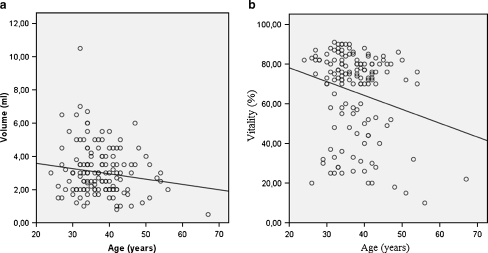
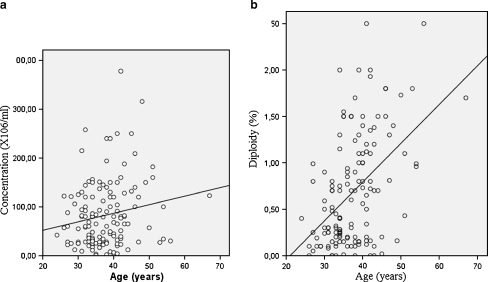
Results: In the patient group, semen volume and vitality of spermatozoa decreased significantly with age, while sperm concentration showed a statistically significant increase with age. DNA fragmentation as well as disomy of sex chromosomes and disomy 8 did not show a statistically significant change with age. However, the diploidy rate was significantly increased with patient's age. In the control group, conventional semen parameters as well as DNA fragmentation and chromosomal abnormalities did not show a statistically significant with age.
Conclusion: Increased age in infertile men is associated with an increase in sperm concentration and diploidy, as well as a decline in semen volume and sperm vitality. However motility, morphology and DNA fragmentation are not affected by male age.
Figures
References
MeSH terms
LinkOut - more resources
Full Text Sources
Medical
