


Analysis of the peroxiredoxin family: using active-site structure and sequence information for global classification and residue analysis
- PMID: 21287625
- PMCID: PMC3065352
- DOI: 10.1002/prot.22936
Analysis of the peroxiredoxin family: using active-site structure and sequence information for global classification and residue analysis
Abstract
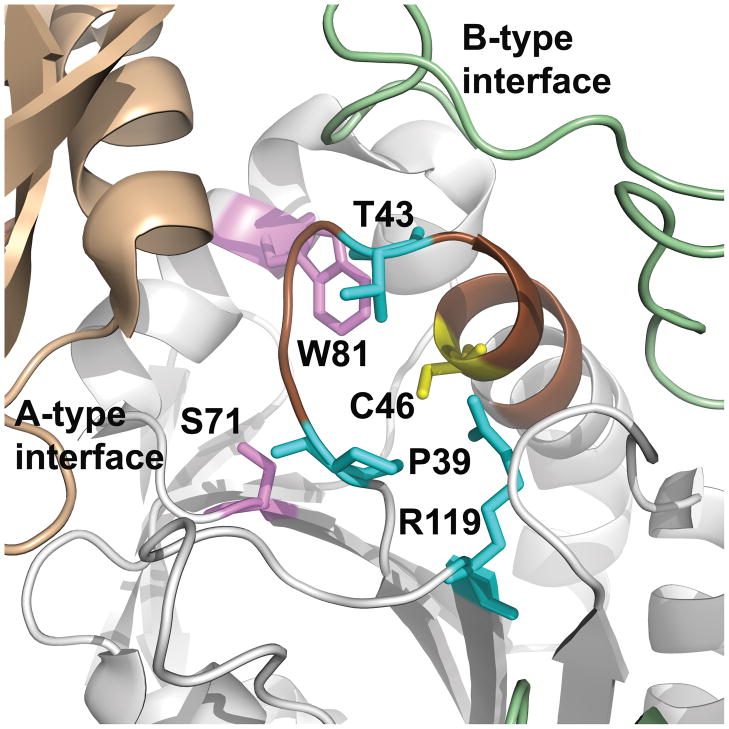
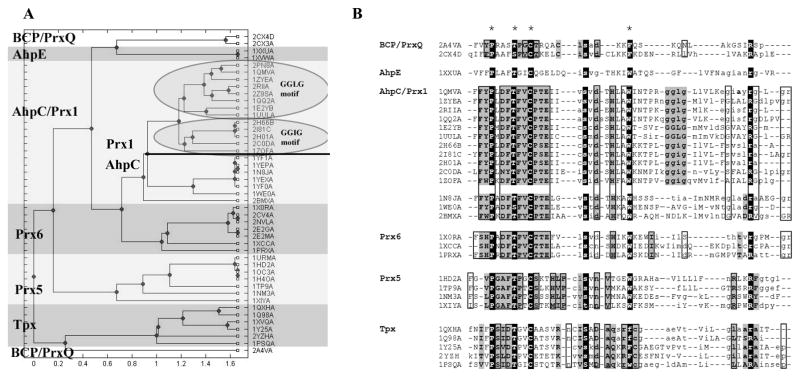
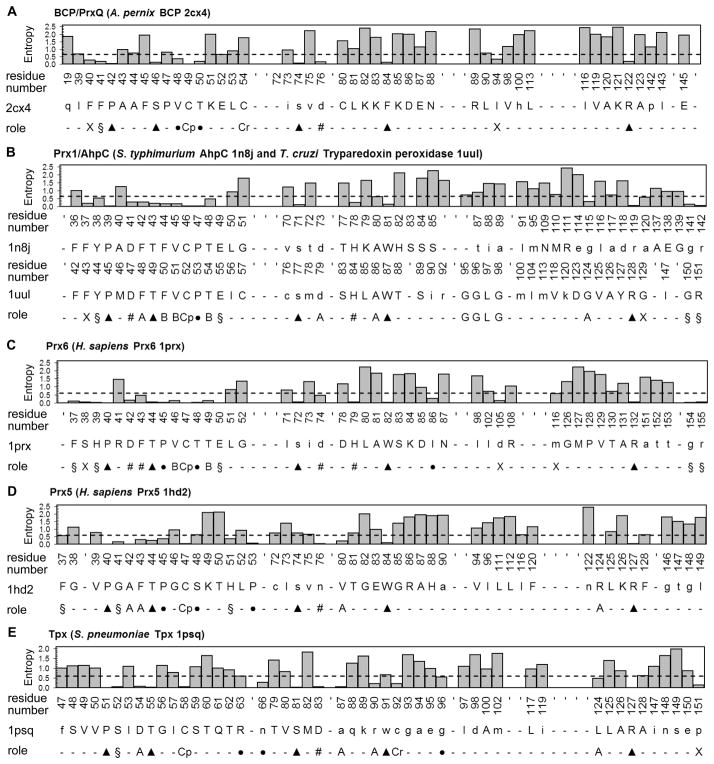
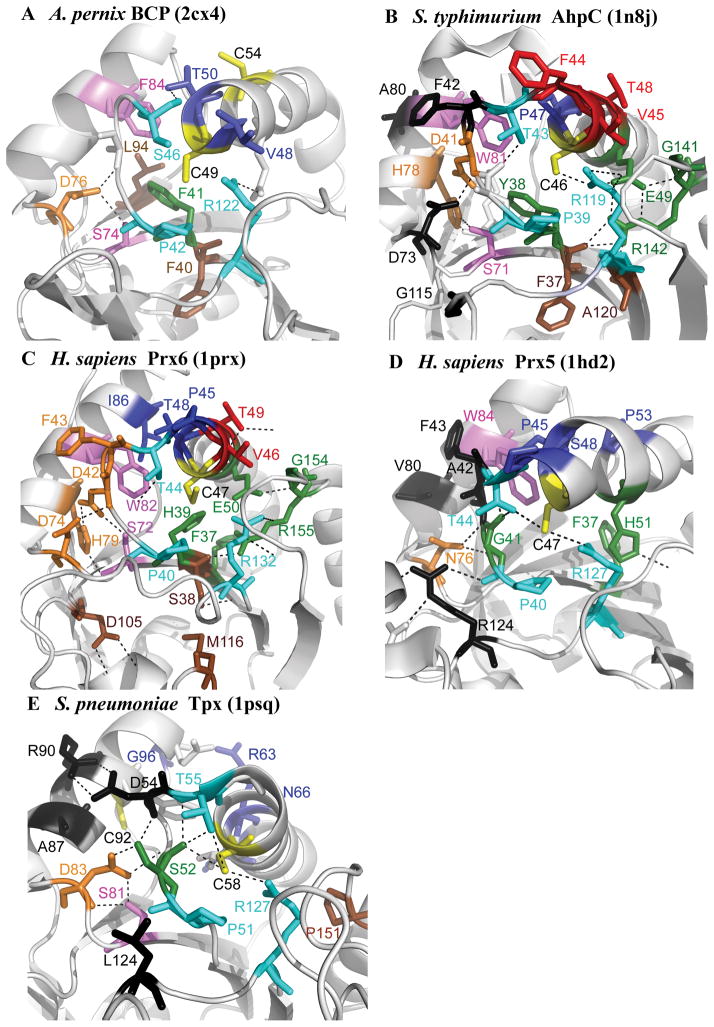
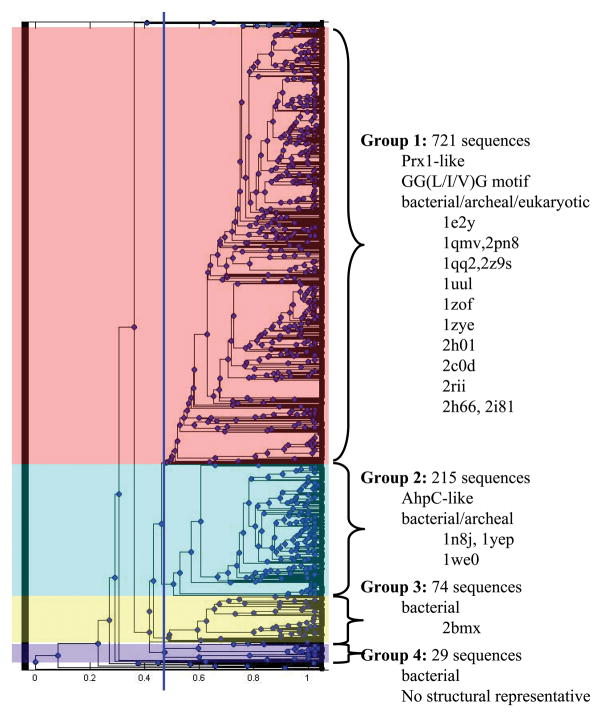
Peroxiredoxins (Prxs) are a widespread and highly expressed family of cysteine-based peroxidases that react very rapidly with H₂O₂, organic peroxides, and peroxynitrite. Correct subfamily classification has been problematic because Prx subfamilies are frequently not correlated with phylogenetic distribution and diverge in their preferred reductant, oligomerization state, and tendency toward overoxidation. We have developed a method that uses the Deacon Active Site Profiler (DASP) tool to extract functional-site profiles from structurally characterized proteins to computationally define subfamilies and to identify new Prx subfamily members from GenBank(nr). For the 58 literature-defined Prx test proteins, 57 were correctly assigned, and none were assigned to the incorrect subfamily. The >3500 putative Prx sequences identified were then used to analyze residue conservation in the active site of each Prx subfamily. Our results indicate that the existence and location of the resolving cysteine vary in some subfamilies (e.g., Prx5) to a greater degree than previously appreciated and that interactions at the A interface (common to Prx5, Tpx, and higher order AhpC/Prx1 structures) are important for stabilization of the correct active-site geometry. Interestingly, this method also allows us to further divide the AhpC/Prx1 into four groups that are correlated with functional characteristics. The DASP method provides more accurate subfamily classification than PSI-BLAST for members of the Prx family and can now readily be applied to other large protein families.
Copyright © 2010 Wiley-Liss, Inc.
Figures
References
-
- Link AJ, Robison K, Church GM. Comparing the predicted and observed properties of proteins encoded in the genome of Escherichia coli K-12. Electrophoresis. 1997;18:1259–313. - PubMed
-
- Wood ZA, Schroder E, Robin Harris J, Poole LB. Structure, mechanism and regulation of peroxiredoxins. Trends Biochem Sci. 2003;28:32–40. - PubMed
-
- Veal EA, Day AM, Morgan BA. Hydrogen peroxide sensing and signaling. Mol Cell. 2007;26:1–14. - PubMed
-
- Winterbourn CC. Reconciling the chemistry and biology of reactive oxygen species. Nat Chem Biol. 2008;4:278–86. - PubMed
Publication types
MeSH terms
Substances
Grants and funding
LinkOut - more resources
Full Text Sources
Molecular Biology Databases
Research Materials
