. 2011 Feb 2;13(1):12.
doi: 10.1186/1532-429X-13-12.

Presence of mechanical dyssynchrony in Duchenne muscular dystrophy

Affiliations

Presence of mechanical dyssynchrony in Duchenne muscular dystrophy

Kan N Hor et al. J Cardiovasc Magn Reson. .

Abstract

Background: Cardiac dysfunction in boys with Duchenne muscular dystrophy (DMD) is a leading cause of death. Cardiac resynchronization therapy (CRT) has been shown to dramatically decrease mortality in eligible adult population with congestive heart failure. We hypothesized that mechanical dyssynchrony is present in DMD patients and that cardiovascular magnetic resonance (CMR) may predict CRT efficacy.

Methods: DMD patients (n = 236) were stratified into 4 groups based on age, diagnosis of DMD, left ventricular (LV) ejection fraction (EF), and presence of myocardial fibrosis defined as positive late gadolinum enhancement (LGE) compared to normal controls (n = 77). Dyssynchrony indices were calculated based on timing of CMR derived circumferential strain (ecc). The calculated indices included cross-correlation delay (XCD), uniformity of strain (US), regional vector of variance (RVV), time to maximum strain (TTMS) and standard deviation (SD) of TTMS. Abnormal XCD value was defined as > normal + 2SD. US, RVV, TTMS and SD were calculated for patients with abnormal XCD.

Results: There was overall low prevalence of circumferential dyssynchrony in the entire DMD population; it increased to 17.1% for patients with abnormal EF and to 31.2% in the most advanced stage (abnormal EF with fibrosis). All but one DMD patient with mechanical dyssynchrony exhibited normal QRS duration suggesting absence of electrical dyssynchrony. The calculated US and RVV values (0.91 ± 0.09, 1.34 ± 0.48) indicate disperse rather than clustered dyssynchrony.

Conclusion: Mechanical dyssynchrony is frequent in boys with end stage DMD-associated cardiac dysfunction. It is associated with normal QRS complex as well as extensive lateral fibrosis. Based on these findings, it is unlikely that this patient population will benefit from CRT.


Figures
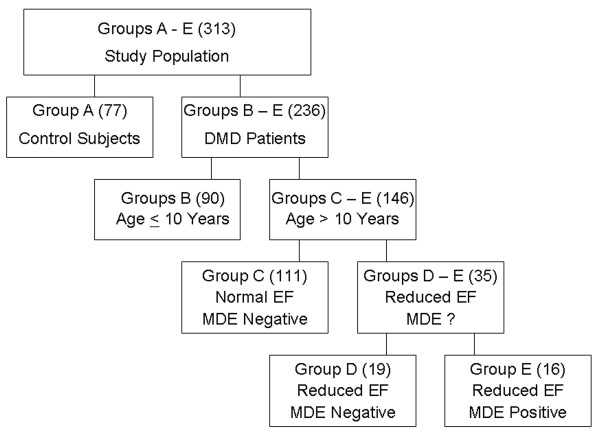
Figure 1
Figure 1
Group Stratification. DMD patients (n = 236) were stratified into 4 groups based on age, diagnosis of DMD, left ventricular (LV) ejection fraction (EF), and presence of myocardial fibrosis defined as positive late gadolinium enhancement(LGE). DMD and compared to normal controls.
Figure 2
Figure 2
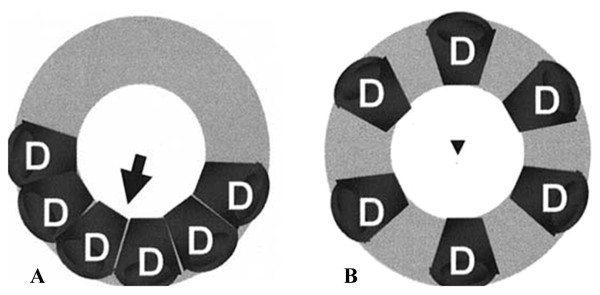
Schematic representation of clustered (A) and disperse (B) dyssynchrony. Depending how dyssynchrony is being indexed, Results could be the same for both situations, despite markedly different impact on dsyynchrony. In example B, there is a "net" synchronous contraction. Uniformity of Strain (US) and Regional Variance of Strain (RVV) are vector derived indices differentiating clustered from dispersed dyssynchrony. Adapted from: Lardo, A. C. et al. J Am Coll Cardiol 2005;46:2223-2228.
Figure 3
Figure 3
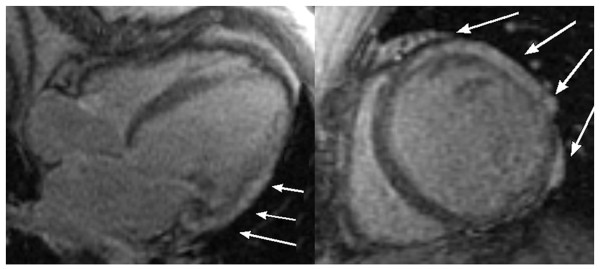
Late gadolinum enhancement (LGE). LGE images of a representative patient from group E. Note predominantly transmural enhancement involving anterolateral and inferolateral segments in apical four chambers and short axis views.

References

    1. Cazeau S, Leclercq C, Lavergne T, Walker S, Varma C, Linde C. et al. Effects of multisite biventricular pacing in patients with heart failure and intraventricular conduction delay. N Engl J Med. 2001;344(12):873–80. doi: 10.1056/NEJM200103223441202. - DOI - PubMed
    1. Cleland JG, Daubert JC, Erdmann E, Freemantle N, Gras D, Kappenberger L. et al. The effect of cardiac resynchronization on morbidity and mortality in heart failure. N Engl J Med. 2005;352(15):1539–49. doi: 10.1056/NEJMoa050496. - DOI - PubMed
    1. Bristow MR, Saxon LA, Boehmer J, Krueger S, Kass DA, De Marco T. et al. Cardiac-resynchronization therapy with or without an implantable defibrillator in advanced chronic heart failure. N Engl J Med. 2004;350(21):2140–50. doi: 10.1056/NEJMoa032423. - DOI - PubMed
    1. Lubitz SA, Leong-Sit P, Fine N, Kramer DB, Singh J, Ellinor PT. Effectiveness of cardiac resynchronization therapy in mild congestive heart failure: systematic review and meta-analysis of randomized trials. Eur J Heart Fail. 2010;12(4):360–6. doi: 10.1093/eurjhf/hfq029. - DOI - PMC - PubMed
    1. van Bommel RJ, Gorcsan J, Chung ES, Abraham WT, Gjestvang FT, Leclercq C. et al. Effects of cardiac resynchronisation therapy in patients with heart failure having a narrow QRS Complex enrolled in PROSPECT. Heart. 2010;96(14):1107–13. doi: 10.1136/hrt.2010.192542. - DOI - PubMed

MeSH terms