. 2011 Feb 15;25(4):385-96.
doi: 10.1101/gad.2001711. Epub 2011 Feb 2.

Small RNA-induced mRNA degradation achieved through both translation block and activated cleavage

Affiliations

Small RNA-induced mRNA degradation achieved through both translation block and activated cleavage

Karine Prévost et al. Genes Dev. .

Abstract

Small RNA (sRNA)-induced mRNA degradation occurs through binding of an sRNA to a target mRNA with the concomitant action of the RNA degradosome, which induces an endoribonuclease E (RNase E)-dependent cleavage and degradation of the targeted mRNA. Because many sRNAs bind at the ribosome-binding site (RBS), it is possible that the resulting translation block is sufficient to promote the rapid degradation of the targeted mRNA. Contrary to this mechanism, we report here that the pairing of the sRNA RyhB to the target mRNA sodB initiates mRNA degradation even in the absence of translation on the mRNA target. Remarkably, even though it pairs at the RBS, the sRNA RyhB induces mRNA cleavage in vivo at a distal site located >350 nucleotides (nt) downstream from the RBS, ruling out local cleavage near the pairing site. Both the RNA chaperone Hfq and the RNA degradosome are required for efficient cleavage at the distal site. Thus, beyond translation initiation block, sRNA-induced mRNA cleavage requires several unexpected steps, many of which are determined by structural features of the target mRNA.


Figures
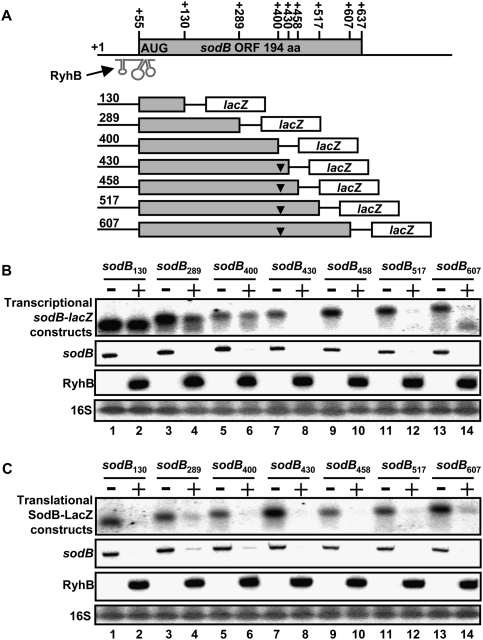
Figure 1.
Figure 1.
Minimal sequence requirement for sRNA-induced mRNA degradation in vivo. (A) Description of the different constructs used to determine the minimal sodB to generate RyhB-induced mRNA degradation. (B) Northern blots with a lacZ probe showing the effect of RyhB expression (for 10 min) on various transcriptional sodB-lacZ constructs and the endogenous sodB transcript. The expression of the endogenous sodB transcript and RyhB is also shown. 16S ribosomal RNA was used as a loading control. (C) Northern blots using a lacZ probe showing the effect of RyhB expression (for 10 min) on various translational SodB-LacZ constructs. The expression of the endogenous sodB transcript and RyhB is also shown. 16S ribosomal RNA was used as a loading control.
Figure 2.
Figure 2.
RyhB-induced mRNA degradation of various target mRNAs. Northern blots with a lacZ probe showing the effect of RyhB expression (for 10 min) on various transcriptional fumA-lacZ constructs (A) and transcriptional iscRS-lacZ constructs (B). RyhB pairs at nucleotides 664–670 of iscRS, which corresponds to the RBS of iscS. Whereas the iscRS687 fusion extends 19 nt into the iscS ORF, the iscRS1268 fusion extend 600 nt into iscS ORF. Expression of endogenous sodB transcript and RyhB is also shown. 16S ribosomal RNA was used as loading control.
Figure 3.
Figure 3.
Both the RNA degradosome and RNA chaperone Hfq are essential for the RyhB-induced degradation of the minimal target sodB430-lacZ. (A) Northern blots using a lacZ probe showing the effect of RyhB expression (for 10 min) on transcriptional sodB430-lacZ fusions (left panel) in wild-type cells (lanes 1,2) and rne131 cells (lanes 3,4), and translational SodB430-LacZ fusions (right panel) in wild-type cells (lanes 5,6) and rne131 cells (lanes 7,8). (B) Effect of RyhB expression on β-galactosidase activity of transcriptional sodB430-lacZ fusions in wild-type and rne131 cells, and translational SodB430-LacZ fusions in wild-type and rne131 cells. (C) Northern blots using a lacZ probe showing the effect of RyhB expression (for 10 min) on transcriptional sodB430-lacZ fusions (left panel) in wild-type cells (lanes 1,2) and hfq cells (lanes 3,4), and translational SodB430-LacZ fusions (right panel) in wild-type cells (lanes 5,6) and rne131 cells (lanes 7,8). (D) Effect of RyhB expression on β-galactosidase activity of transcriptional sodB430-lacZ fusions (left panel) in wild-type and hfq cells, and translational SodB430-LacZ fusions (right panel) in wild-type cells and hfq cells.
Figure 4.
Figure 4.
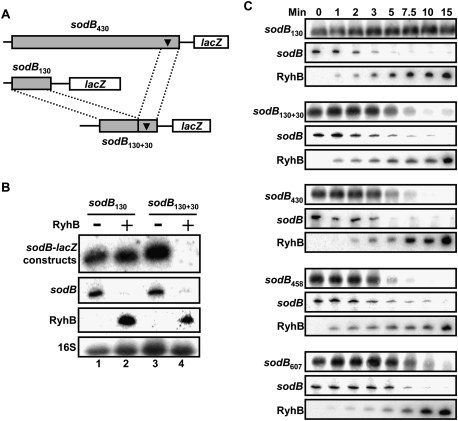
The putative cleavage site of sodB430 promotes the degradation of a RyhB-resistant sodB130 construct. (A) Schematic description of sodB430 and sodB130 + 30, with the putative cleavage site represented by the black triangle. (B) Northern blots using a lacZ probe showing the effect of RyhB expression (for 10 min) on sodB130-lacZ and sodB130 + 30-lacZ transcriptional fusions. (C) Northern blots using a lacZ probe showing the effect of RyhB during a time-course expression on sodB130-lacZ, sodB130 + 30-lacZ, sodB430-lacZ, sodB458-lacZ, and sodB607-lacZ.
Figure 5.
Figure 5.
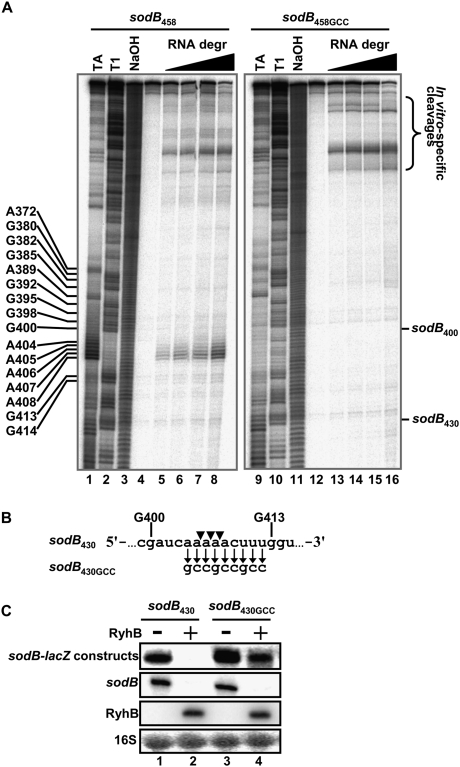
In vitro mapping and mutagenesis of the minimal sodB430 cleavage site. (A) Effect of increasing amounts of purified RNA degradosomes (0.5, 0.76, 1.0, and 1.5 ng/μL final) on 32P-pCp 3′-end radiolabeled sodB458 (left panel, lanes 48) and sodB458GCC (right panel, lanes 1216). (Lanes 1,9) RNase TA ladder. (Lanes 2,10) RNase T1 ladder. (Lanes 3,11) NaOH ladder. (Lanes 4,12) Radiolabeled RNA alone. (B) Local nucleotide sequence (between G400 and G413) of the cleavage site from sodB430 (top line) and the mutated sodB430GCC (bottom). (C) Northern blots using a lacZ probe on sodB430-lacZ and sodB430GCC-lacZ transcriptional fusions in the absence or presence of RyhB expression (for 10 min).
Figure 6.
Figure 6.
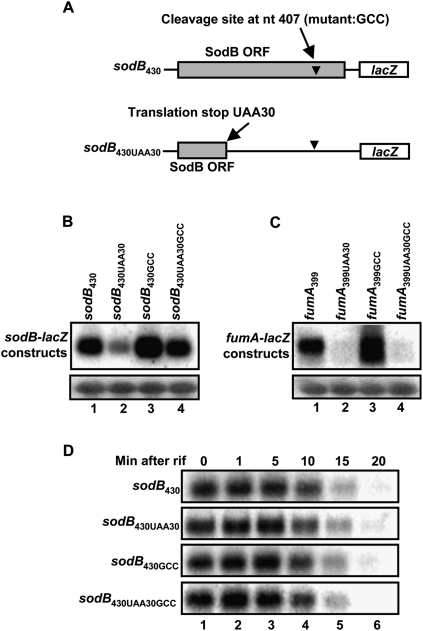
Translation block alone in the absence of RyhB is not sufficient to cause full degradation of sodB mRNA. (A) Schematic description of the different sodB constructs used to monitor the effect of translation on mRNA steady-state level and stability. The gray bar represents sodB ORF. The arrowhead is the cleavage site at position 407. UAA30 is the stop codon introduced to prematurely terminate translation. GCC represents the mutation introduced to inactivate the cleavage site at position 407. (B) Northern blots using a lacZ probe showing the steady-state levels of sodB430, sodB430UAA30, sodB430GCC, and sodB430UAA30GCC constructs. (C) Northern blots using a lacZ probe showing the steady-state level of fumA399, fumA399UAA30, fumA399GCC, and fumA399UAA30GCC constructs. (D) Northern blots using a lacZ probe showing the stability of sodB430, sodB430UAA30, sodB430GCC, and sodB430UAA30GCC constructs. Rifampicin (250 μg/mL) was added at time 0 before total RNAs were extracted at the indicated time points. Control 16S are shown in Supplemental Figure S8.
Figure 7.
Figure 7.
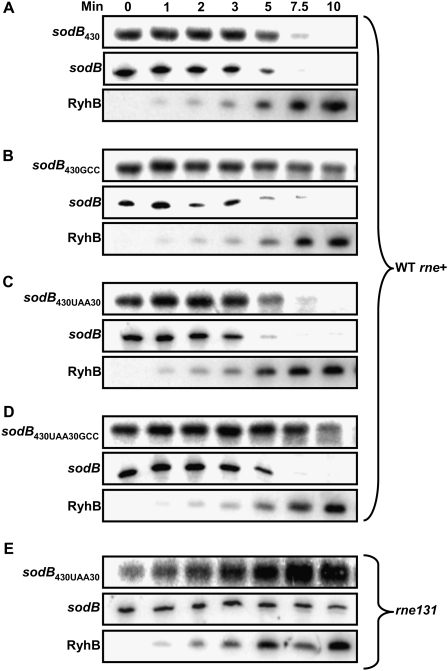
RyhB-induced mRNA cleavage in prior absence of translation on the target mRNA sodB430-lacZ. Northern blots using a lacZ probe showing the effect of RyhB expression in wild-type cells on sodB430 (A), sodB430GCC (B), sodB430UAA30 (C), and sodB430UAA30GCC (D). (E) Northern blots using a lacZ probe showing the effect of RyhB expression on sodB430UAA30 in rne131 cells.
Figure 8.
Figure 8.
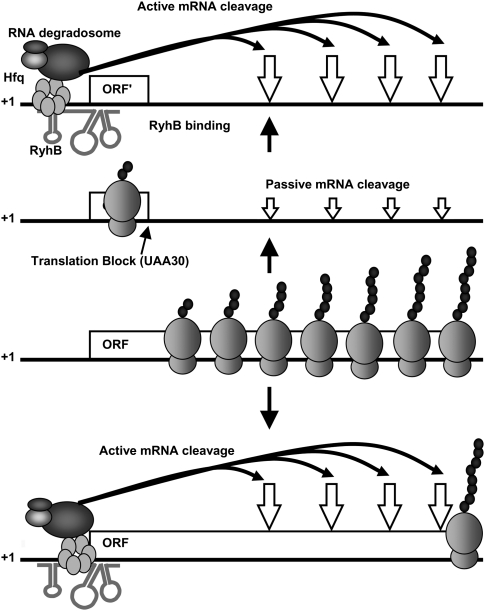
Model for sRNA-induced mRNA degradation (see the text for details).

Comment in

References

    1. Afonyushkin T, Vecerek B, Moll I, Blasi U, Kaberdin VR 2005. Both RNase E and RNase III control the stability of sodB mRNA upon translational inhibition by the small regulatory RNA RyhB. Nucleic Acids Res 33: 1678–1689 - PMC - PubMed
    1. Aiba H, Adhya S, de Crombrugghe B 1981. Evidence for two functional gal promoters in intact Escherichia coli cells. J Biol Chem 256: 11905–11910 - PubMed
    1. Belasco JG 2010. All things must pass: Contrasts and commonalities in eukaryotic and bacterial mRNA decay. Nat Rev Mol Cell Biol 11: 467–478 - PMC - PubMed
    1. Carpousis AJ 2007. The RNA degradosome of Escherichia coli: An mRNA-degrading machine assembled on RNase E. Annu Rev Microbiol 61: 71–87 - PubMed
    1. Carpousis AJ, Luisi BF, McDowall KJ 2009. Endonucleolytic initiation of mRNA decay in Escherichia coli. Prog Mol Biol Transl Sci 85: 91–135 - PubMed

Publication types

MeSH terms

LinkOut - more resources