


Inflammatory genes in epicardial fat contiguous with coronary atherosclerosis in the metabolic syndrome and type 2 diabetes: changes associated with pioglitazone
- PMID: 21289232
- PMCID: PMC3041217
- DOI: 10.2337/dc10-2083
Inflammatory genes in epicardial fat contiguous with coronary atherosclerosis in the metabolic syndrome and type 2 diabetes: changes associated with pioglitazone
Abstract
Objective: To determine changes in gene expression in epicardial adipose tissue (EAT) associated with coronary atherosclerosis (CAD) and effects of pioglitazone therapy.
Research design and methods: Genes were quantified by RT-PCR in EAT and thoracic subcutaneous adipose tissue (SAT) obtained during surgery in CAD patients with metabolic syndrome (MS) or type 2 diabetes and control subjects with minimal or no CAD and no MS or type 2 diabetes.
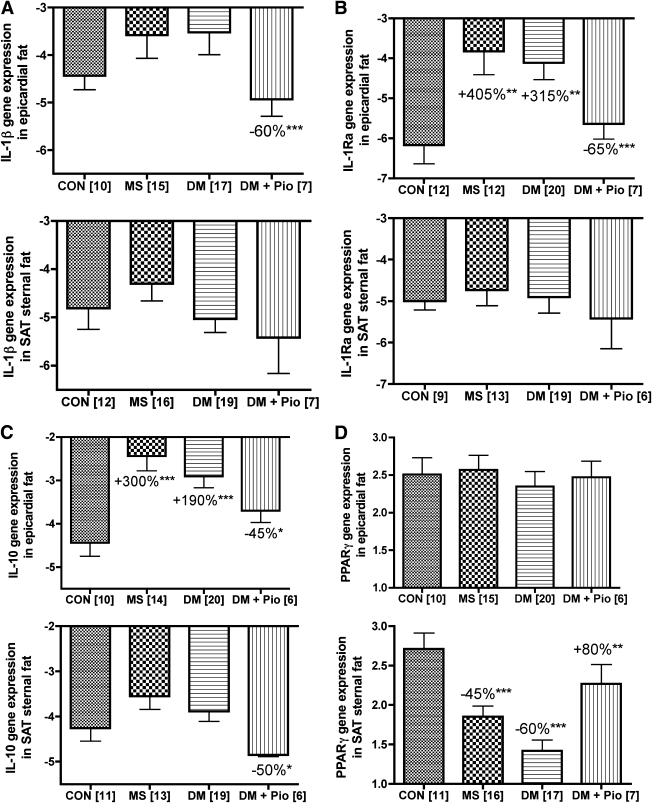
Results: Increased expression of interleukin-1 receptor antagonist (IL-1Ra) and IL-10, a trend for higher IL-1β, and no change in peroxisome proliferator-activated receptor-γ (PPARγ) was found in EAT from MS or type 2 diabetes. Only PPARγ mRNA was reduced in SAT. Pioglitazone therapy in type 2 diabetes was associated with decreased expression of IL-1β, IL-1Ra, and IL-10 in EAT; decreased IL-10 in SAT; and increased PPARγ in SAT.
Conclusions: In MS and type 2 diabetes with CAD, proinflammatory and anti-inflammatory genes were differentially increased in EAT and selectively reduced in association with pioglitazone treatment.
Figures
References
-
- Mazurek T, Zhang L, Zalewski A, et al. Human epicardial adipose tissue is a source of inflammatory mediators. Circulation 2003;108:2460–2466 - PubMed
-
- Eiras S, Teijeira-Fernández E, Salgado-Somoza A, et al. Relationship between epicardial adipose tissue adipocyte size and MCP-1 expression. Cytokine 2010;51:207–212 - PubMed
-
- Lacobellis G, Pistilli D, Gucciardo M, et al. Adiponectin expression in human epicardial adipose tissue in vivo is lower in patients with coronary artery disease. Cytokine 2005;29:251–255 - PubMed
-
- Sacks HS, Fain JN. Human epicardial adipose tissue: a review. Am Heart J 2007;153:907–917 - PubMed
-
- Vela D, Buja M, Madjid M, et al. The role of peri-adventitial fat in atherosclerosis: an adipose subset with potential diagnostic and therapeutic implications. Arch Pathol Lab Med 2006;130:108–115
Publication types
MeSH terms
Substances
LinkOut - more resources
Full Text Sources
Medical
Research Materials
Miscellaneous
