


Advances and challenges in the treatment of branched-chain amino/keto acid metabolic defects
- PMID: 21290185
- PMCID: PMC4136412
- DOI: 10.1007/s10545-010-9269-1
Advances and challenges in the treatment of branched-chain amino/keto acid metabolic defects
Abstract
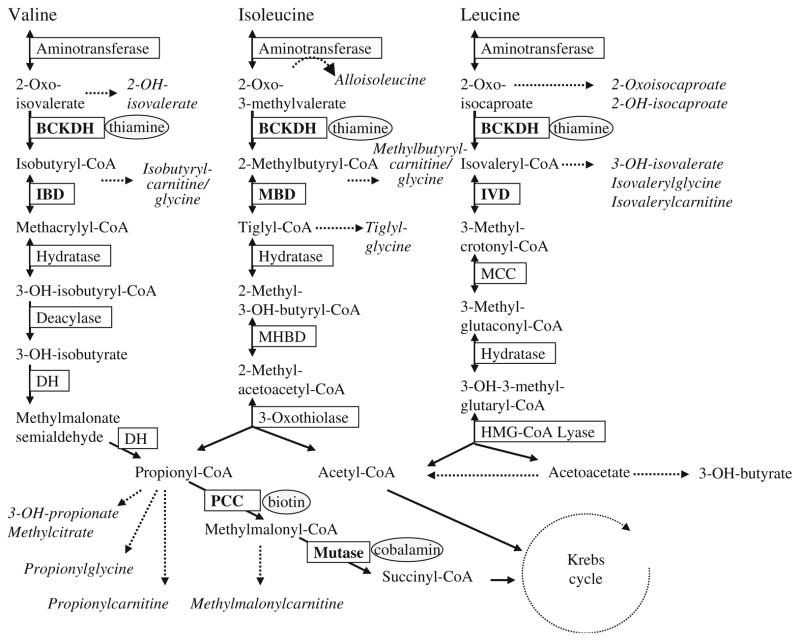
Disorders of branched-chain amino/keto acid metabolism encompass diverse entities, including maple syrup urine disease (MSUD), the 'classical' organic acidurias isovaleric acidemia (IVA), propionic acidemia (PA), methylmalonic acidemia (MMA) and, among others, rarely described disorders such as 2-methylbutyryl-CoA dehydrogenase deficiency (MBDD) or isobutyryl-CoA dehydrogenase deficiency (IBDD). Our focus in this review is to highlight the biochemical basis underlying recent advances and ongoing challenges of long-term conservative therapy including precursor/protein restriction, replenishment of deficient substrates, and the use of antioxidants and anaplerotic agents which refill the Krebs cycle. Ongoing clinical assessments of affected individuals in conjunction with monitoring of disease-specific biochemical parameters remain essential. It is likely that mass spectrometry-based 'metabolomics' may be a helpful tool in the future for studying complete biochemical profiles and diverse metabolic phenotypes. Prospective studies are needed to test the effectiveness of adjunct therapies such as antioxidants, ornithine-alpha-ketoglutarate (OKG) or creatine in addition to specialized diets and to optimize current therapeutic strategies in affected individuals. With the individual life-time risk and degree of severity being unknown in asymptomatic individuals with MBDD or IBDD, instructions regarding risks for metabolic stress and fasting avoidance along with clinical monitoring are reasonable interventions at the current time. Overall, it is apparent that carefully designed prospective clinical investigations and multicenter cohort-controlled trials are needed in order to leverage that knowledge into significant breakthroughs in treatment strategies and appropriate approaches.
Conflict of interest statement
Competing interest: None declared
Figures
References
-
- Aldámiz-Echevarría L, Sanjurjo P, Elorz J, Prieto JA, Pérez C, Andrade F, Rodríguez-Soriano J. Effect of docosahexaenoic acid administration on plasma lipid profile and metabolic parameters of children with methylmalonic acidaemia. J Inherit Metab Dis. 2006;29:58–63. - PubMed
-
- Alfardan J, Mohsen AW, Copeland S, Ellison J, Keppen-Davis L, Rohrbach M, Powell BR, Gillis J, Matern D, Kant J, Vockley J. Characterization of new ACADSB gene sequence mutations and clinical implications in patients with 2-methylbutyrylglycinuria identified by newborn screening. Mol Genet Metab. 2010;100:333–338. - PMC - PubMed
-
- Amaral AU, Leipnitz G, Fernandes CG, Seminotti B, Schuck PF, Wajner M. Alpha-Ketoisocaproic acid and leucine provoke mitochondrial bioenergetic dysfunction in rat brain. Brain Res. 2010;1324:75–84. - PubMed
-
- Arbeiter AK, Kranz B, Wingen AM, Bonzel KE, Dohna-Schwake C, Hanssler L, Neudorf U, Hoyer PF, Büscher R. Continuous venovenous haemodialysis (CVVHD) and continuous peritoneal dialysis (CPD) in the acute management of 21 children with inborn errors of metabolism. Nephrol Dial Transplant. 2010;25:1257–1265. - PubMed
-
- Ballhausen D, Mittaz L, Boulat O, Bonafé L, Braissant O. Evidence for catabolic pathway of propionate metabolism in CNS: expression pattern of methylmalonyl-CoA mutase and propionyl-CoA carboxylase alpha-subunit in developing and adult rat brain. Neuroscience. 2009;164:578–587. - PubMed
Publication types
MeSH terms
Substances
Grants and funding
LinkOut - more resources
Full Text Sources
Other Literature Sources
Medical
